
Kodo Millet
Paspalum scrobiculatum · అరికలు Arikalu · कोदो · Varagu · Harka
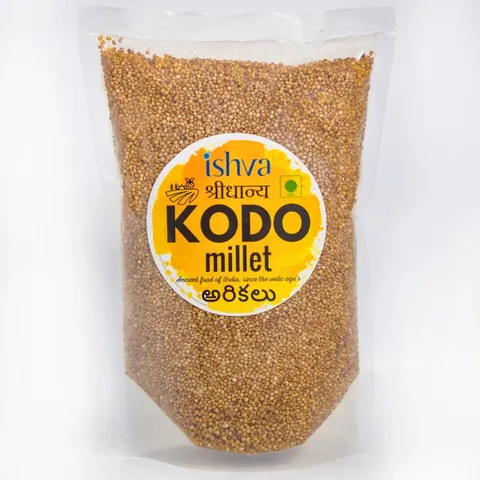
VegetarianWhole kodo millet: arikalu in Telugu, kodo in Hindi, varagu in Tamil. Packed in Hyderabad in a 500 g pouch with the golden Ishva label, the one you will find on the DMart shelf.
Kodo is India's own millet: it originated here and was domesticated some 3,000 years ago. Kautilya's Arthashastra lists kodrava among the crops sown first in the season, and its storehouse rules record that cooked kodrava comes to three times its raw quantity. The Sangam anthology Purananuru names it as varagu.
Per 100 g of the raw grain, India's food composition tables (ICMR-NIN, IFCT 2017) give 332 kcal, 8.9 g protein, 6.4 g dietary fibre and 122 mg magnesium. In the kitchen it makes upma, adai, tomato rice, kheer, idli and dosa.
Hear it pour
Our own pack of kodo millet, opened and poured into a steel bowl — filmed on a phone, nothing added.
Turn the sound on: the grain has its own sound as it falls.
On the pack
- Ingredients
- Kodo Millet Grains
- Shelf life
- Best before nine months from packing
- Storage
- Transfer the contents to an airtight container after opening and store in a cool, dry place. Do not buy a pack that is open, tampered or punctured.
In the Vedic rituals
No Vedic text names kodo millet. The one related line is in a medieval commentary on a household rite, which lists kodrava among the grains that are NOT offered.
In the old books
- Kauṭilya's Arthaśāstra (2.24.12) lists kodrava — kodo millet — among the crops sown first in the season. (Arthaśāstra, GRETIL text, Monier-Williams)
- The Amarakośa, the classical Sanskrit thesaurus, gives koradūṣa as another name for kodrava. (Amarakośa, GRETIL text)
- The Sangam-era Tamil anthology Puṟanāṉūṟu (poem 34) mentions varaku — kodo millet in the Tamil Lexicon. (Puṟanāṉūṟu, Project Madurai, Tamil Lexicon)
- Apastamba Grihya Sutra, Haradatta's commentary, ApGS 8.3, Anakula commentary — The only kodrava found in this search: a medieval commentary lists dark grains such as chickpea and kodrava among foods the learned do not offer in household rites. It is a commentary, not a Vedic text. (source)
- Kṣemakutūhala, 10th utsava, verses 31-32 — Laḍḍus made from ghee-fried papads of urad, mung, kodrava or rice, crushed with sugar and coated with sugar syrup. (source)
- Bhojanakutūhala, Part 1, printed p. 125 — Dhānyāmla, a fermented sour gruel, is said to be made from rice flour or from kodrava and other grains. (source)
How it was cooked
Names in Hindi, Tamil and Kannada: ICAR-Indian Institute of Millets Research; Telugu name as on our pack.
Vegetarian recipes with kodo millet, each shared as its source gives it, with the source named.
- Kodo Millet UpmaTraditional · South India · breakfast
- Kodo Millet AdaiTraditional · Tamil Nadu · breakfast
- Kodo Millet Tomato Rice (Varagu Tomato Rice)Traditional · Tamil Nadu · lunch
- Kodo Millet Curry Leaf RiceTraditional · South India · lunch
- Kodo Millet KheerTraditional · North India · sweet
- Kodo Millet, Date and Pistachio BallsModern · Pan-India · snack
- Kodo Millet (Varagu) and Banana Flower AdaiTraditional · Tamil Nadu · breakfast
- Kodo Millet Kara Kozhukattai (Savoury Steamed Dumplings)Traditional · Tamil Nadu · breakfast
- Kodo Millet PaniyaramTraditional · Tamil Nadu · dinner
- Kodo Millet DhoklaTraditional · Gujarat · snack
- Kodo Millet Methi RiceTraditional · Pan-India · dinner
- Kodo Millet Vegetable PulaoTraditional · Pan-India · lunch
- Kodo Millet and Drumstick Leaf Soup (Varagarisi Murungai Keerai Soup)Traditional · Tamil Nadu · dinner
- Kodo Millet Poha TikkiModern · Pan-India (modern) · snack
- Kodo Millet Salad with Cucumber, Tomato and LemonModern · Pan-India (modern) · lunch
- Kodo Millet PhirniFestival · North India · sweet
- Kodo Millet Banana SmoothieModern · Pan-India (modern) · drink
- Kodo Millet (Varagu) Idli and DosaTraditional · Tamil Nadu · breakfast
- Kodrava (Plain Boiled Kodo Millet, from Kautilya's Arthashastra)Ancient · India (Mauryan-era statecraft text) · lunch
Nutrition of the grain, per 100 g (raw)
| Nutrient | Amount |
|---|---|
| Energy | 332 kcal |
| Protein | 8.92 g |
| Fat | 2.55 g |
| Carbohydrate (available) | 66.19 g |
| Dietary fibre (total) | 6.39 g |
| Calcium | 15.27 mg |
| Iron | 2.34 mg |
| Magnesium | 122 mg |
| Phosphorus | 101 mg |
| Zinc | 1.65 mg |
Source: Indian Food Composition Tables 2017, ICMR-National Institute of Nutrition · food code A017 (Varagu). Energy converted from the tables’ kJ (1 kcal = 4.184 kJ). Published values for the grain, not a laboratory test of this pack.