
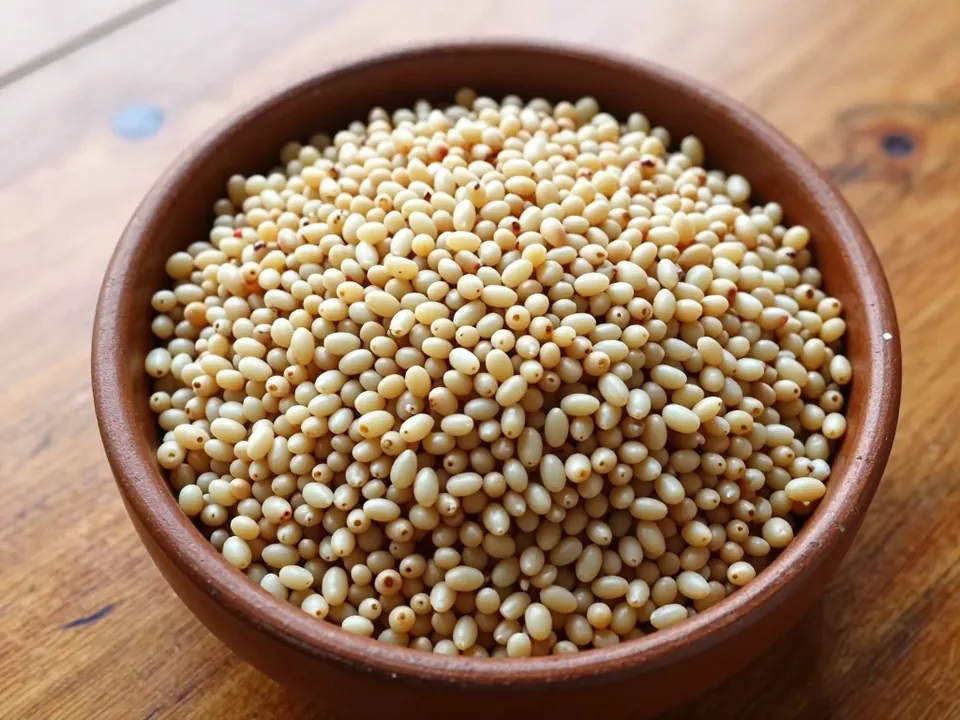
Kodrava (Plain Boiled Kodo Millet, from Kautilya's Arthashastra)
Cook 18 min · Servings not given in the source
Ingredients
- kodo millet (dehulled grain) — 30 g
- water — 150 ml (open-pot figure from the source table)
Method
- Sort the kodo millet to remove any stones or loose husk, wash it twice in fresh water and drain.
- Put the drained grain in a small uncovered pot with the 150 ml of water and bring it to a gentle boil.
- Keep it simmering, stirring now and again so nothing catches, for 16 to 18 minutes.
- Take a few grains out and press them: when they are soft through with no hard core, the pot is ready. Serve warm.
From the old texts
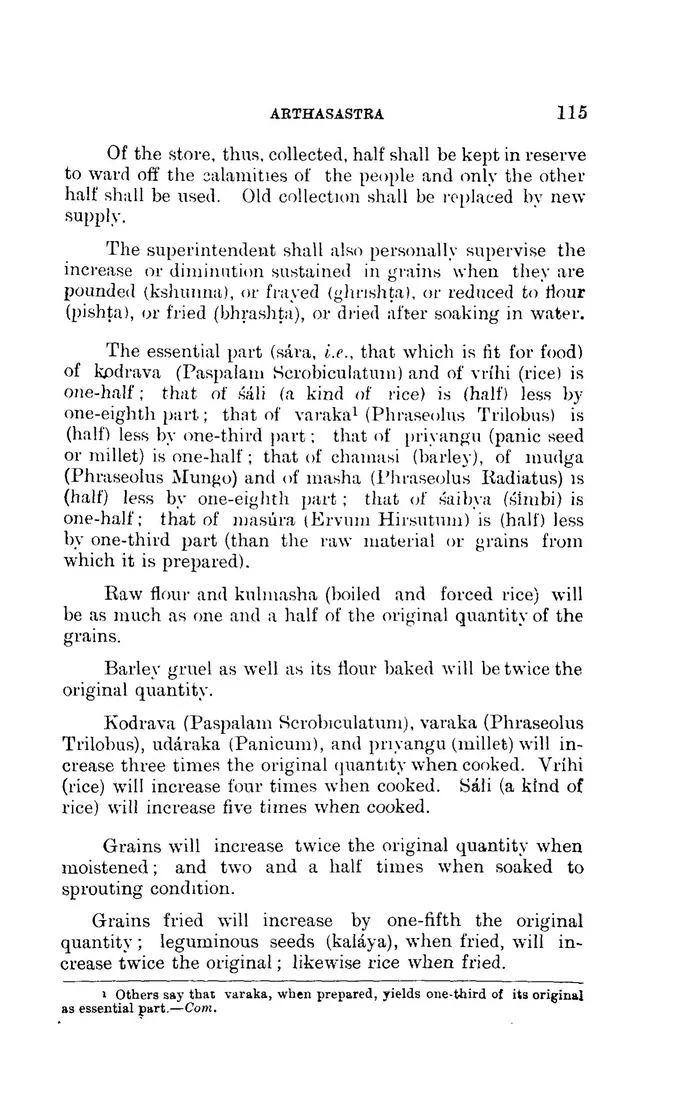
“Kodrava (Paspalam Scrobiculatum), varaka (Phraseolus Trilobus), udáraka (Panicum), and priyangu (millet) will increase three times the original quantity when cooked.”
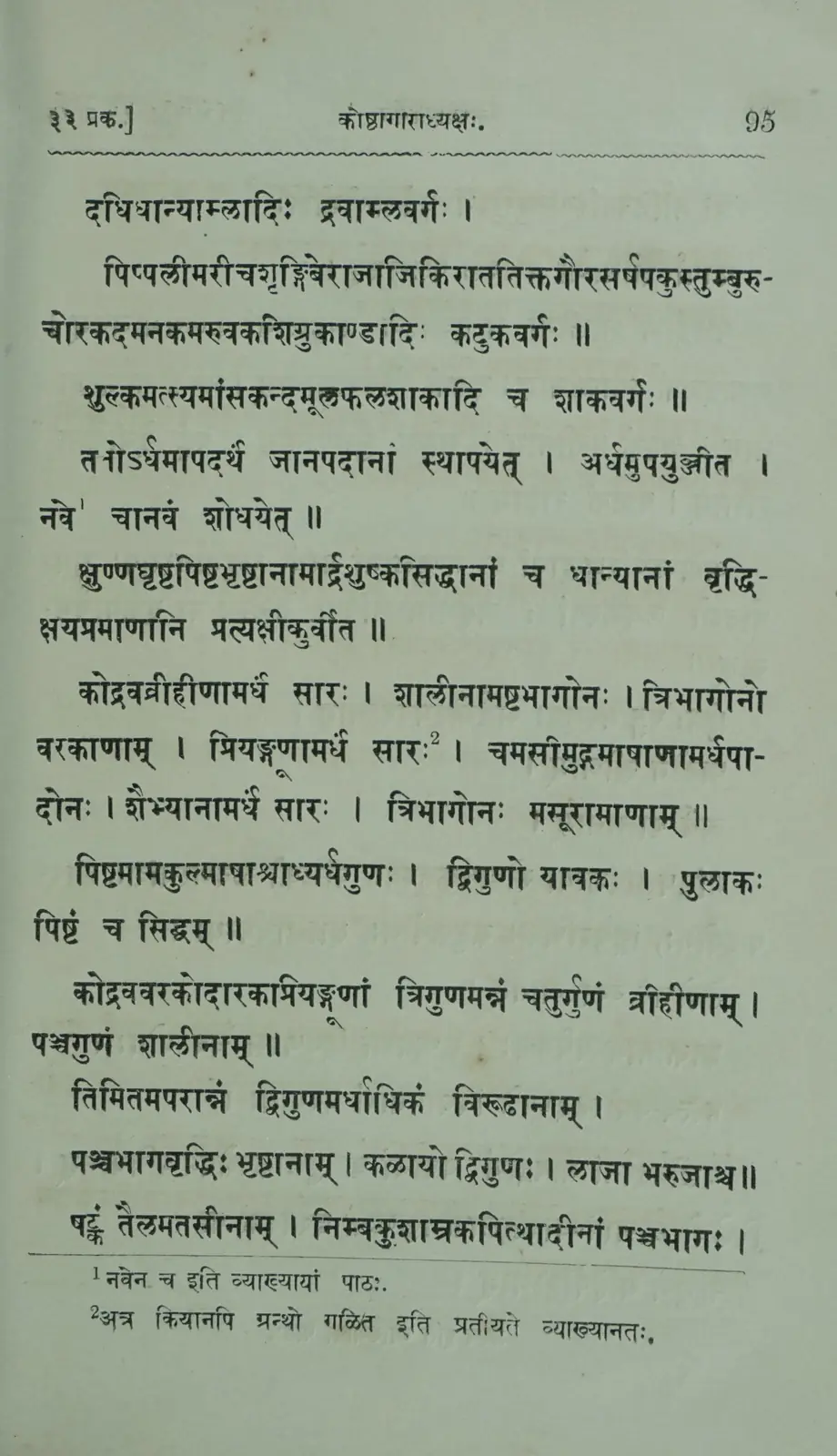 The printed page
Kauṭilīyaṃ Arthaśāstram. The Arthasastra of Kautilya, edited by R. Shama Sastri (Government Oriental Library Series, Bibliotheca Sanskrita No. 37) (ed. R. Shama Sastri (Rudrapatna Shamasastry), Librarian, Government Oriental Library, Mysore), Mysore, Government Branch Press, 1909, p. 95
Kautilya (attributed), Arthashastra (traditionally placed in the Mauryan period (4th century BCE); scholars date the compiled text later - approximate), Arthashastra Book II, chapter 15 ("The Superintendent of Store-house"), translated by R. Shamasastry — read the translation.
Which grain: “kodrava m. a species of grain eaten by the poor ( Paspalum scrobiculatum )” (Monier-Williams, A Sanskrit-English Dictionary (1899), p. 313, via Cologne Digital Sanskrit Dictionaries)
Amounts and times: the old text gives none, so they are from Raparthi Akshitha (2022). In Vitro Glycaemic Profiling of Foods Prepared from Minor Millet Grain Processed by Traditional and Modern Methods. M.Sc. thesis, Professor Jayashankar Telangana State Agricultural University (PJTSAU), Hyderabad, PDF p. 54 (printed p. 36).
Tips
- From the text: Kautilya's storehouse rules record that cooked kodrava comes to three times its raw quantity - a handy guide when choosing the pot.
- From the source: hand-pounded grain was used for the open-pot figures. For machine-dehulled kodo in a pressure cooker the same table gives 180 ml water and 22-30 minutes.
- From the source: 30 g cooked in the open pot weighed about 132 g (Table 4.8, mean of six trials).
- From another text: in Puranānūru 215 a herder woman serves pounded, cooked varagu with white curds. No source gives the curd quantity, so curd is not listed here.
- The amounts are the source's own measured portion: 30 g of grain at a time.
Adapted from Kautilya (attributed), Arthashastra, Book II, written in our own words.