
Rajgira (amaranth)
Amaranthus spp.Names: ICAR-Indian Institute of Millets Research
Pictures
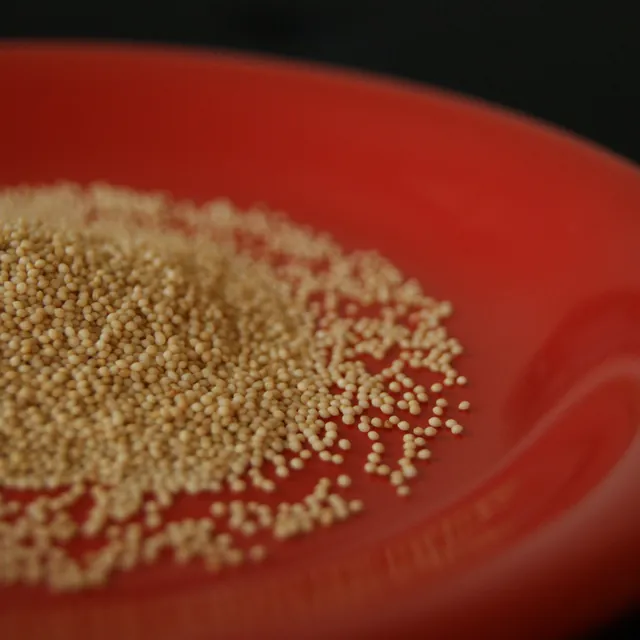
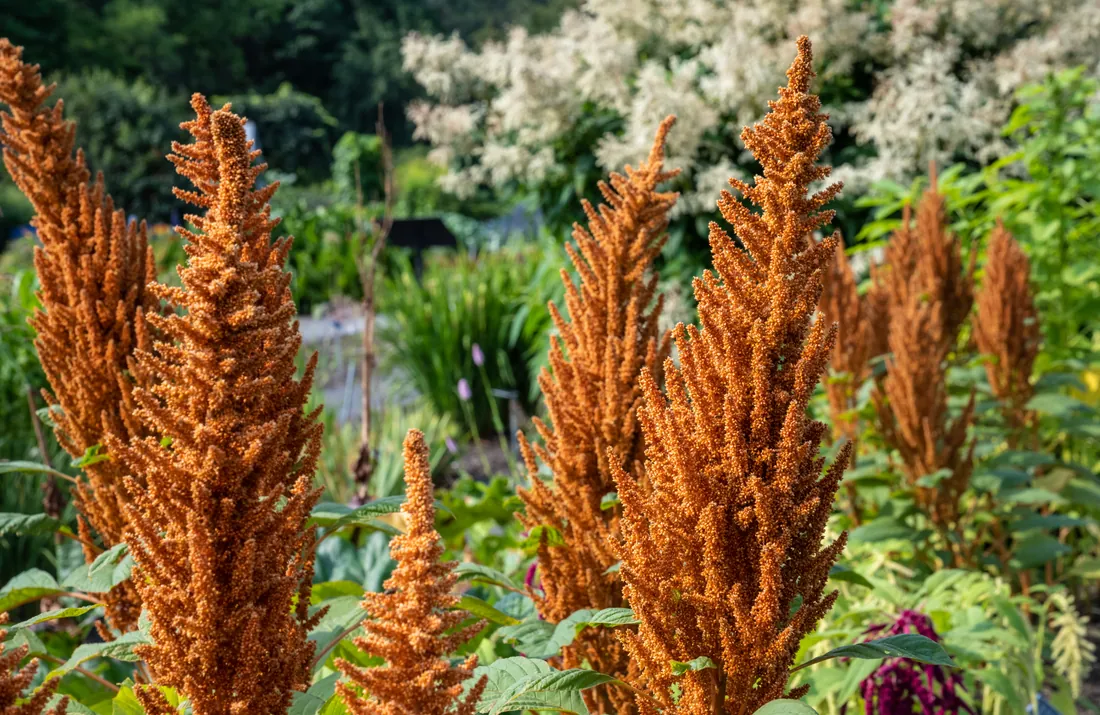
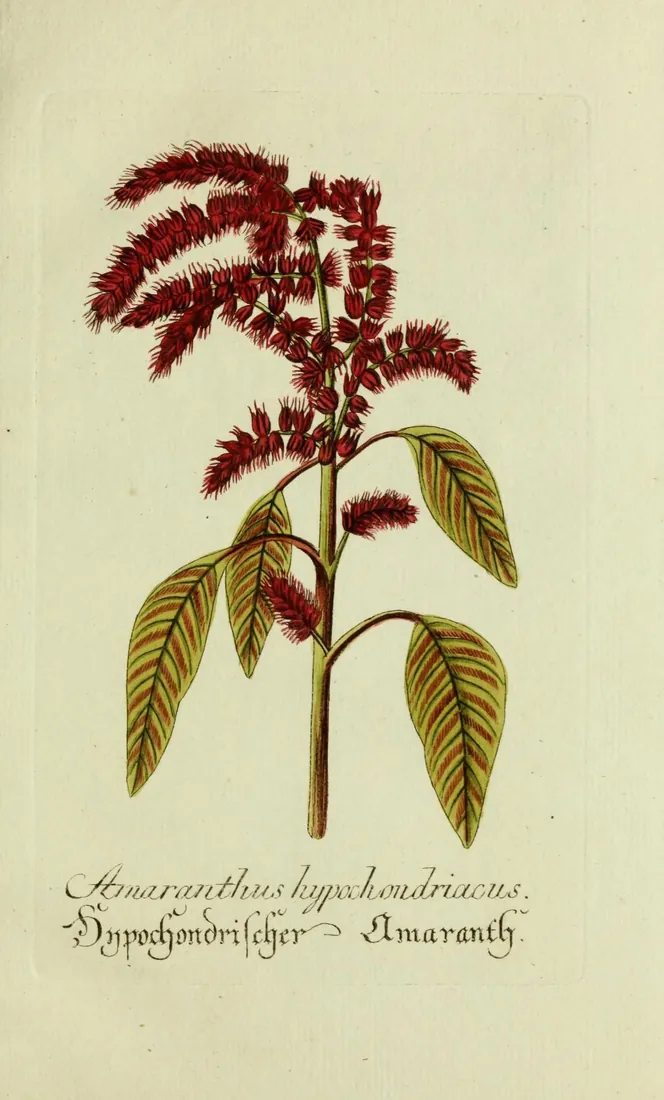
Nutrition of the raw grain, per 100 g
| Energy | 356 kcal |
| Protein | 13.27 g |
| Fat | 5.56 g |
| Carbohydrate (available) | 61.46 g |
| Dietary fibre (total) | 7.47 g |
| Calcium | 162 mg |
| Iron | 8.02 mg |
| Magnesium | 270 mg |
| Phosphorus | 412 mg |
| Zinc | 2.52 mg |
Source: Indian Food Composition Tables 2017, ICMR-National Institute of Nutrition, food code A002. Energy converted from kilojoules (1 kcal = 4.184 kJ).
Every nutrient in the raw grain — 96 values, per 100 g
Energy, protein, fat, carbohydrate, fibre9
| Water (moisture) | 9.2 g |
| Protein | 13.27 g |
| Ash (total minerals) | 3.05 g |
| Fat | 5.56 g |
| Dietary fibre (total) | 7.47 g |
| Insoluble fibre | 5.8 g |
| Soluble fibre | 1.67 g |
| Carbohydrate (available) | 61.46 g |
| Energy | 1489 kJ |
Starch and sugars6
| Available carbohydrate (starch + sugars) | 60.13 g |
| Starch | 59.33 g |
| Fructose | 0.1 g |
| Glucose | 0.22 g |
| Sucrose | 0.48 g |
| Free sugars (total) | 0.8 g |
Not detected in this grain (the table leaves it blank or zero): Maltose.
Minerals5
| Calcium | 162 mg |
| Magnesium | 270 mg |
| Phosphorus | 412 mg |
| Potassium | 413 mg |
| Sodium | 2.81 mg |
Trace elements8
Vitamins13
| Thiamine (B1) | 0.04 mg |
| Riboflavin (B2) | 0.04 mg |
| Niacin (B3) | 0.52 mg |
| Pantothenic acid (B5) | 0.28 mg |
| Vitamin B6 | 0.33 mg |
| Biotin (B7) | 1.87 µg |
| Folate (B9) | 24.65 µg |
| Vitamin D2 (ergocalciferol) | 53.98 µg |
| Vitamin E: alpha-tocopherol | 0.06 mg |
| Vitamin E: beta-tocopherol | 0.22 mg |
| Vitamin E: gamma-tocopherol | 0.03 mg |
| Vitamin E (alpha-tocopherol equivalents) | 0.15 mg |
| Vitamin K1 | 2.5 µg |
Not detected in this grain (the table leaves it blank or zero): Vitamin E: alpha-tocotrienol, Vitamin E: delta-tocopherol, Vitamin E: gamma-tocotrienol.
Carotenoids2
| Lutein | 4.11 µg |
| Carotenoids (total) | 59.68 µg |
Not detected in this grain (the table leaves it blank or zero): Beta-carotene, Zeaxanthin.
Amino acids18 · g per 100 g of protein
| Histidine | 1.98 g |
| Isoleucine | 2.85 g |
| Leucine | 4.94 g |
| Lysine | 5.5 g |
| Methionine | 1.95 g |
| Cystine | 1.51 g |
| Phenylalanine | 4.75 g |
| Threonine | 2.99 g |
| Tryptophan | 1.69 g |
| Valine | 4.3 g |
| Alanine | 3.83 g |
| Arginine | 7.21 g |
| Aspartic acid | 12.7 g |
| Glutamic acid | 17.39 g |
| Glycine | 8.28 g |
| Proline | 3.83 g |
| Serine | 7.27 g |
| Tyrosine | 3.1 g |
Fatty acids13
| Myristic acid (C14:0) | 10.68 mg |
| Palmitic acid (C16:0) | 891 mg |
| Stearic acid (C18:0) | 172 mg |
| Arachidic acid (C20:0) | 36.02 mg |
| Behenic acid (C22:0) | 15.61 mg |
| Lignoceric acid (C24:0) | 13.51 mg |
| Oleic acid (C18:1) | 1030 mg |
| Eicosenoic acid (C20:1) | 12.71 mg |
| Linoleic acid (C18:2, omega-6) | 2223 mg |
| Alpha-linolenic acid (C18:3, omega-3) | 43.03 mg |
| Saturated fat (total) | 1140 mg |
| Monounsaturated fat (total) | 1043 mg |
| Polyunsaturated fat (total) | 2266 mg |
Not detected in this grain (the table leaves it blank or zero): Capric acid (C10:0), Erucic acid (C22:1), Lauric acid (C12:0), Myristoleic acid (C14:1), Palmitoleic acid (C16:1).
Organic acids9
| Oxalate (total) | 209 mg |
| Oxalate (soluble) | 32.3 mg |
| Oxalate (insoluble) | 177 mg |
| cis-Aconitic acid | 0.14 mg |
| Citric acid | 7.93 mg |
| Fumaric acid | 0.14 mg |
| Malic acid | 47.16 mg |
| Quinic acid | 75.06 mg |
| Succinic acid | 1.89 mg |
Not detected in this grain (the table leaves it blank or zero): Tartaric acid.
Polyphenols8
| 3,4-Dihydroxybenzoic acid | 1.23 mg |
| Protocatechuic acid | 0.26 mg |
| Vanillic acid | 0.04 mg |
| p-Coumaric acid | 0.04 mg |
| Caffeic acid | 0.03 mg |
| Chlorogenic acid | 0.1 mg |
| Ferulic acid | 0.59 mg |
| Polyphenols (total) | 11.75 mg |
Not detected in this grain (the table leaves it blank or zero): 3-Hydroxybenzaldehyde, Apigenin, Apigenin-7-O-neohesperidoside, Catechin, Cinnamic acid, Gallic acid, Isorhamnetin, Kaempferol, Luteolin, Quercetin, Quercetin-3-galactoside, Quercetin-3-glucoside, Quercetin-3-rutinoside (rutin), Sinapic acid, o-Coumaric acid.
Phytosterols3
| Campesterol | 1.58 mg |
| Stigmasterol | 8.51 mg |
| Beta-sitosterol | 60.15 mg |
Other compounds2
| Phytate | 341 mg |
| Saponins (total) | 1.28 g |
Not detected in this grain (the table leaves it blank or zero): Raffinose, Stachyose.
Source, one for the whole list: Indian Food Composition Tables 2017, ICMR-NIN. Values exactly as the table prints them; published values for the grain, not a laboratory test of our packs. Tap a name for what it is and does.
Where it comes from
- Grain amaranths (A. cruentus, A. hypochondriacus) belong to Mesoamerica's crop diversity; archaeological finds at Tehuacan (Puebla, Mexico) show cultivation over 6,000 years ago; a staple of the Aztecs. (Hernandez Bermejo JE, Leon J)
- In India grain amaranth was mainly a hill crop; from the 1990s it spread to the Central and Western Plateau regions. (Raiger HL, Jajoriya NK)
Where it grows
- India grows about 40-50 thousand ha of grain amaranth; once mainly a hill crop, now also Central/Western plateau; Gujarat (Banaskantha, Kheda) >12,000 ha in rabi 2017-18. (Raiger HL, Jajoriya NK)
- Why dry land: replaced wheat and potato in Banaskantha/Kheda because of water scarcity; C4 plant with tolerance of harsh conditions. (Raiger HL, Jajoriya NK)
In the kitchen
- Popped amaranth grain is eaten as pudding or bound with sugar syrup into laddoo and candy; tender leaves are a vegetable. (Raiger HL, Jajoriya NK)
Recipes
- Rajgira Aloo Roti (Amaranth and Potato Flatbread)Festival · Breakfast
- Ramdana Rainbow Salad (Amaranth with Fruit and Vegetables)Modern · Breakfast
- Ramdana Poha (Puffed Amaranth with Sprouts and Vegetables)Modern · Breakfast
- Amaranth Mango SmoothieModern · Drink
- Ramdana Upma (Amaranth Upma with Potato and Peanuts)Traditional · Breakfast
- Rajgira Chikki (Amaranth and Almond Brittle)Festival · Sweet
- Rajgira Sprouts BhelModern · Snack
- Amaranth and Sweet Potato CutletsModern · Snack
- Amaranth and Carrot CheelaTraditional · Breakfast
- Layered Amaranth Pudding with Fruit and Caramelised MakhanaModern · Sweet
- Amaranth Tart CaseModern · Snack
- Amaranth (Ramdana) and Oats IdliModern · Breakfast
- Amaranth Bowl with Chickpeas, Black Beans and VegetablesModern · Lunch