← Millets through the ages
Millets in Rituals
Long before millets were a health food, they were an offering. The Vedic ritual texts tell us which millet was cooked, for which god, by whom,
in which season, and why. Here is each rite as the texts give it: what is offered, why, how, when, who performs it and what it means.
Open “From the text” under any line to read the passage itself, with its reference.
The rites Stories from the scriptures
Barnyard millet śyāmāka
Śyāmāka is the millet of the first-fruits offering: when the new harvest comes in, the first pot of it goes to Soma. It is offered in the royal consecration, to the lunar mansion Mṛgaśīrṣa, and in the worship of Vishnu.
Shrauta fire rite (ishti)
First-fruits offering of the new harvest, shyamaka form (solemn Shrauta rite)
āgrayaṇeṣṭi / śyāmākeṣṭi
Barnyard millet · śyāmāka
- What is offered
- A pot (caru) of the newly harvested shyamaka grain, offered to Soma. It is the "shyamaka offering" (śyāmākeṣṭi) of the first-fruits rite; Apastamba also allows it as a separate offering.
From the text (4)
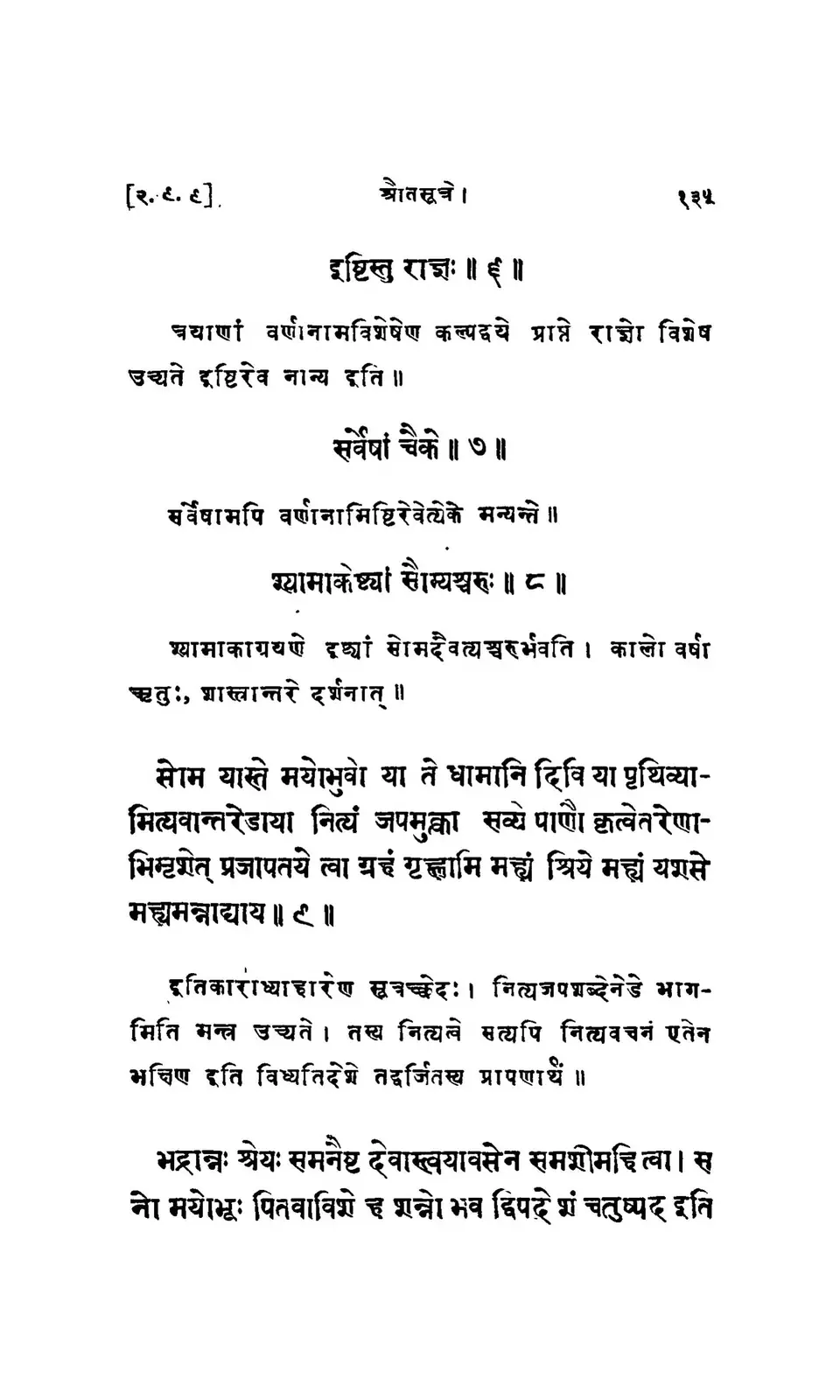
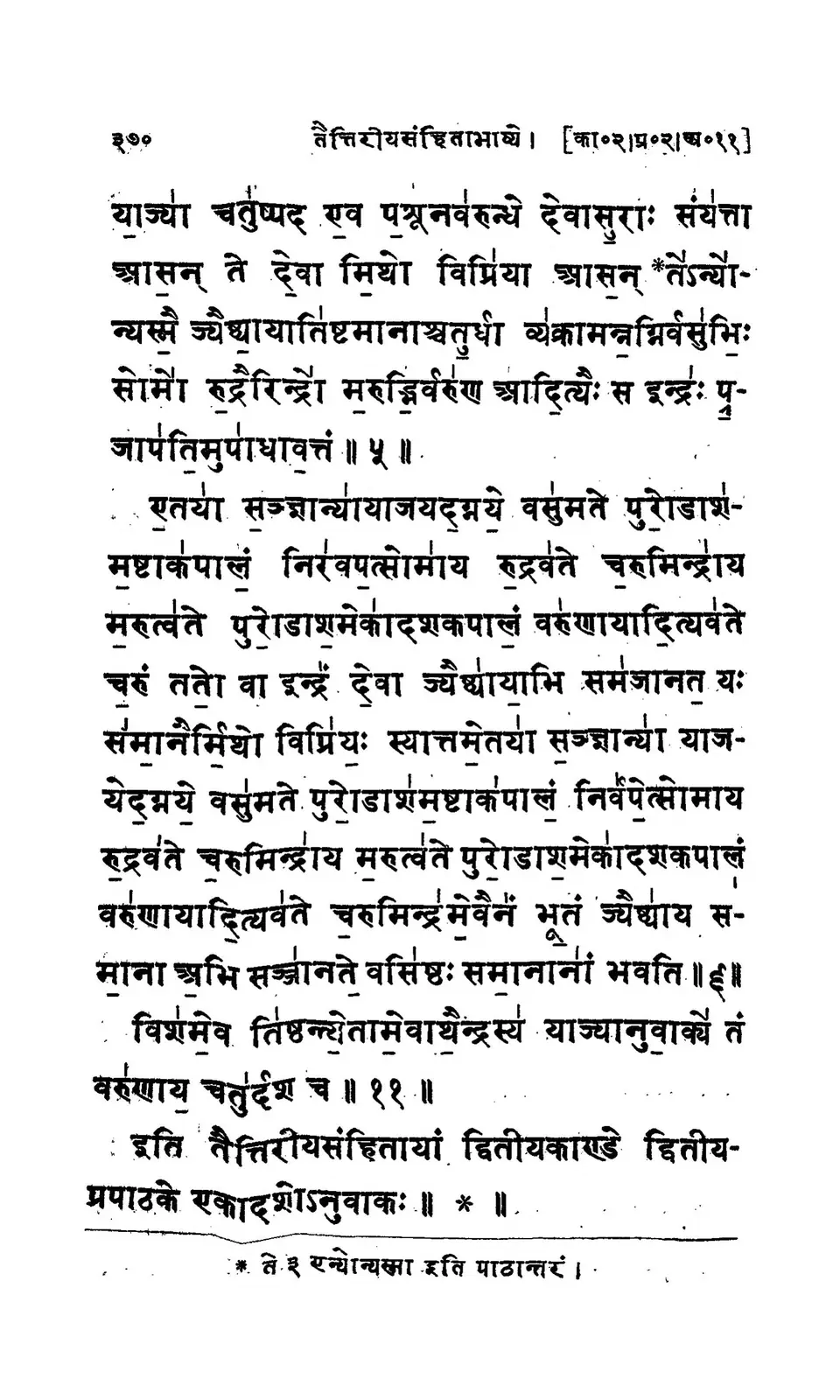
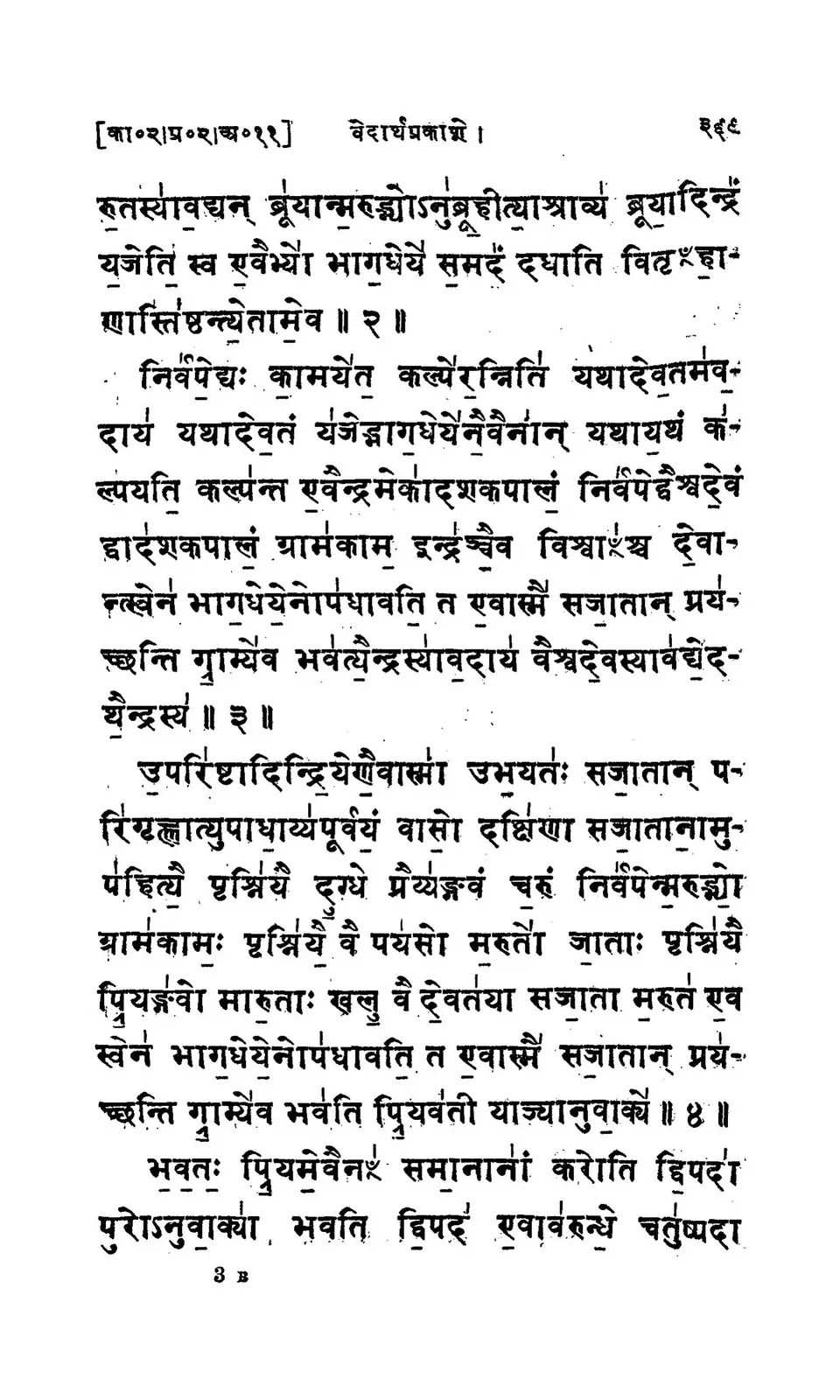
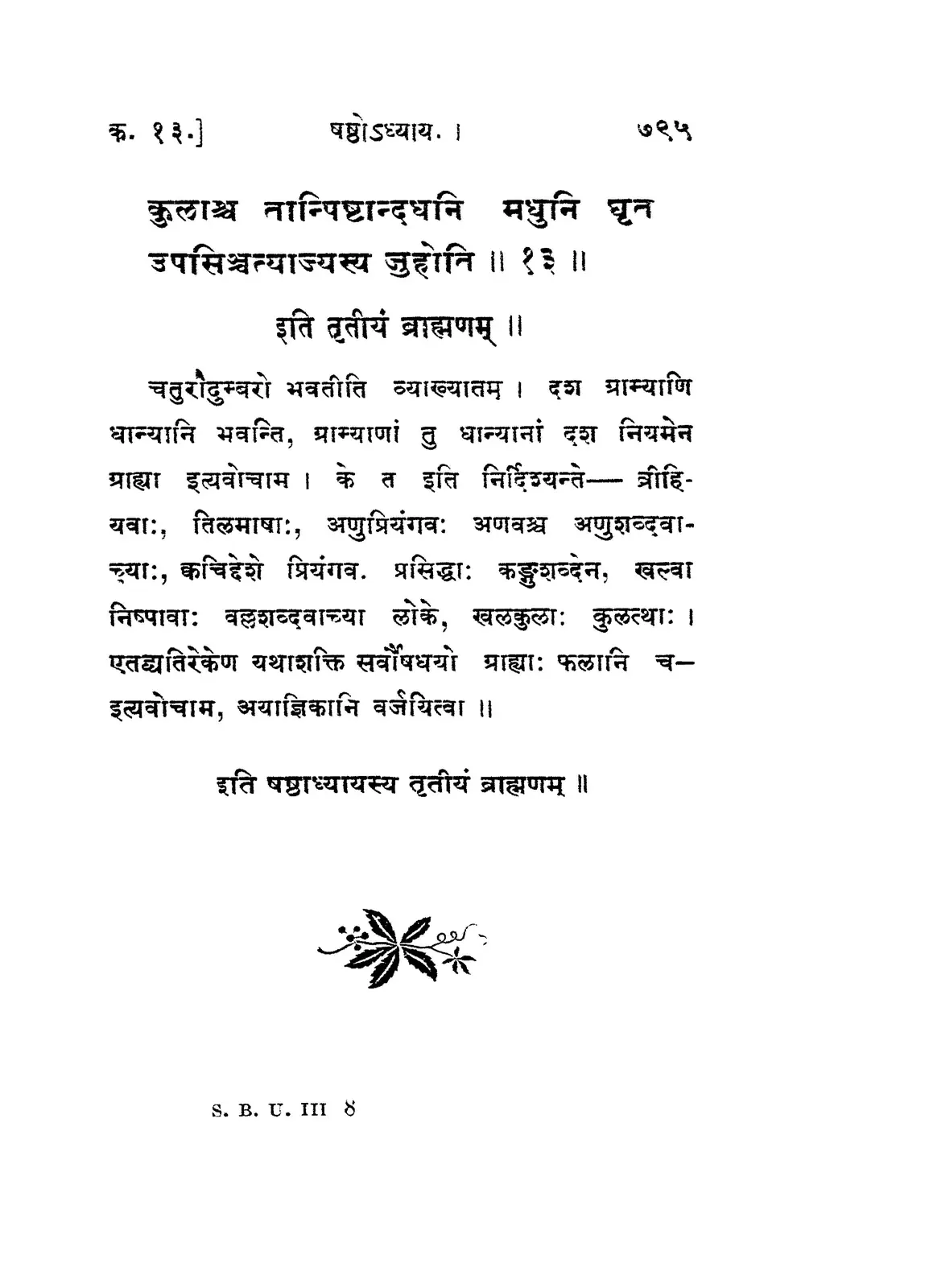
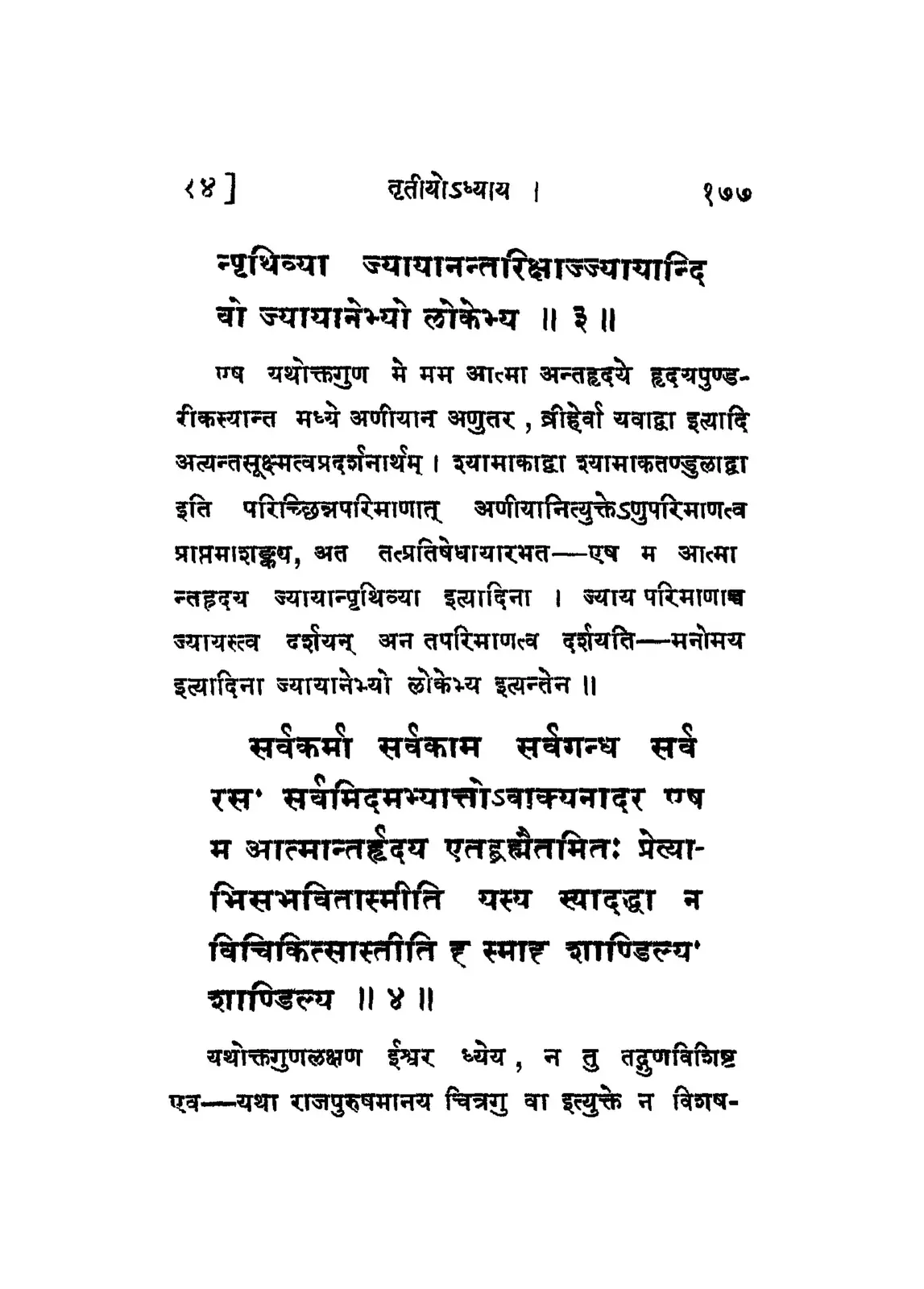
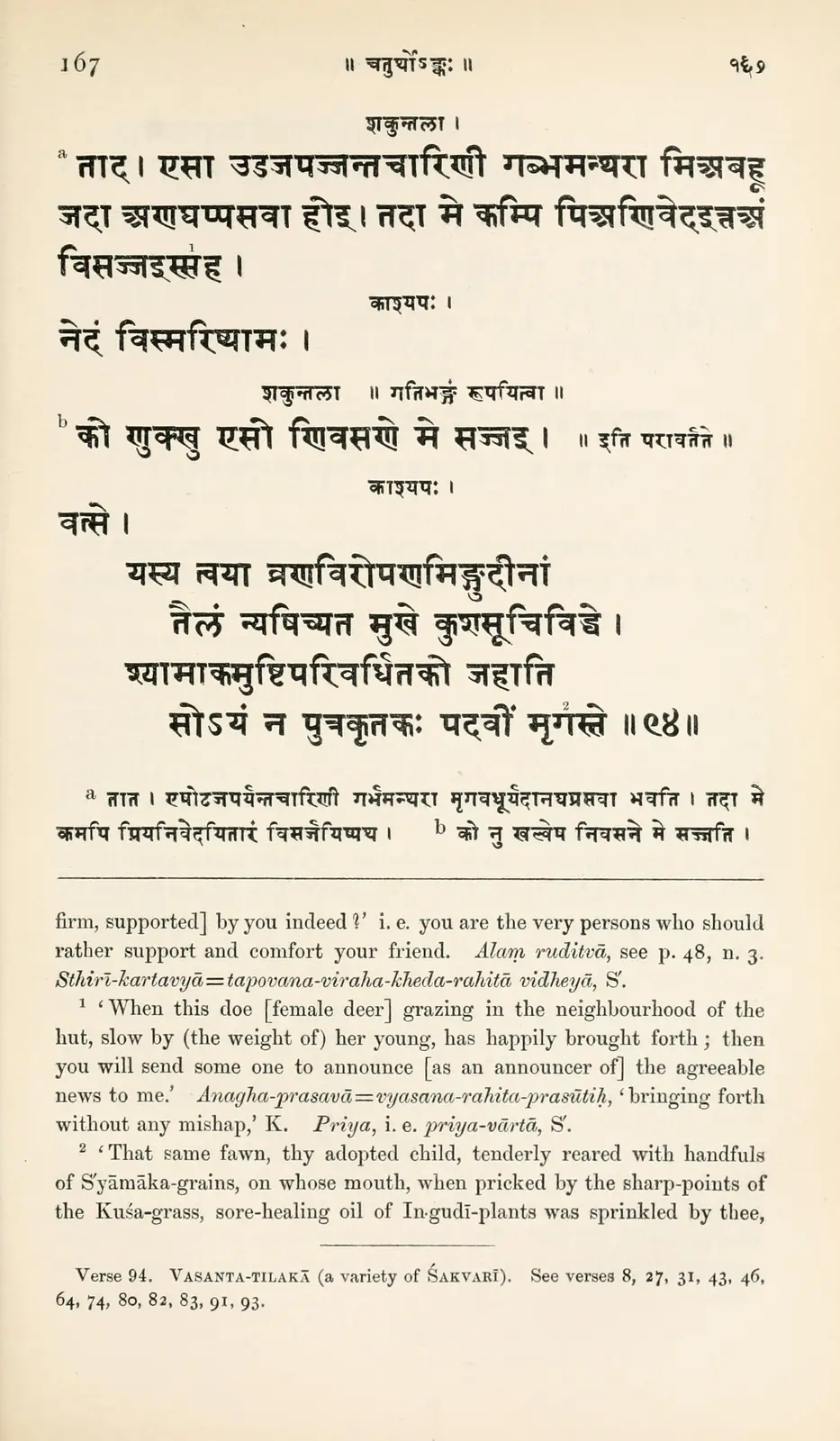
श्यामाकेष्ट्यां सौम्यश्चरुः
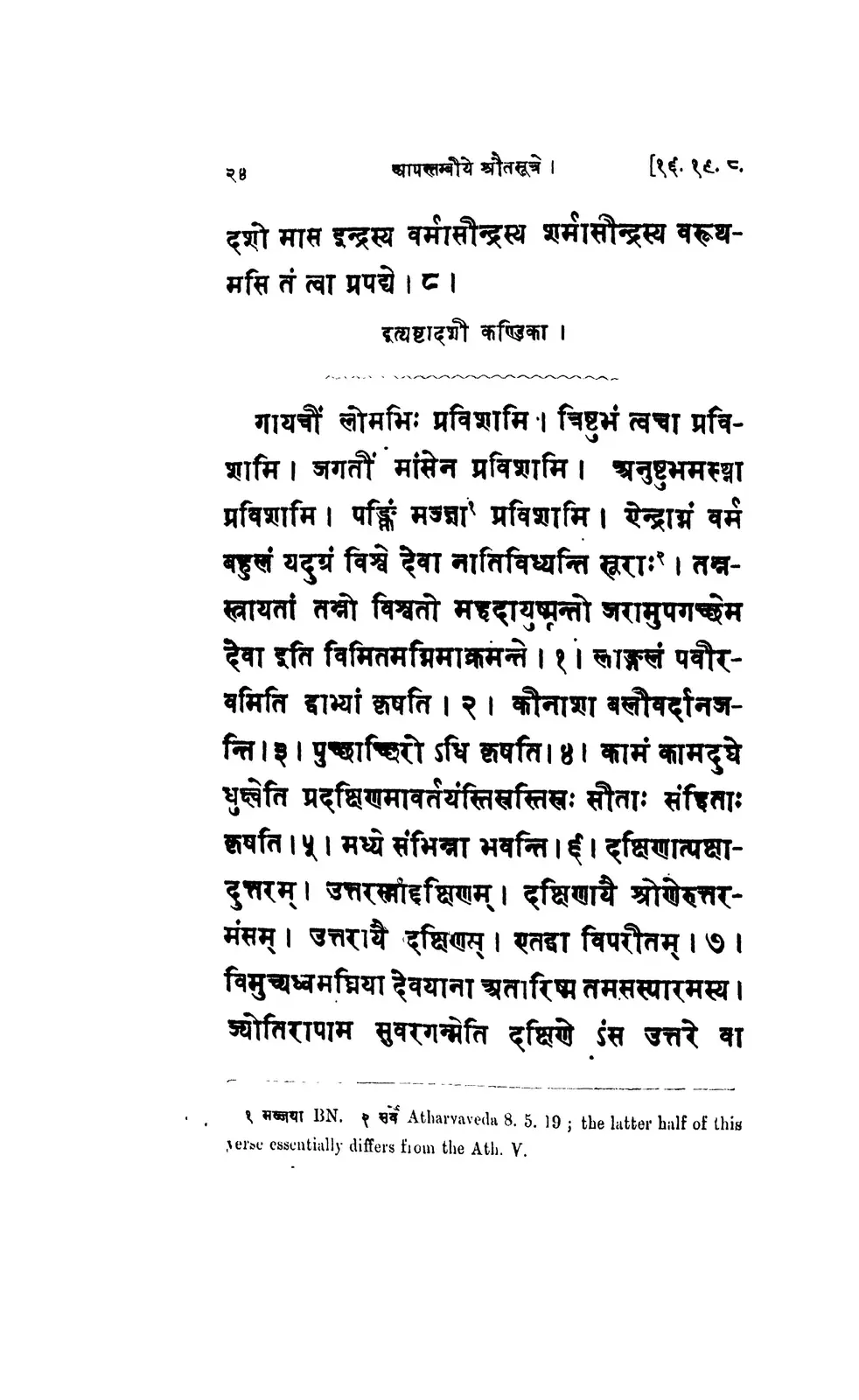
 The printed page
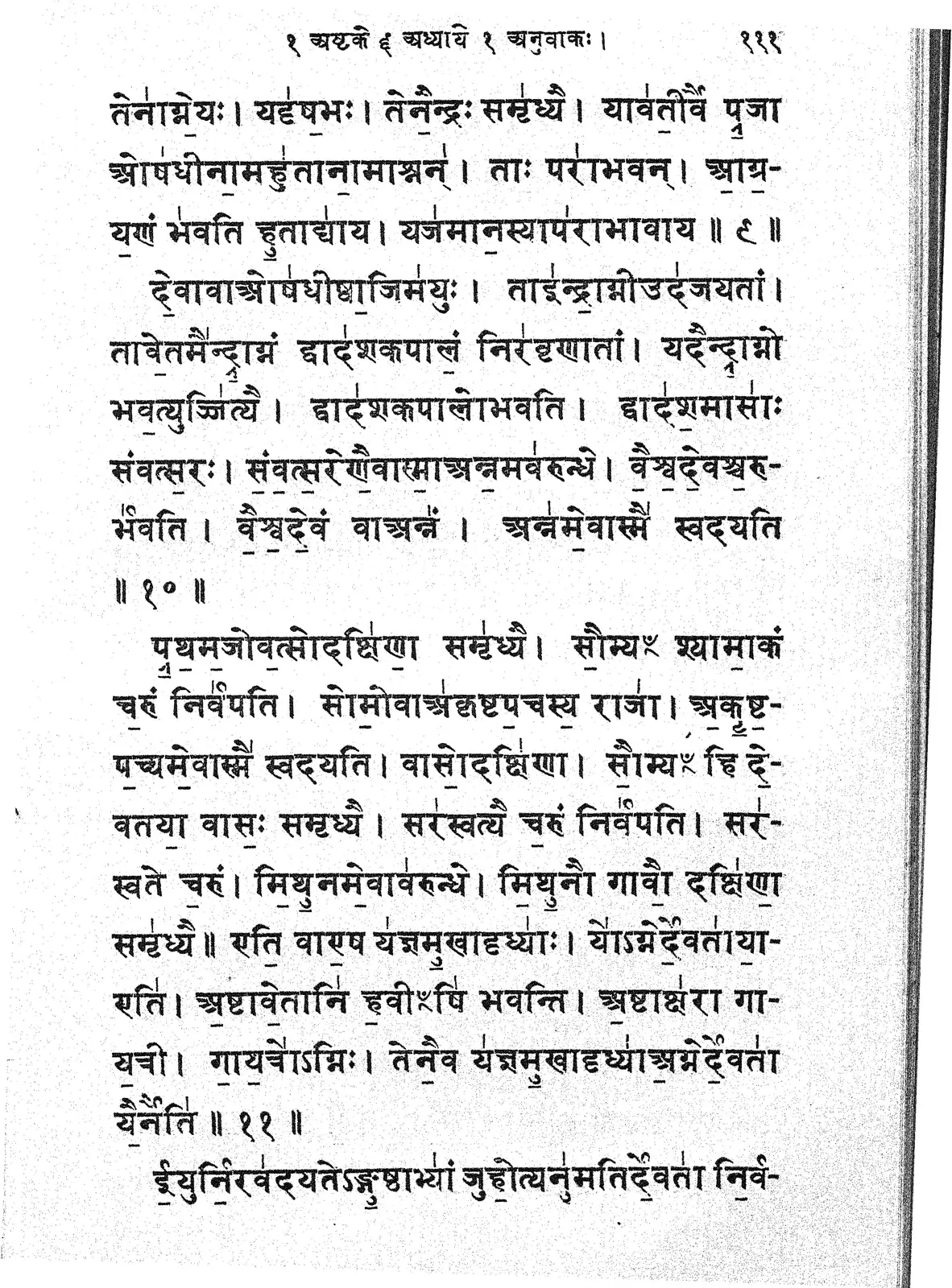
The Śrauta Sútra of Áśvaláyana, with the commentary of Gárgya Náráyaṇa (Bibliotheca Indica, New Series Nos. 55, 61, 66, 69, 71, 80, 84, 86, 90, 93 and (ed. Rámanáráyaṇa Vidyáratna), Calcutta (Baptist Mission and Válmíki Presses, for the Asiatic Society of Bengal), 1874, p. 135śyāmāka.iṣṭyām.saumyaś.caruḥ"At the shyamaka offering, a pot for Soma." (our translation)
AsvSS II.9 (GRETIL numbering 2.9.1-13)
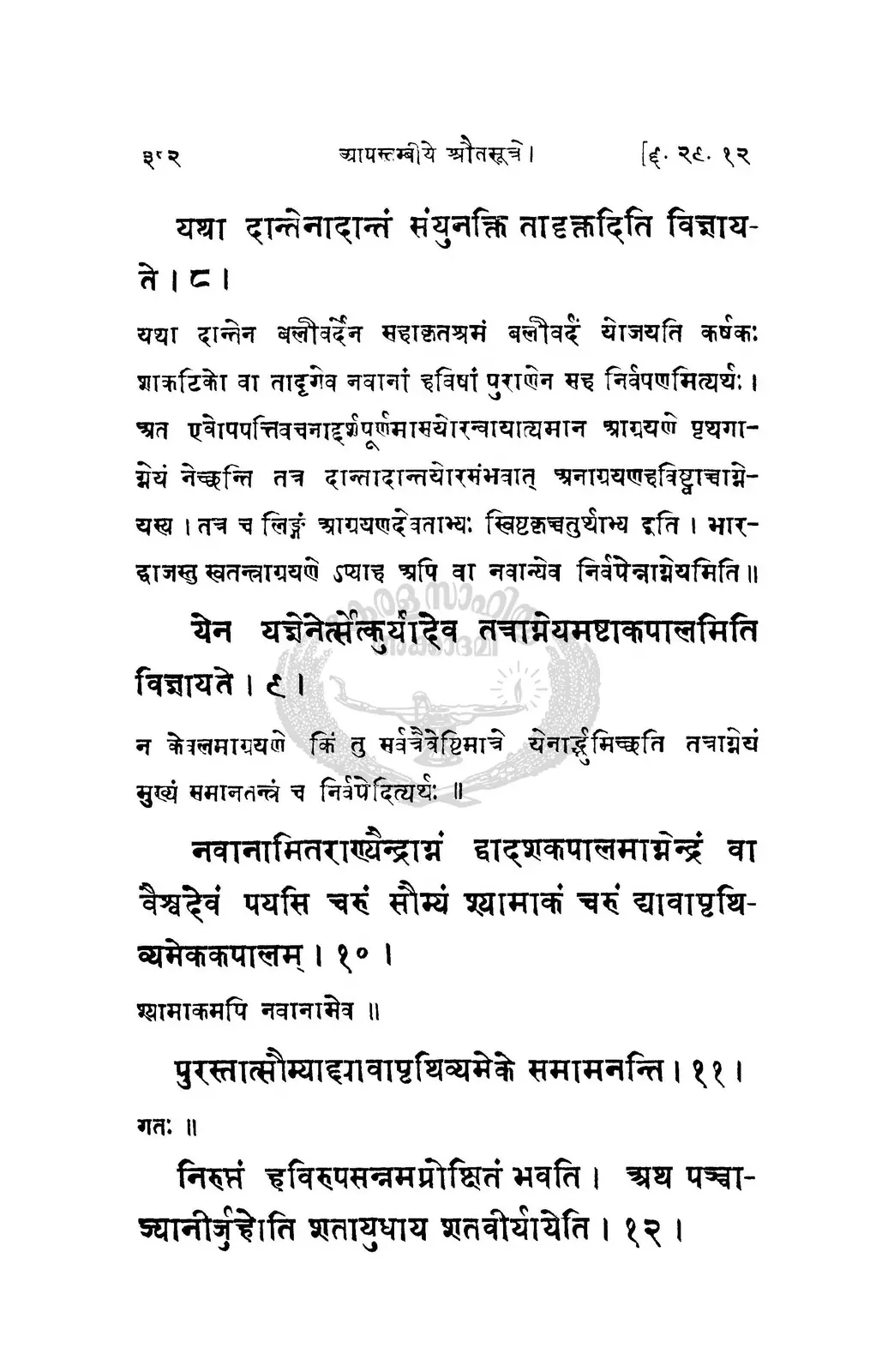
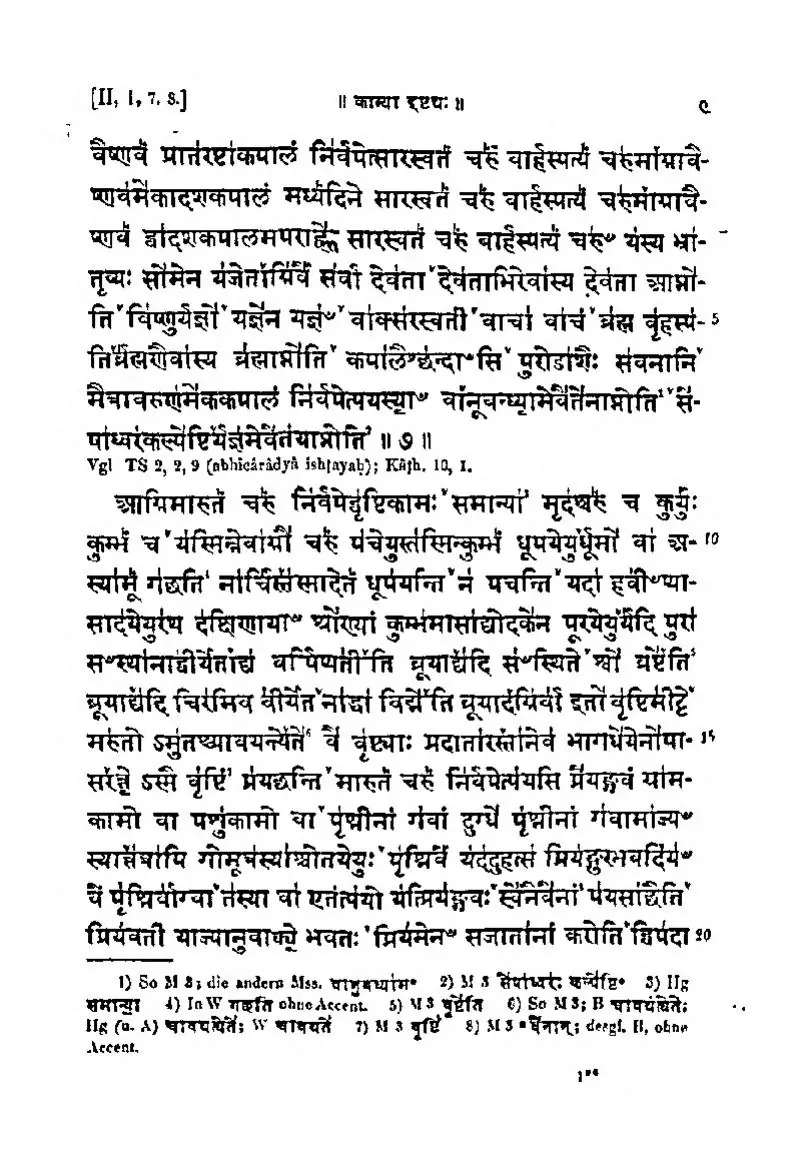
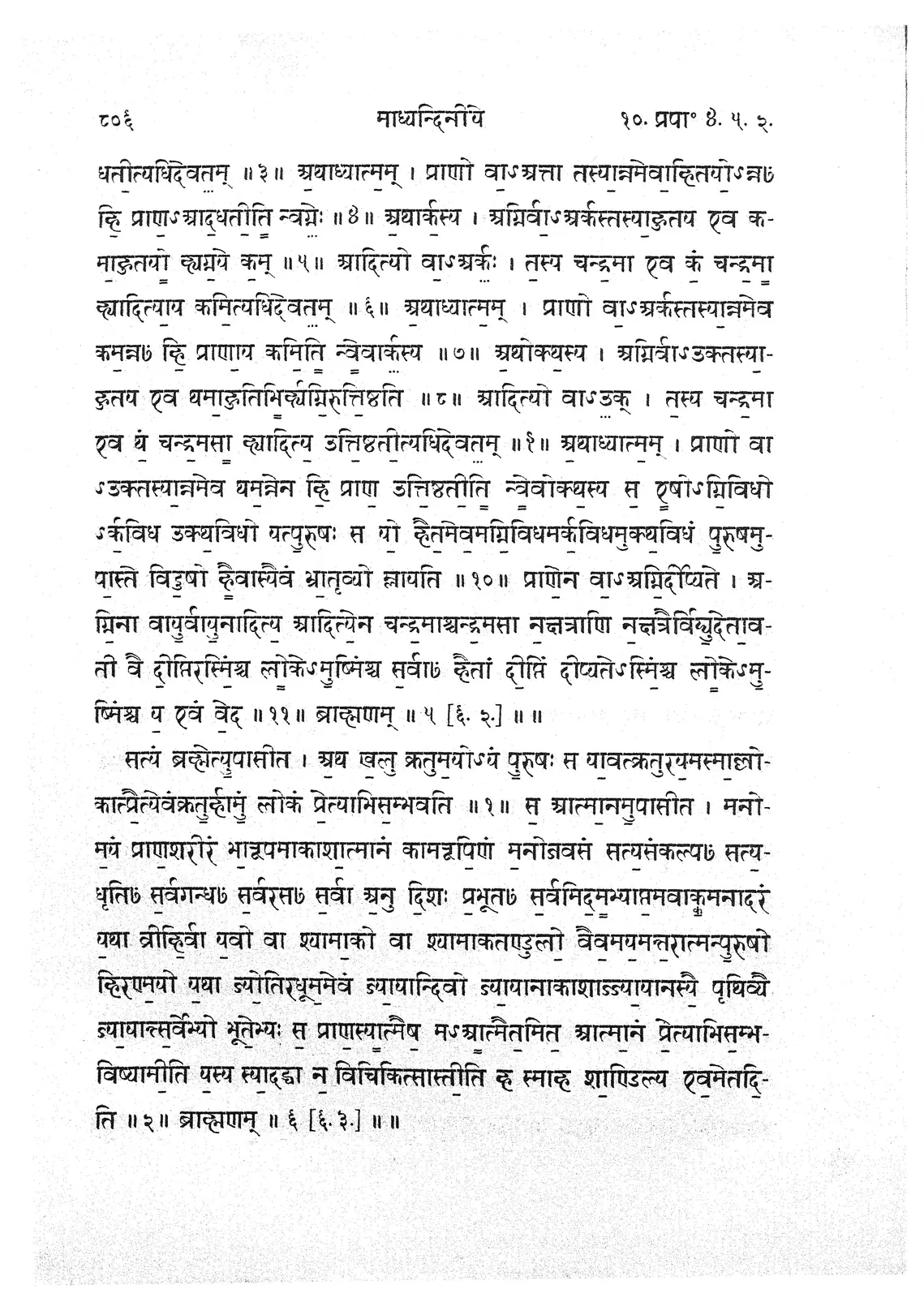
वैश्वदेवं पयसि चरुं सौम्यं श्यामाकं चरुं
 The printed page
The Śrauta Sútra of Ápastamba belonging to the Taittiríya Saṃhitá, with the commentary of Rudradatta (Bibliotheca Indica) (ed. Richard Garbe), Calcutta (Baptist Mission Press, for the Asiatic Society of Bengal), 1882, p. 382vaiśvadevaṃ payasi caruṃ saumyaṃ śyāmākaṃ caruṃ"a pot cooked in milk for the All-gods, a pot of shyamaka for Soma" (our translation)
ApSS VI.29.2-10
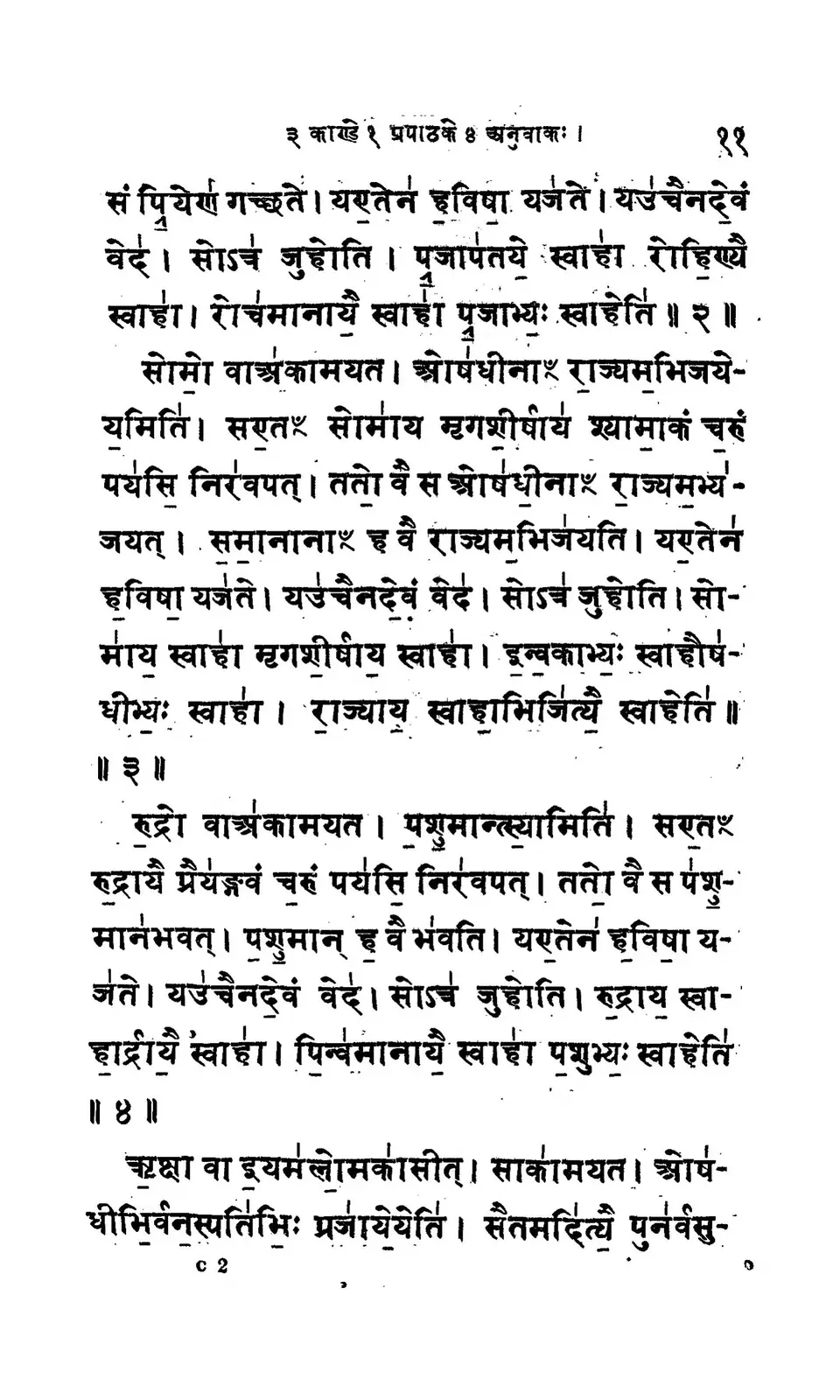
There is a pap for SomaKB IV.12 (Keith; GRETIL numbering KB 4.8) · printed p. 369
a potful of boiled syâmâka or bamboo grains respectivelySB II.4.3 introduction (Eggeling, from Katyayana SS IV.6) and SB II.4.3.1 · printed pp. 369-370 · translator’s note
- Why
- The texts state: one who desires food to eat should sacrifice with the first-fruits offering (Kausitaki Brahmana); the sap of the new plants is first offered to the gods, and only then eaten (Shatapatha Brahmana). Keith adds that the rite secures the fruitfulness of the new crop.
From the text (4)
He who desires proper food should sacrifice with the Agrayana.KB IV.12 (Keith; GRETIL numbering KB 4.8) · printed p. 369
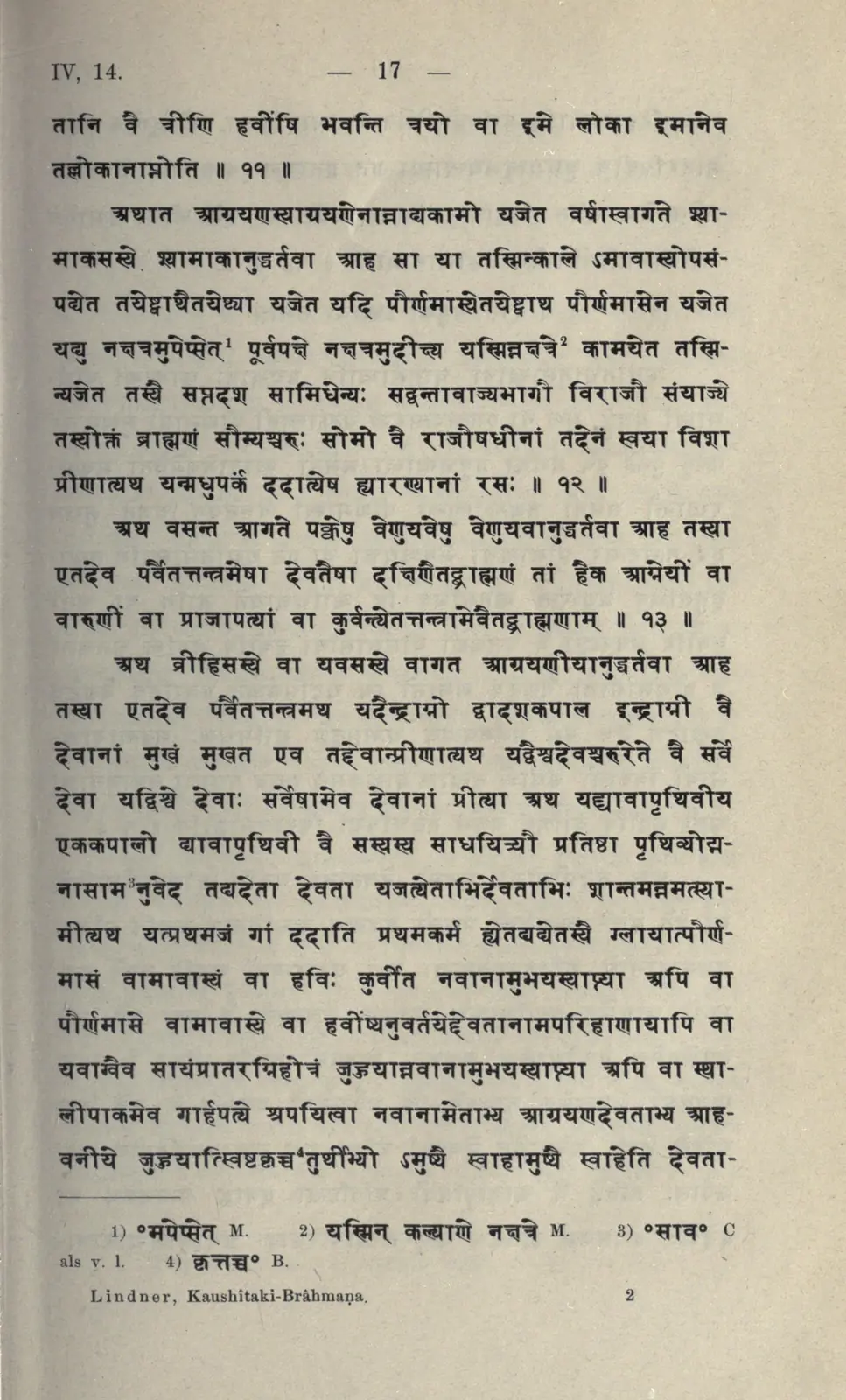
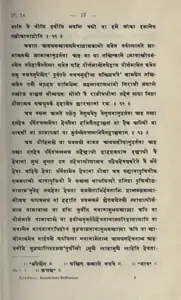
आग्रयणेनान्नाद्यकामो यजेत
 The printed page
Das Kaushitaki Brahmana, herausgegeben und uebersetzt von B. Lindner. I. Text (Kaushitakibrahmanam) (ed. Bruno Lindner), Jena (H. Costenoble), 1887, p. 17āgrayaṇena.anna.adya.kāmo.yajeta"One who desires food to eat should sacrifice with the first-fruits offering." (our translation)
KB 4.8.2 (GRETIL)
having offered of this sap to the gods, we will eat itSB II.4.3 introduction (Eggeling, from Katyayana SS IV.6) and SB II.4.3.1 · printed pp. 369-370The Sanskrit of this lineऽस्य रसस्य हुत्वा देवेभ्यो ऽथेममश्नामेति
as an offering to secure the fruitfulness of the new cropKB IV.12 (Keith; GRETIL numbering KB 4.8) · printed p. 369 · translator’s note
- How
- A pot of new shyamaka is cooked for Soma. For a separate shyamaka offering the order is given to gather the shyamaka grain. Seventeen kindling verses are recited. The priest's fee is a garment (Apastamba) or a honey drink (Kausitaki, Sankhayana). The share of the new shyamaka is eaten with the verse "May Agni eat first, for he knows how the offering is".
From the text (6)
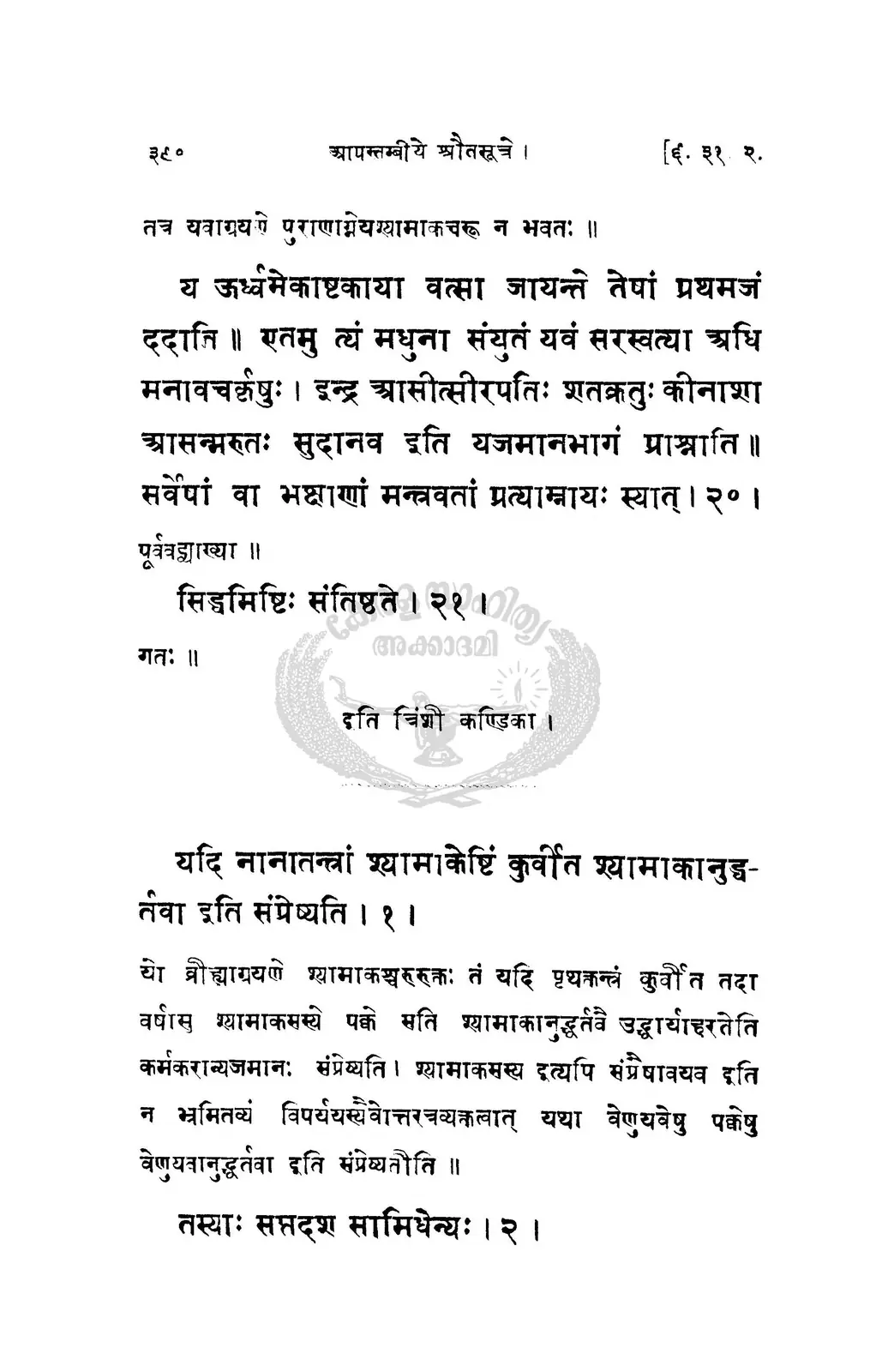
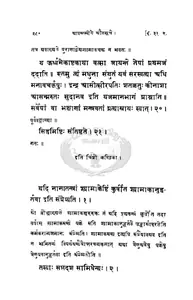
यदि नानातन्त्रां श्यामाकेष्टिं कुर्वीत श्यामाकानुद्धर्तवा इति संप्रेष्यति
 The printed page
The Śrauta Sútra of Ápastamba belonging to the Taittiríya Saṃhitá, with the commentary of Rudradatta (Bibliotheca Indica) (ed. Richard Garbe), Calcutta (Baptist Mission Press, for the Asiatic Society of Bengal), 1882, p. 390yadi nānātantrāṃ śyāmākeṣṭiṃ kurvīta śyāmākānuddʰartavā iti saṃpreṣyati"If he performs the shyamaka offering as a separate rite, he gives the order: 'the shyamaka are to be gathered'." (our translation)
ApSS VI.31.1-14
There are seventeen kindling verses in this sacrificeKB IV.12 (Keith; GRETIL numbering KB 4.8) · printed p. 369
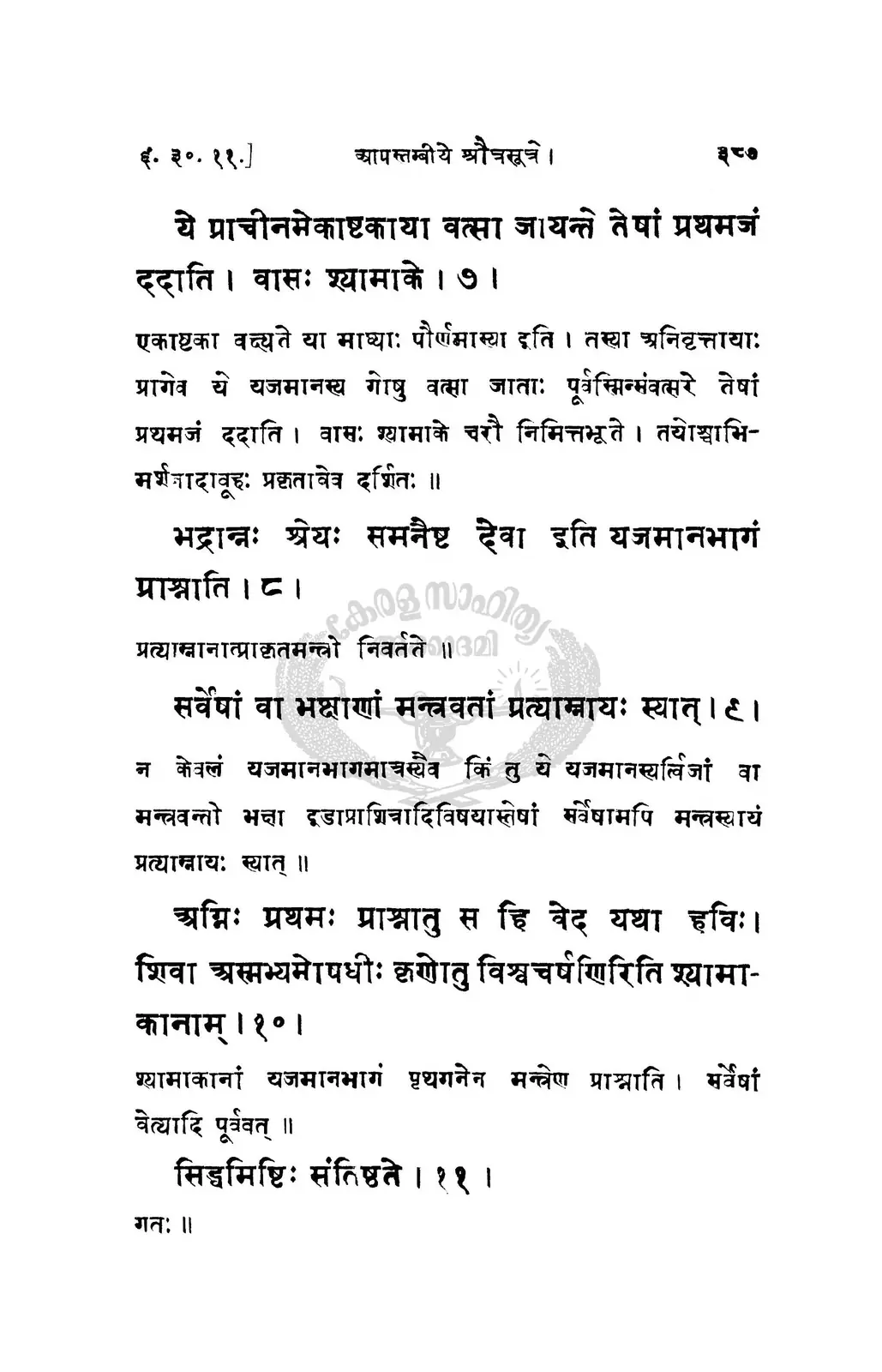
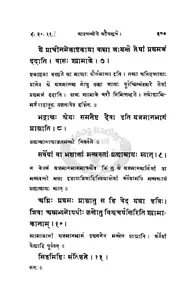
वासः श्यामाके
 The printed page
The Śrauta Sútra of Ápastamba belonging to the Taittiríya Saṃhitá, with the commentary of Rudradatta (Bibliotheca Indica) (ed. Richard Garbe), Calcutta (Baptist Mission Press, for the Asiatic Society of Bengal), 1882, p. 387vāsaḥ śyāmāke"(the fee is) a garment at the shyamaka (offering)" (our translation)
ApSS VI.30.7-10
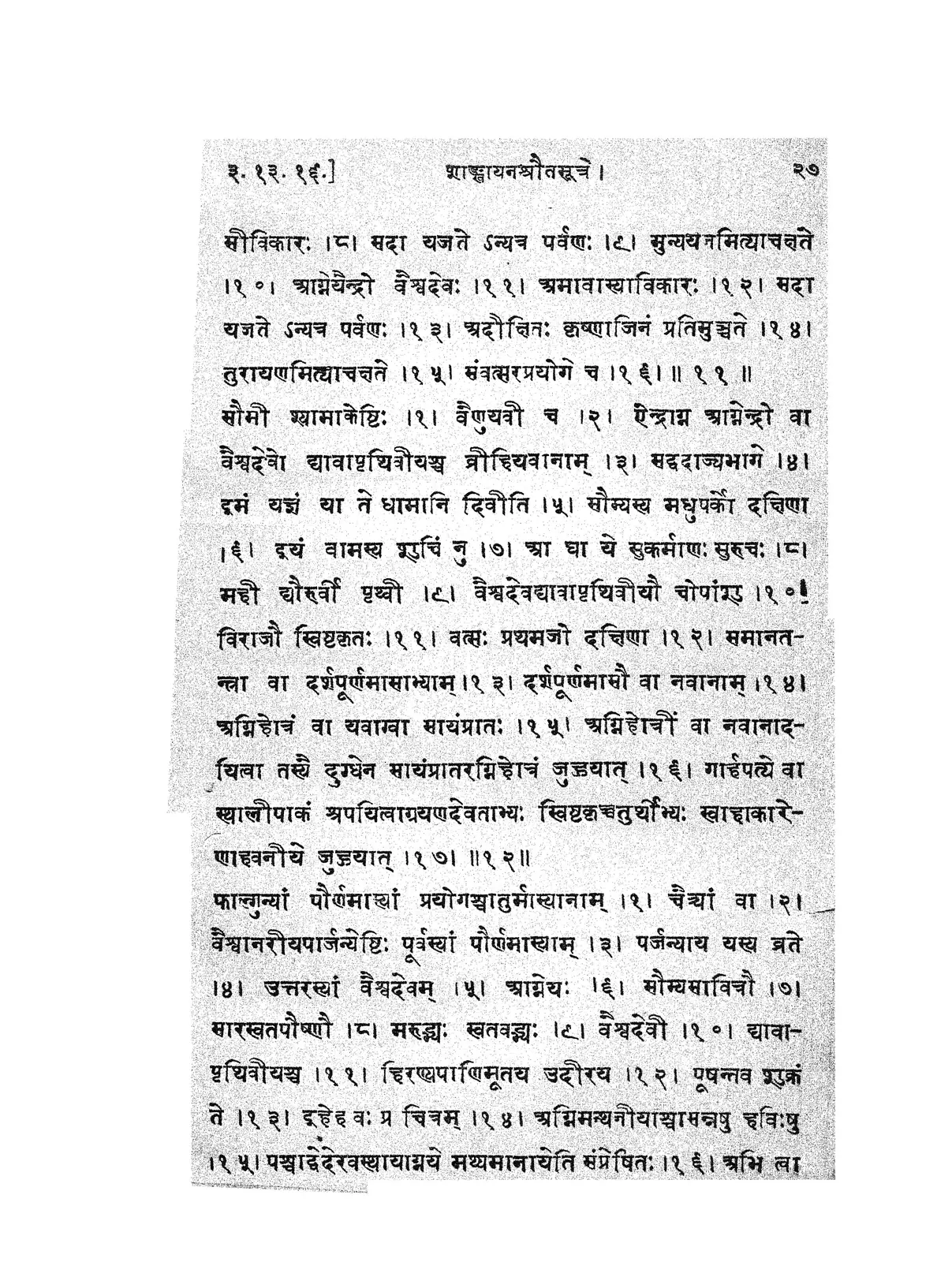
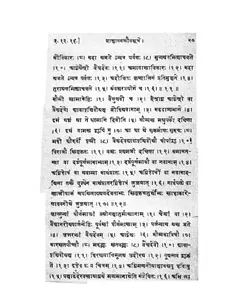
सौम्यस्य मधुपर्को दक्षिणा
 The printed page
The Śāṅkhāyana Śrauta Sūtra together with the commentary of Varadattasuta Ānartīya, Vol. I: Text of the Sūtra, critical notes, indices (Bibliotheca In (ed. Alfred Hillebrandt), Calcutta (G. H. Rouse, Baptist Mission Press), 1888, p. 27saumyasya.madhu.parko.dakṣiṇā"For the Soma (offering) the fee is the honey mixture (madhuparka)." (our translation)
SSS III.12.1, III.12.6
In that he gives the honey drink, it is because this is the sap of the forest thingsKB IV.12 (Keith; GRETIL numbering KB 4.8) · printed p. 369
अग्निः प्रथमः प्राश्नातु स हि वेद यथा हविः
The printed page
The Śrauta Sútra of Ápastamba belonging to the Taittiríya Saṃhitá, with the commentary of Rudradatta (Bibliotheca Indica) (ed. Richard Garbe), Calcutta (Baptist Mission Press, for the Asiatic Society of Bengal), 1882, p. 387agniḥ pratʰāmaḥ prāśnātu sa hi veda yatʰā haviḥ"May Agni eat first, for he knows how the offering is" (the verse for eating the new shyamaka, ApSS VI.30.10) (our translation)
ApSS VI.30.7-10
- When
- In the rainy season, when the shyamaka harvest has come; on the new-moon (or full-moon) day falling at that time. Eggeling, following the Katyayana sutra, gives the rainy season or autumn.
From the text (5)
In the rains when the millet harvest has come, he gives orders to pluck millet.KB IV.12 (Keith; GRETIL numbering KB 4.8) · printed p. 369
The new moon night which coincides with that time, on it should he sacrifice and then offer this sacrificeKB IV.12 (Keith; GRETIL numbering KB 4.8) · printed p. 369
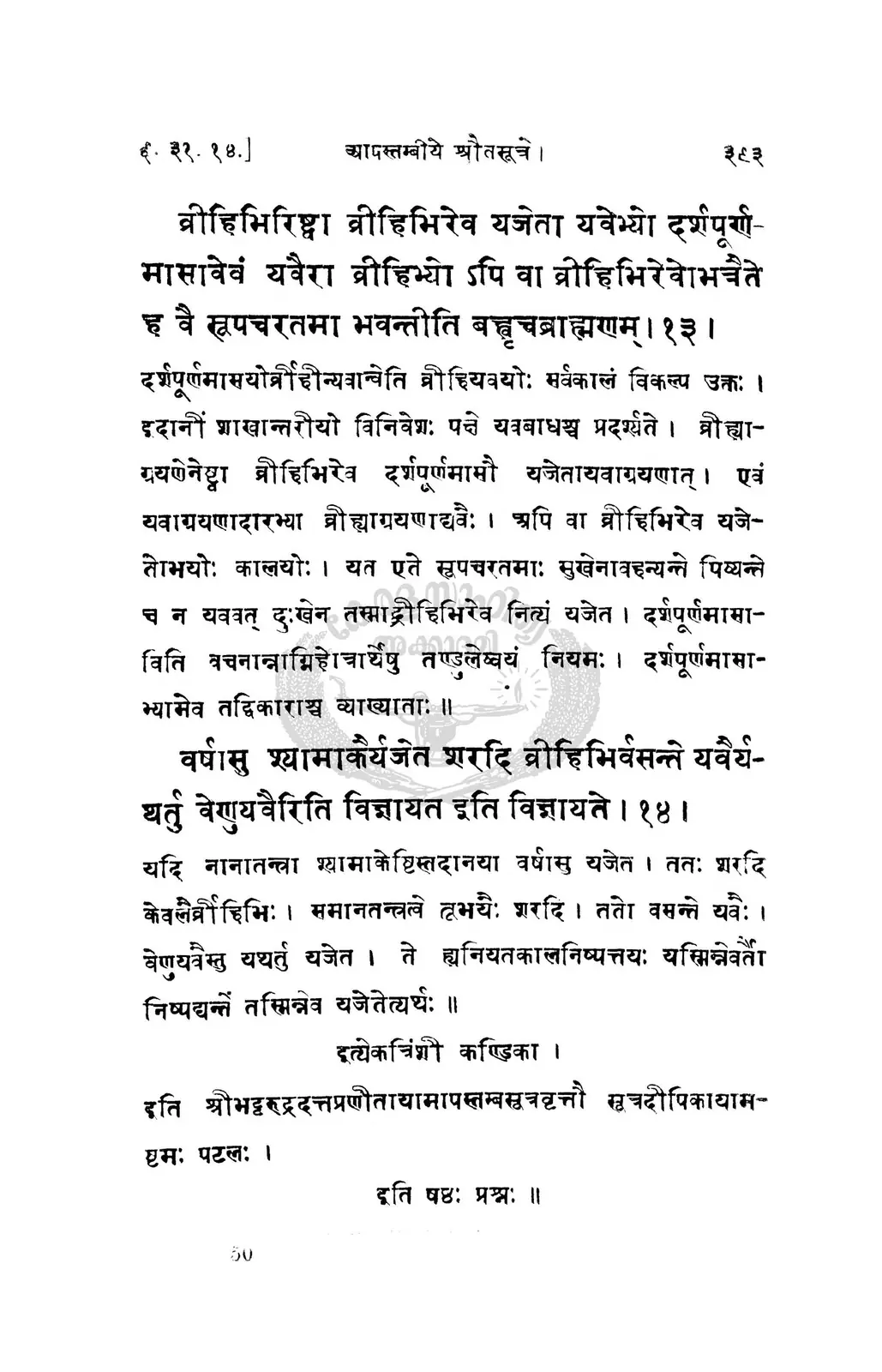
वर्षासु श्यामाकैर्यजेत
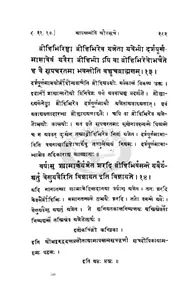 The printed page
The Śrauta Sútra of Ápastamba belonging to the Taittiríya Saṃhitá, with the commentary of Rudradatta (Bibliotheca Indica) (ed. Richard Garbe), Calcutta (Baptist Mission Press, for the Asiatic Society of Bengal), 1882, p. 393varṣāsu śyāmākairyajeta"In the rains he should sacrifice with shyamaka." (our translation)
ApSS VI.31.1-14
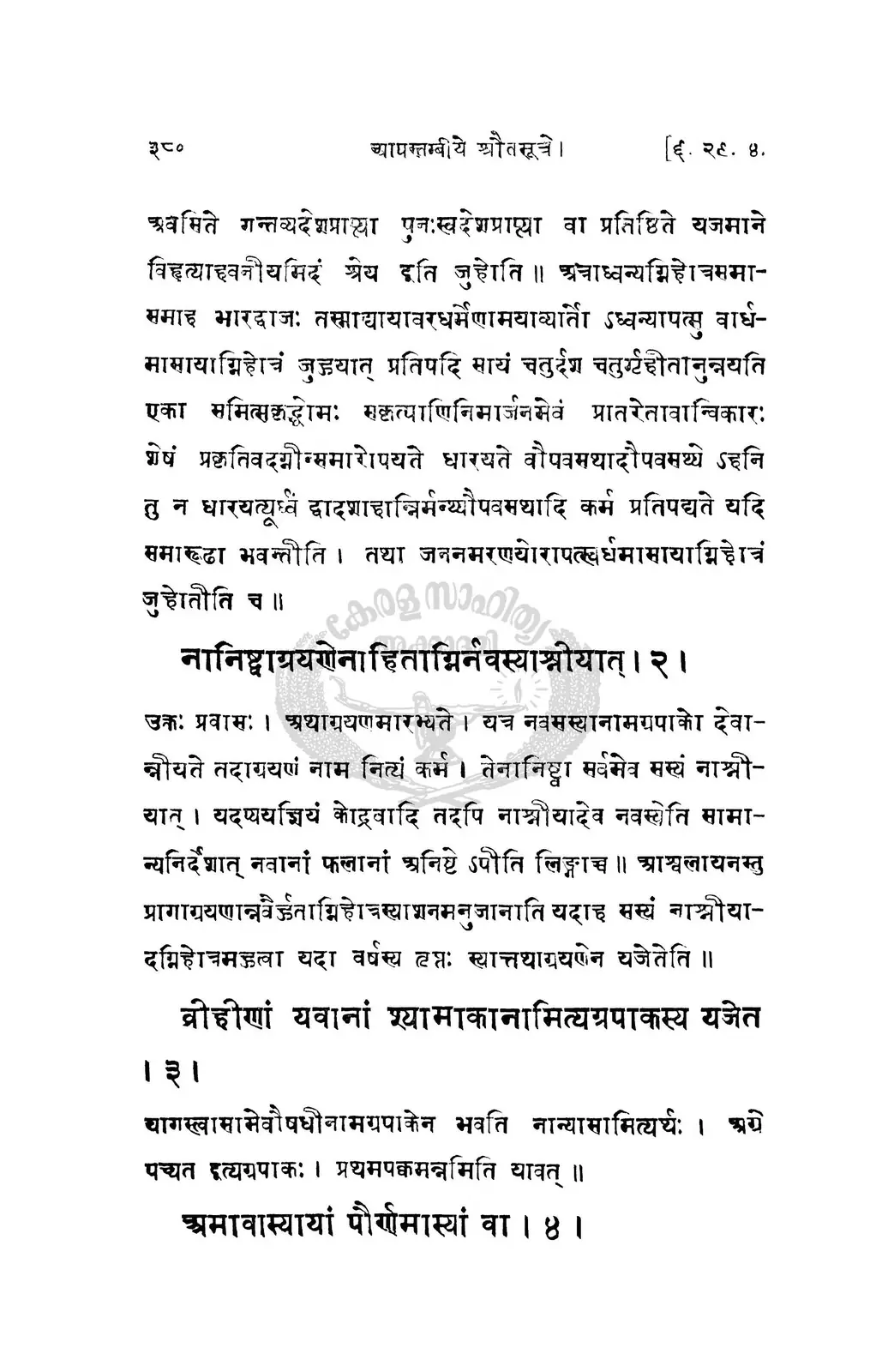
अमावास्यायां पौर्णमास्यां वा
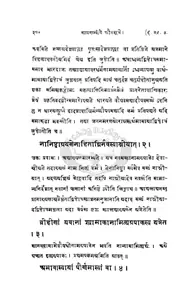 The printed page
The Śrauta Sútra of Ápastamba belonging to the Taittiríya Saṃhitá, with the commentary of Rudradatta (Bibliotheca Indica) (ed. Richard Garbe), Calcutta (Baptist Mission Press, for the Asiatic Society of Bengal), 1882, p. 380amāvāsyāyāṃ paurṇamāsyāṃ vā"on the new-moon or the full-moon day" (our translation)
ApSS VI.29.2-10
(syâmâka), in the rainy season or in autumnSB II.4.3 introduction (Eggeling, from Katyayana SS IV.6) and SB II.4.3.1 · printed pp. 369-370 · translator’s note
- Who performs it
- A householder who has set up the sacred Shrauta fires (āhitāgni), as sacrificer: he may not eat of the new grain before this offering.
From the text (2)
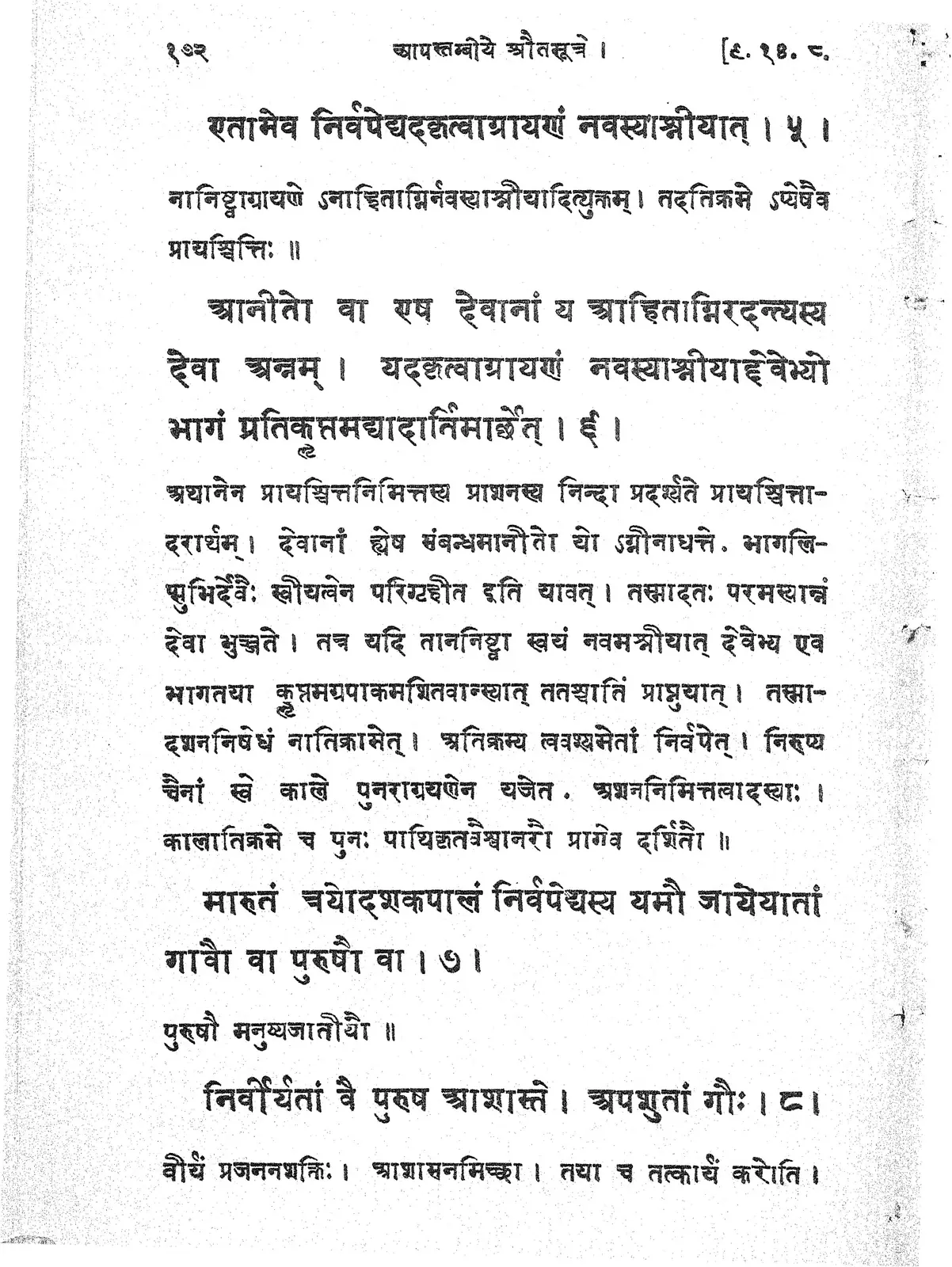
नानिष्ट्वाग्रयणेनाहिताग्निर्नवस्याश्नीयात्
The printed page
The Śrauta Sútra of Ápastamba belonging to the Taittiríya Saṃhitá, with the commentary of Rudradatta (Bibliotheca Indica) (ed. Richard Garbe), Calcutta (Baptist Mission Press, for the Asiatic Society of Bengal), 1882, p. 380nāniṣṭvāgrayaṇenāhitāgnirnavasyāśnīyāt"One who has set up the (sacred) fires should not eat of the new (crop) without having offered the first-fruits offering." (our translation)
ApSS VI.29.2-10
with relation to a sacrificer who keeps theOldenberg, note on Asvalayana GS II.2.4 · printed p. 203 · translator’s note
- Its meaning
- Soma is called the king of the plants, so the new shyamaka is offered to him (Kausitaki). Apastamba says that whoever eats the new grain without this offering eats the share set apart for the gods. Even during a year-long sacrificial session the first-fruits offering must not lapse: it is kept up "by Soma's pap" (Shatapatha XII).
From the text (5)
Soma is the king of the plants ; thus he delights him with his own subjectsKB IV.12 (Keith; GRETIL numbering KB 4.8) · printed p. 369
यदकृत्वाग्रायणं नवस्याश्नीयाद्देवेभ्यो भागं प्रतिकॢप्तमद्याद्
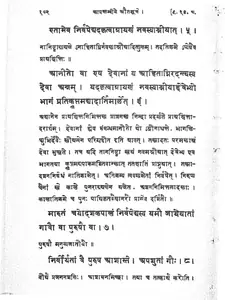 The printed page
The Śrauta Sútra of Ápastamba belonging to the Taittiríya Saṃhitá, with the commentary of Rudradatta (Bibliotheca Indica) (ed. Richard Garbe), Calcutta (Asiatic Society of Bengal), 1885, p. 172yadakr̥tvāgrāyaṇaṃ navasyāśnīyāddevebʰyo bʰāgaṃ pratikḷptamadyād"If he ate of the new (grain) without having performed the first-fruits offering, he would be eating the share set apart for the gods." (our translation)
ApSS IX.14.5-6
how does their offering of firstfruits come to be uninterruptedSB XII.3.5.7 and Eggeling's note (citing Katyayana SS IV.6.11 ff.) · printed p. 176
By Soma’s papSB XII.3.5.7 and Eggeling's note (citing Katyayana SS IV.6.11 ff.) · printed p. 176
is to be offered to Soma at the proper season (during the rains, or autumn)SB XII.3.5.7 and Eggeling's note (citing Katyayana SS IV.6.11 ff.) · printed p. 176 · translator’s note
Sources: Kausitaki Brahmana · KB IV.12 (Keith; GRETIL numbering KB 4.8) · tr. Arthur Berriedale Keith · Rigveda Brahmanas: the Aitareya and Kausitaki Brahmanas, Harvard Oriental Series 25, 1920 | Kausitaki Brahmana (Sanskrit) · KB 4.8.2 (GRETIL) · Kausitaki-Brahmana, GRETIL | Shatapatha Brahmana · SB II.4.3 introduction (Eggeling, from Katyayana SS IV.6) and SB II.4.3.1 · tr. Julius Eggeling · The Satapatha-Brahmana, Part I, Sacred Books of the East 12, Oxford 1882 | Asvalayana Srauta Sutra (Sanskrit) · AsvSS II.9 (GRETIL numbering 2.9.1-13) · Asvalayana-Srautasutra, GRETIL | Sankhayana Srauta Sutra (Sanskrit) · SSS III.12.1, III.12.6 · Sankhayana-Srautasutra, GRETIL | Apastamba Srauta Sutra (Sanskrit) · ApSS VI.29.2-10 · Apastamba-Srautasutra, TITUS e-text (ed. R. Garbe) | Apastamba Srauta Sutra (Sanskrit) · ApSS VI.30.7-10 · Apastamba-Srautasutra, TITUS e-text (ed. R. Garbe) | Apastamba Srauta Sutra (Sanskrit) · ApSS VI.31.1-14 · Apastamba-Srautasutra, TITUS e-text (ed. R. Garbe) | Apastamba Srauta Sutra (Sanskrit) · ApSS IX.14.5-6 · Apastamba-Srautasutra, TITUS e-text (ed. R. Garbe) | Shatapatha Brahmana · SB XII.3.5.7 and Eggeling's note (citing Katyayana SS IV.6.11 ff.) · tr. Julius Eggeling · The Satapatha-Brahmana, Part V, Sacred Books of the East 44, Oxford 1900 | Asvalayana Grihya Sutra (translator's note) · Oldenberg, note on Asvalayana GS II.2.4 · tr. Hermann Oldenberg · The Grihya-Sutras, Part I, Sacred Books of the East 29, Oxford 1886
Grihya (household) fire rite
Household first-fruits offering, shyamaka form (domestic Grihya rite)
āgrayaṇa (gṛhya), śyāmāka
Barnyard millet · śyāmāka
- What is offered
- A pot dish (sthālīpāka) of the new shyamaka grain for the household fire: boiled whole (Jaiminiya), cooked in milk (Manava; Gobhila treats it "in the same way" as its milk-rice), or cooked in water or milk (Kausika).
From the text (5)
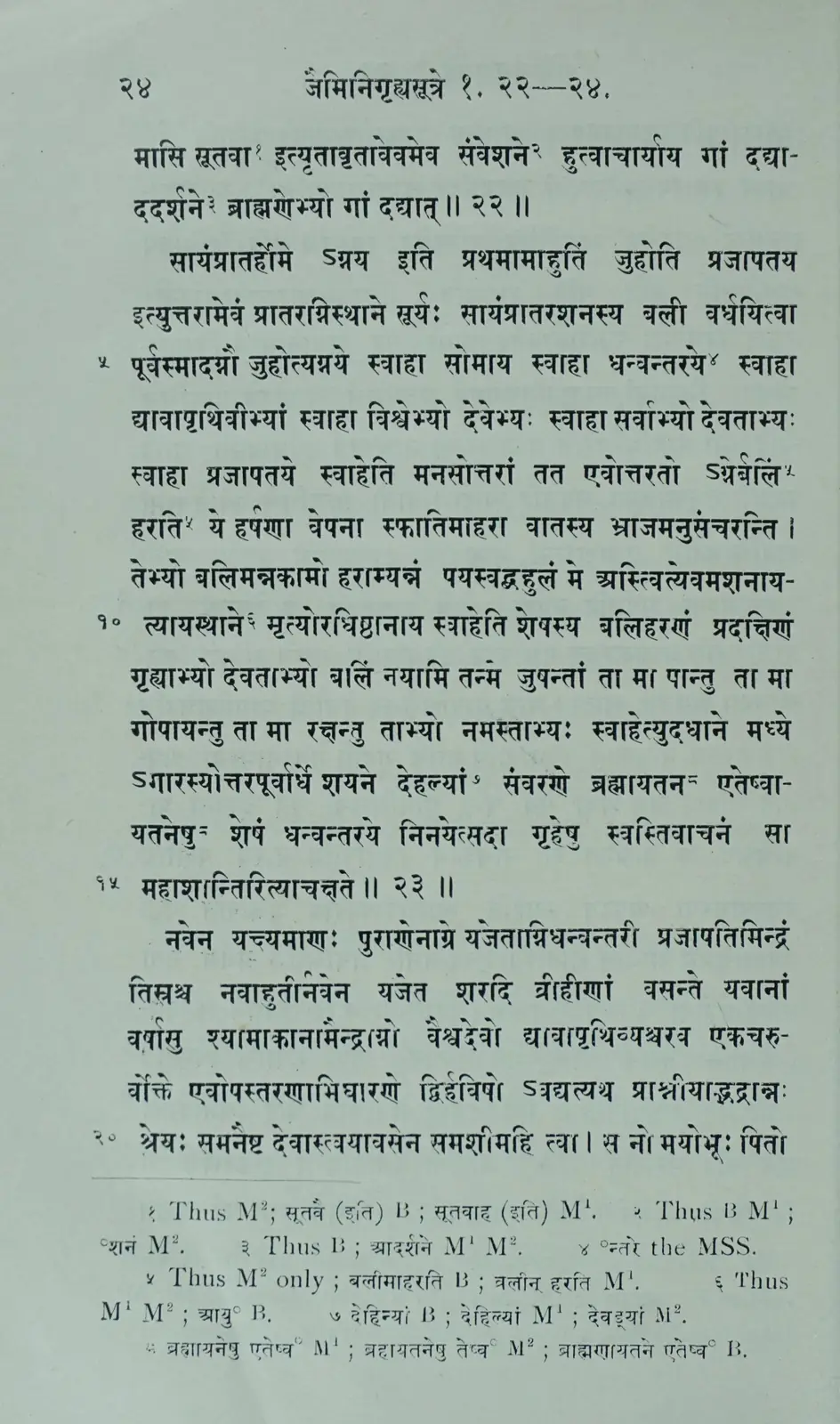
In the same way (sacrifices of the first fruits are performed) of Syamaka (panicum frumentaceum) and of barley.GGS III.8.9-24 · printed pp. 93-94
a mess of boiled rice-grains with milk, sacred to Indra and AgniGGS III.8.9-24 · printed pp. 93-94
a mess of the corns boiled wholeJGS I.24 · printed pp. 43-44
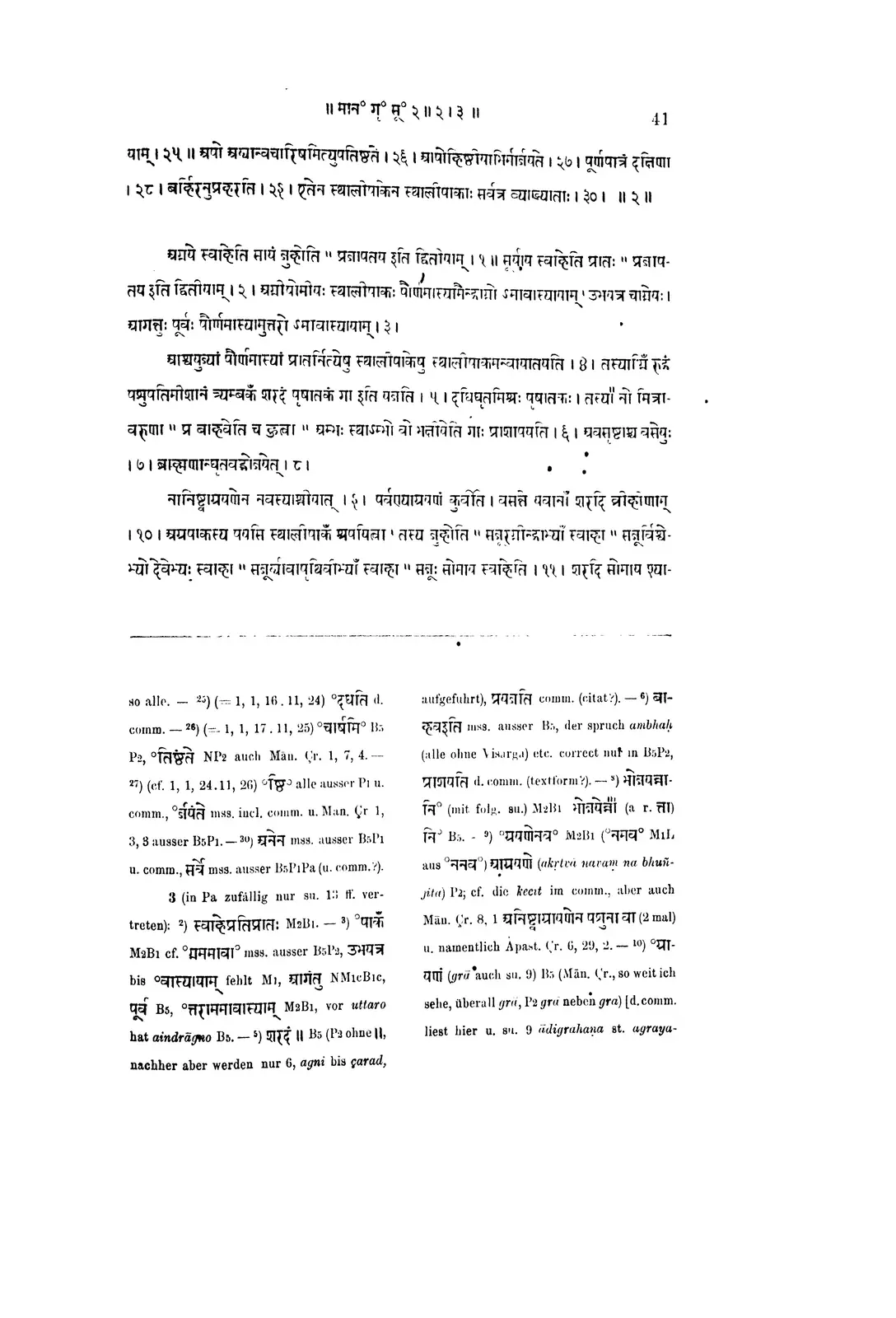
अग्रपाकस्य पयसि स्थालीपाकं श्रपयित्वा
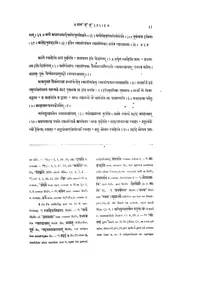 The printed page
Das Mānava-Gṛhya-Sūtra nebst Commentar in kurzer Fassung (ed. Friedrich Knauer), St. Petersburg, 1897, p. 41agrapākasya payasi sthālīpākaṃ śrapayitvā"having cooked a pot dish of the first-ripened (grain) in milk" (our translation)
MGS II.3.9-14 (GRETIL)
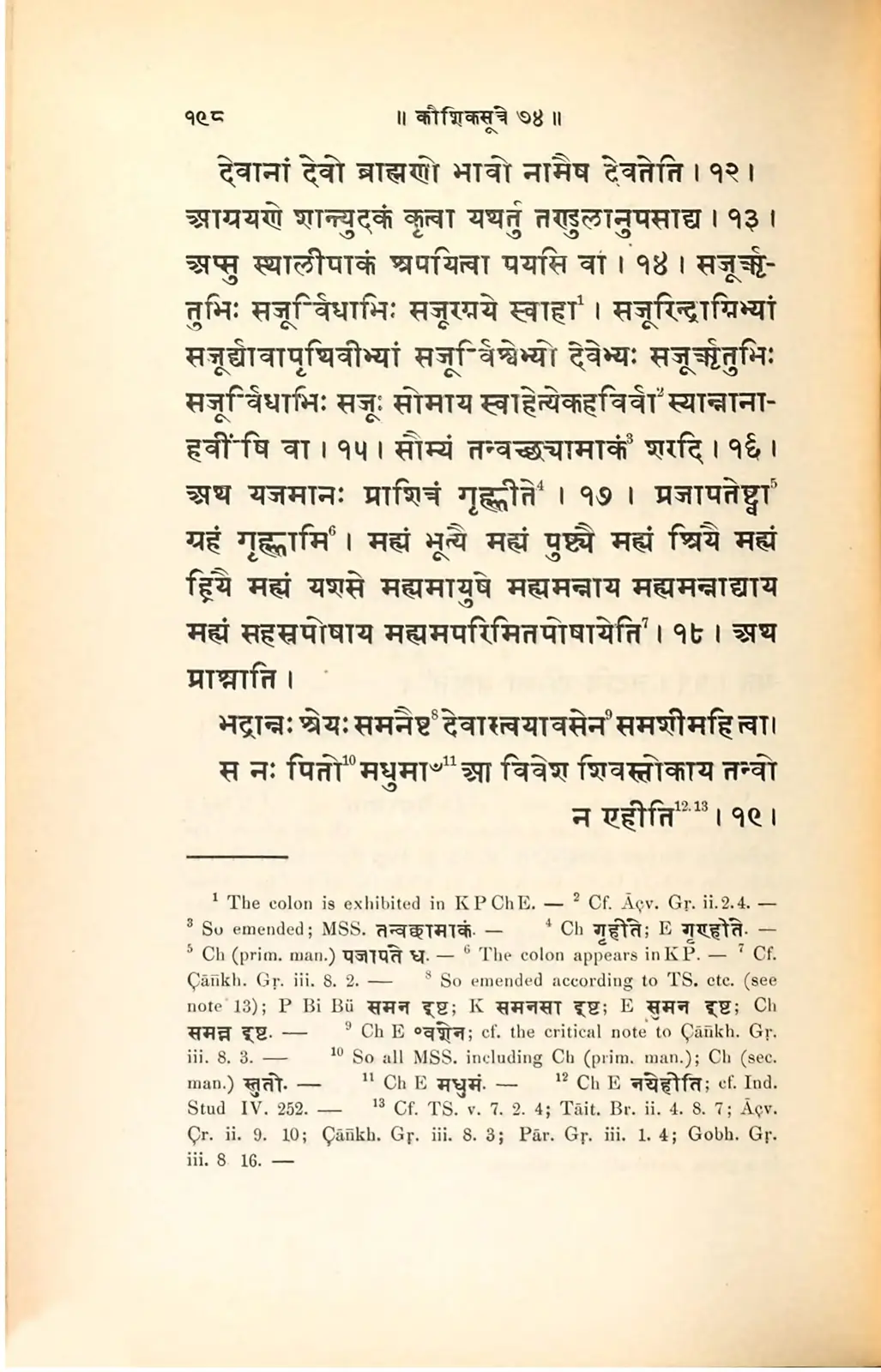
अप्सु स्थालीपाकं श्रपयित्वा पयसि वा
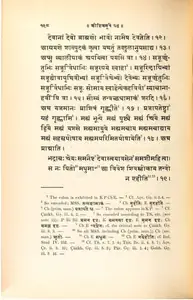 The printed page
The Kāuçika-Sūtra of the Atharva-Veda, with extracts from the commentaries of Dārila and Keçava (Journal of the American Oriental Society, vol. XIV) (ed. Maurice Bloomfield), New Haven (American Oriental Society), 1890, p. 198apsu sthālīpākaṃ śrapayitvā payasi vā"having cooked the pot dish in water, or in milk" (our translation)
KausS 74.13-17 (GRETIL numbering 9,6[74])
- Why
- The household may not eat the new grain until it has been offered: "one should not eat of the new (crop) without having offered the first-fruits offering" (Manava).
From the text (1)
नानिष्ट्वाग्रयणेन नवस्याश्नीयात्
The printed page
Das Mānava-Gṛhya-Sūtra nebst Commentar in kurzer Fassung (ed. Friedrich Knauer), St. Petersburg, 1897, p. 41nāniṣṭvāgrayaṇena navasyāśnīyāt"One should not eat of the new (crop) without having offered the first-fruits offering." (our translation)
MGS II.3.9-14 (GRETIL)
- How
- The pot of new grain is offered in the domestic fire to the deities of the first-fruits rite (with Agni Svishtakrit as the fourth; Manava: to Heaven and Earth and to Soma). The householder then eats of it; for shyamaka the verse is "May Agni eat first ...". Gobhila gives the remnants to all present who have been initiated. Manava: the fee is a first-born calf.
From the text (6)
He prepares a Sthalipaka of the fresh fruitsApGS VII.19.6-7 · printed p. 289
तस्य जुहोति सजूर्द्यावापृथिवीभ्यां स्वाहा सजूः सोमाय स्वाहेति
The printed page
Das Mānava-Gṛhya-Sūtra nebst Commentar in kurzer Fassung (ed. Friedrich Knauer), St. Petersburg, 1897, p. 41tasya juhoti sajūrdyāvāpṛthivībhyāṃ svāhā sajūḥ somāya svāheti"He offers of it (saying): 'together with Heaven and Earth, svaha; together with Soma, svaha'." (our translation)
MGS II.3.9-14 (GRETIL)
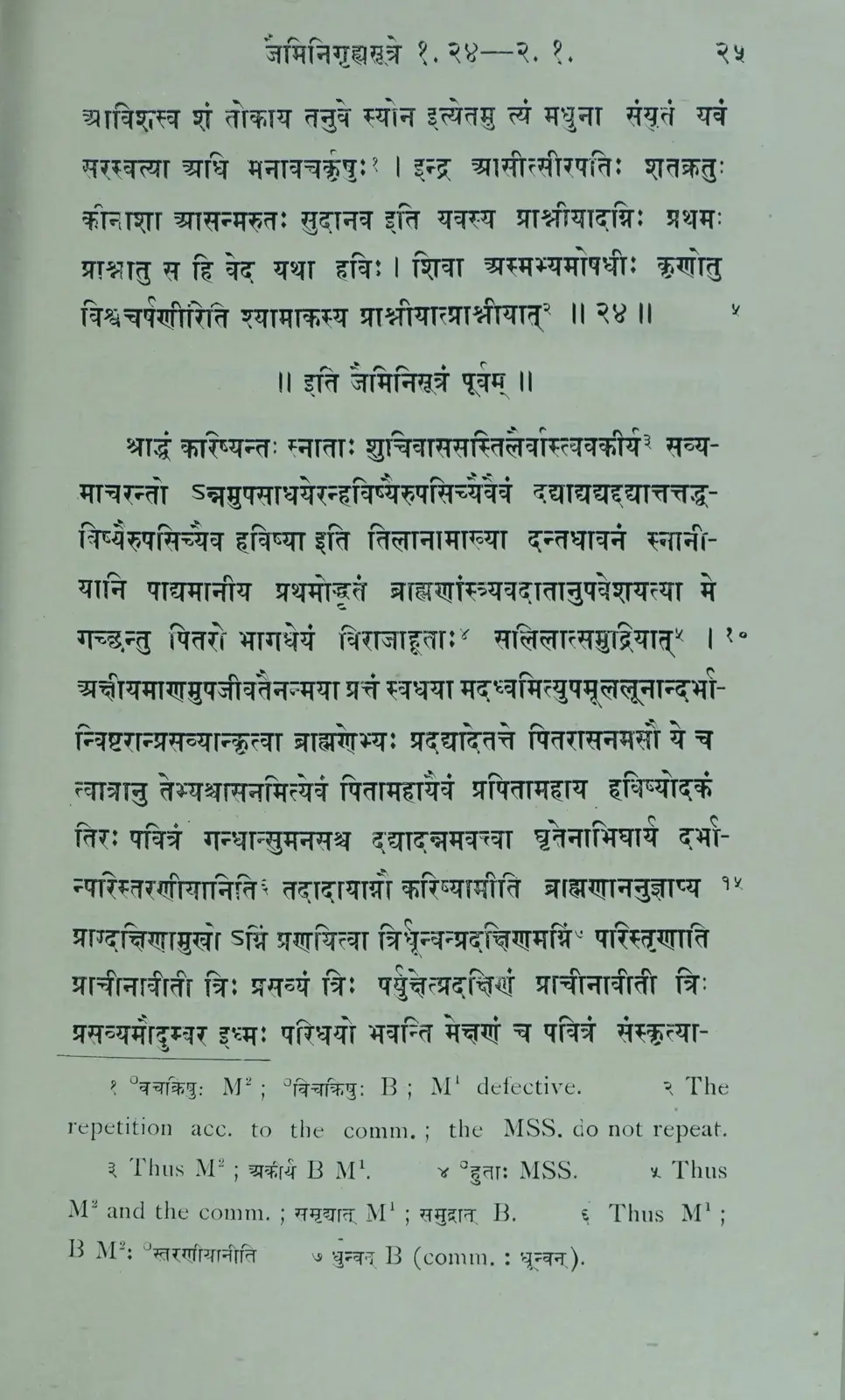
Of the millet he should partake with the verseJGS I.24 · printed pp. 43-44
अग्निः प्रथमः प्राश्नातु स हि वेद यथा हविः
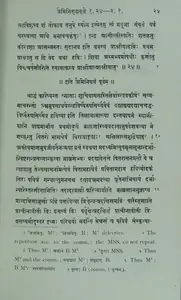 The printed page
The Jaiminigṛhyasūtra belonging to the Sāmaveda, with extracts from the commentary (Punjab Sanskrit Series No. 2) (ed. W. Caland), Lahore (Punjab Sanskrit Book Depot), 1922, p. 25agniḥ prathamaḥ prāśnātu sa hi veda yathā haviḥ"May Agni eat first, for he knows how the offering is" (our translation)
JGS 1.24 (GRETIL)
he should give to eat to all (persons present) who have received the initiation (Upanayana)GGS III.8.9-24 · printed pp. 93-94
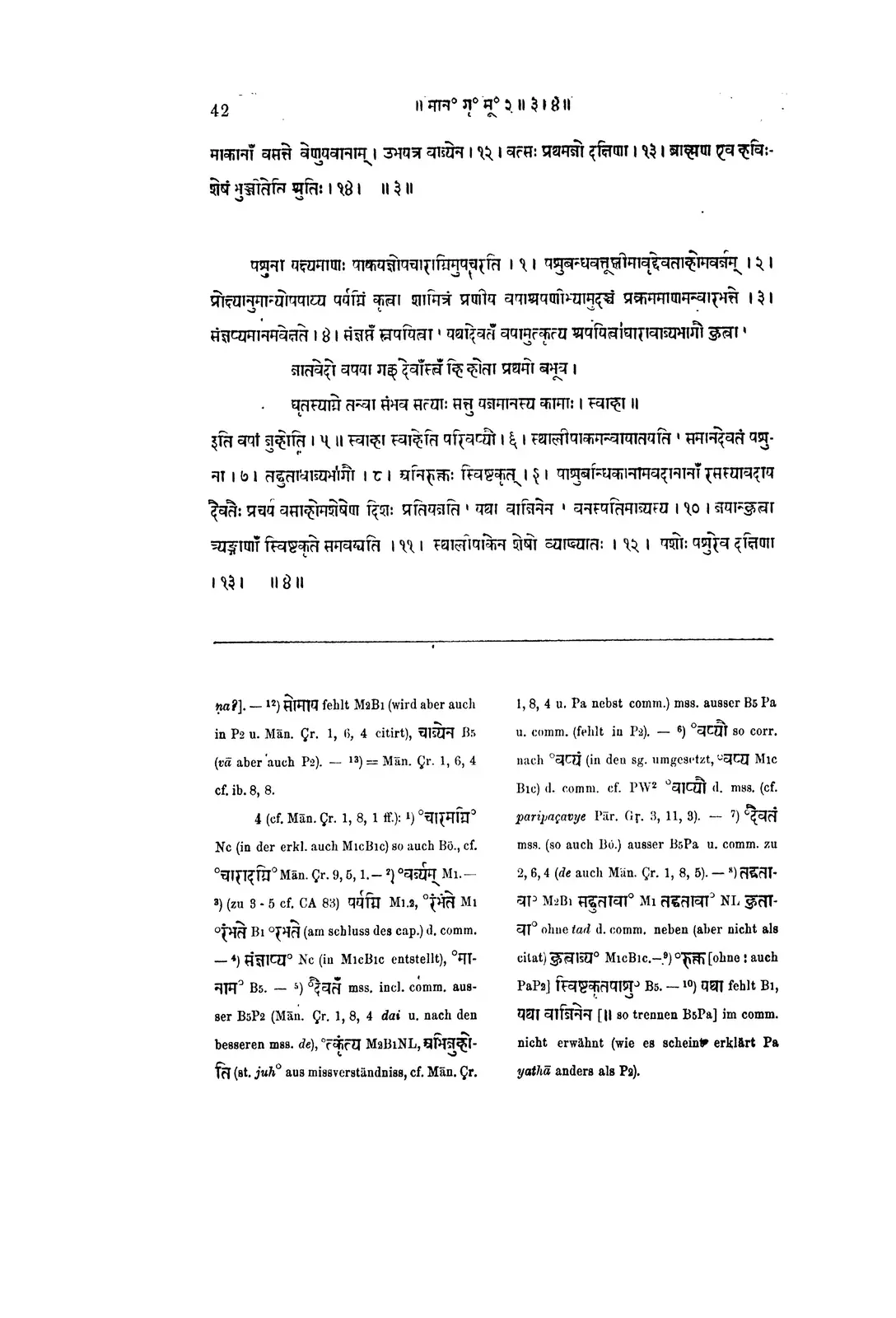
वत्सः प्रथमजो दक्षिणा
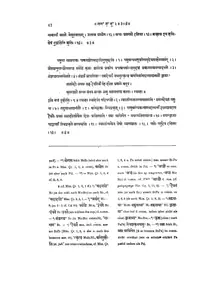 The printed page
Das Mānava-Gṛhya-Sūtra nebst Commentar in kurzer Fassung (ed. Friedrich Knauer), St. Petersburg, 1897, p. 42vatsaḥ prathamajo dakṣiṇā"The fee is a first-born calf." (our translation)
MGS II.3.9-14 (GRETIL)
- When
- Jaiminiya: in the rainy season (rice in autumn, barley in spring). Manava and Kausika: the shyamaka offering in autumn. Manava: on a parvan (new- or full-moon) day.
From the text (5)
of barley, in the rainy season of milletJGS I.24 · printed pp. 43-44
वर्षासु श्यामाकानाम्
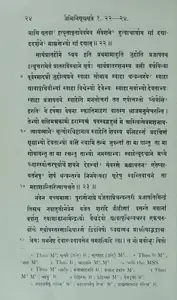 The printed page
The Jaiminigṛhyasūtra belonging to the Sāmaveda, with extracts from the commentary (Punjab Sanskrit Series No. 2) (ed. W. Caland), Lahore (Punjab Sanskrit Book Depot), 1922, p. 24varṣāsu śyāmākānām"in the rains, of shyamaka" (our translation)
JGS 1.24 (GRETIL)
शरदि सोमाय श्यामाकानाँ
The printed page
Das Mānava-Gṛhya-Sūtra nebst Commentar in kurzer Fassung (ed. Friedrich Knauer), St. Petersburg, 1897, p. 41śaradi somāya śyāmākānāṃ"in autumn, to Soma, of shyamaka" (our translation)
MGS II.3.9-14 (GRETIL)
सौम्यं तन्वच्छ्यामाकं शरदि
The printed page
The Kāuçika-Sūtra of the Atharva-Veda, with extracts from the commentaries of Dārila and Keçava (Journal of the American Oriental Society, vol. XIV) (ed. Maurice Bloomfield), New Haven (American Oriental Society), 1890, p. 198saumyaṃ tanvat_śyāmākaṃ śaradi"(for) Soma, shyamaka, in autumn" (tanvat left untranslated) (our translation)
KausS 74.13-17 (GRETIL numbering 9,6[74])
पर्वण्याग्रयणं कुर्वीत
The printed page
Das Mānava-Gṛhya-Sūtra nebst Commentar in kurzer Fassung (ed. Friedrich Knauer), St. Petersburg, 1897, p. 41parvaṇyāgrayaṇaṃ kurvīta"He should perform the first-fruits offering on a parvan (new- or full-moon) day." (our translation)
MGS II.3.9-14 (GRETIL)
- Who performs it
- The householder who keeps only the domestic fire, i.e. one who has not set up the Shrauta fires; he (the sacrificer, yajamāna) takes the first portion to eat.
From the text (3)
partaking of the first-fruits) of one who has not set upApGS VII.19.6-7 · printed p. 289The Sanskrit of this lineअनाहिताग्नेराग्रयणम्
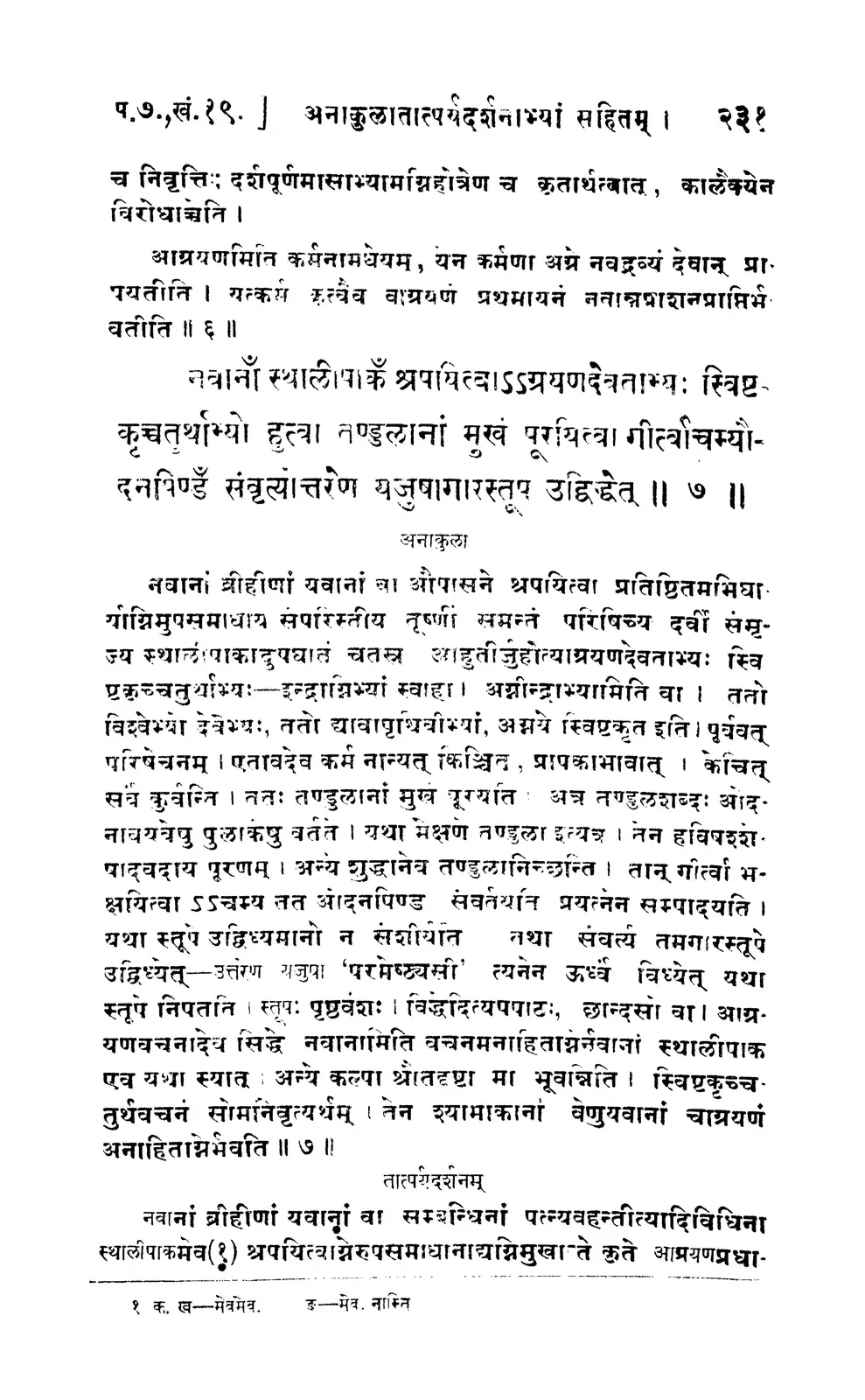
तेन श्यामाकानां वेणुयवानां चाग्रयणं अनाहिताग्नेर्भवति
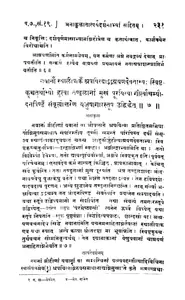 The printed page
Āpastambagṛhyasūtra with two commentaries, the Anākulā of Haradatta Miśra and the Tātparyadarśana of Sudarśanācārya (Kashi Sanskrit Series No. 59, Kar (ed. A. Chinnaswami Sastri), Benares (Jaikrishnadas-Haridas Gupta, Chowkhamba Sanskrit Series Office), 1928, p. 231tena śyāmākānāṃ veṇukānāṃ veṇuyavānāṃ cāgrayaṇaṃ anāhitāgnerbhavati"Thereby the first-fruits offering of shyamaka, of bamboo seed and bamboo grain (also) applies to one who has not set up the (Shrauta) fires." (Haradatta) (our translation)
ApGS 19.6-7 with Haradatta's Anakula and Sudarsana's Tatparyadarsana (GRETIL)
अथ यजमानः प्राशित्रं गृह्णीते
The printed page
The Kāuçika-Sūtra of the Atharva-Veda, with extracts from the commentaries of Dārila and Keçava (Journal of the American Oriental Society, vol. XIV) (ed. Maurice Bloomfield), New Haven (American Oriental Society), 1890, p. 198atha yajamānaḥ prāśitraṃ gṛhṇīte"Then the sacrificer takes the portion to be eaten." (our translation)
KausS 74.13-17 (GRETIL numbering 9,6[74])
- Its meaning
- Sudarsana's commentary explains the name āgrayaṇa: it is the rite by which the new produce first (agre) reaches the gods. The eating verse asks Agni to "make the plants kindly for us".
From the text (2)
येन कर्मणा अग्रे नवद्रव्यं देवान् प्रापयतीति
The printed page
Āpastambagṛhyasūtra with two commentaries, the Anākulā of Haradatta Miśra and the Tātparyadarśana of Sudarśanācārya (Kashi Sanskrit Series No. 59, Kar (ed. A. Chinnaswami Sastri), Benares (Jaikrishnadas-Haridas Gupta, Chowkhamba Sanskrit Series Office), 1928, p. 231yena karmaṇā agre navadravyaṃ devān prāpayatīti"(Āgrayaṇa is the name of the rite) by which one first brings the new produce to the gods." (Sudarsana) (our translation)
ApGS 19.6-7 with Haradatta's Anakula and Sudarsana's Tatparyadarsana (GRETIL)
शिवा अस्मभ्यमोषधीः कृणोतु
The printed page
The Jaiminigṛhyasūtra belonging to the Sāmaveda, with extracts from the commentary (Punjab Sanskrit Series No. 2) (ed. W. Caland), Lahore (Punjab Sanskrit Book Depot), 1922, p. 25śivā asmabhyamoṣadhīḥ kṛṇotu"may he make the plants kindly for us" (our translation)
JGS 1.24 (GRETIL)
Sources: Gobhila Grihya Sutra · GGS III.8.9-24 · tr. Hermann Oldenberg · The Grihya-Sutras, Part II, Sacred Books of the East 30, Oxford 1892 | Jaiminiya Grihya Sutra · JGS I.24 · tr. W. Caland · The Jaiminigrhyasutra, with extracts from the commentary, Lahore: Motilal Banarsidass, 1922 (Punjab Sanskrit Series 2) | Jaiminiya Grihya Sutra (Sanskrit) · JGS 1.24 (GRETIL) · Jaiminiya-Grhyasutra, GRETIL | Manava Grihya Sutra (Sanskrit) · MGS II.3.9-14 (GRETIL) · Manava-Grhyasutra, GRETIL | Apastamba Grihya Sutra · ApGS VII.19.6-7 · tr. Hermann Oldenberg · The Grihya-Sutras, Part II, Sacred Books of the East 30, Oxford 1892 | Apastamba Grihya Sutra with medieval commentaries (Sanskrit) · ApGS 19.6-7 with Haradatta's Anakula and Sudarsana's Tatparyadarsana (GRETIL) · Apastamba-Grhyasutra with the commentaries of Haradatta (Anakula) and Sudarsana (Tatparyadarsana), GRETIL | Kausika Sutra (Sanskrit) · KausS 74.13-17 (GRETIL numbering 9,6[74]) · Kausika-Sutra, GRETIL (input by Arlo Griffiths)
Shrauta rite within the royal consecration (rājasūya), grain offering
Royal consecration: the first-fruits offering with a pot of shyamaka for Soma
rājasūya: āgrayaṇa (saumya śyāmāka caru)
Barnyard millet · śyāmāka
- What is offered
- A pot of shyamaka for Soma, among the opening offerings of the royal consecration. The Taittiriya Brahmana calls this group a first-fruits offering (āgrayaṇa), and the Shatapatha likewise has the king perform the offering of first-fruits here.
From the text (4)
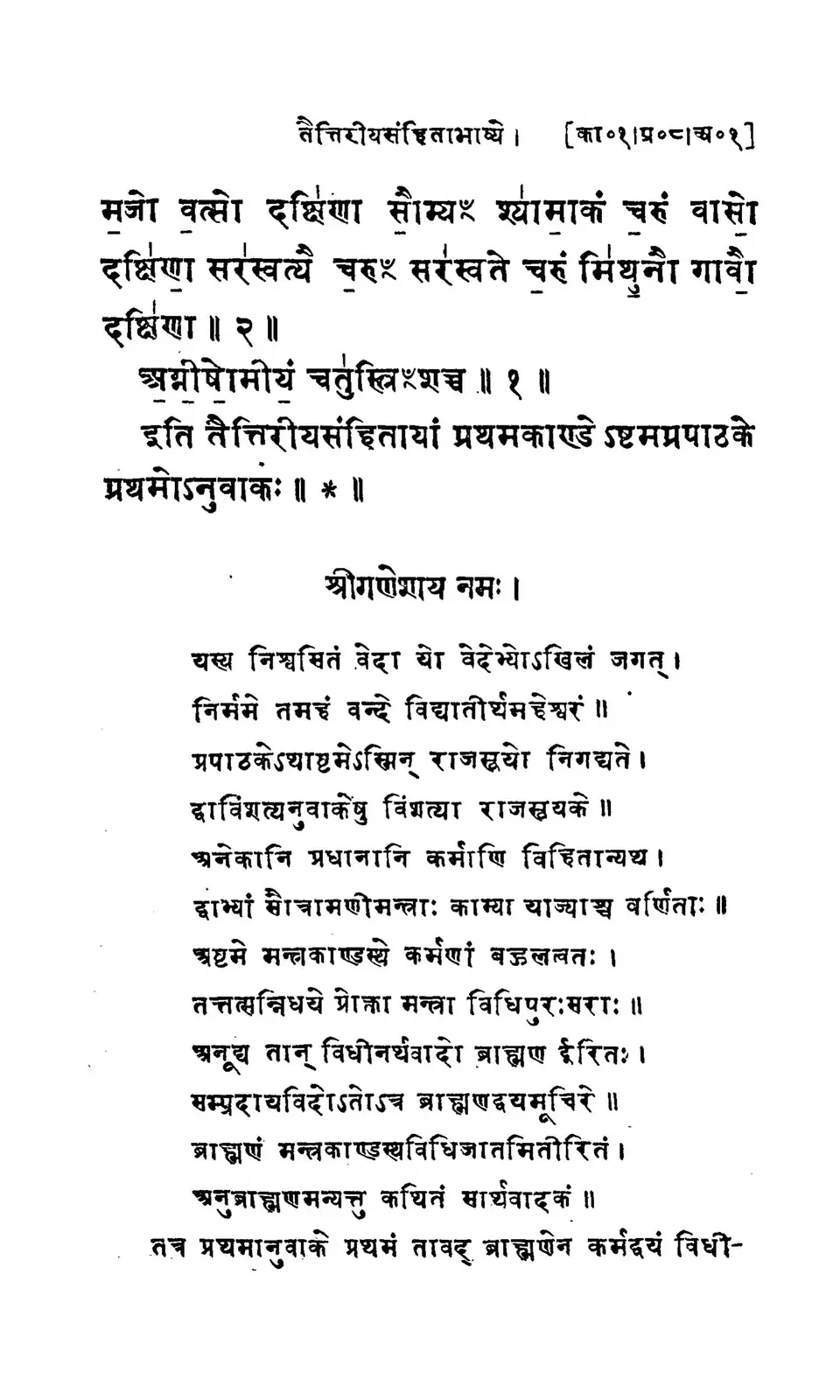
oblation of millet to Soma; the sacrificial fee is a garmentTS I.8.1.2 · printed p. 114 (PDF p. 286)
सौम्यꣳ श्यामाकं चरुं वासो दक्षिणा
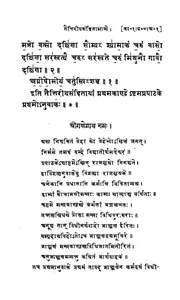 The printed page
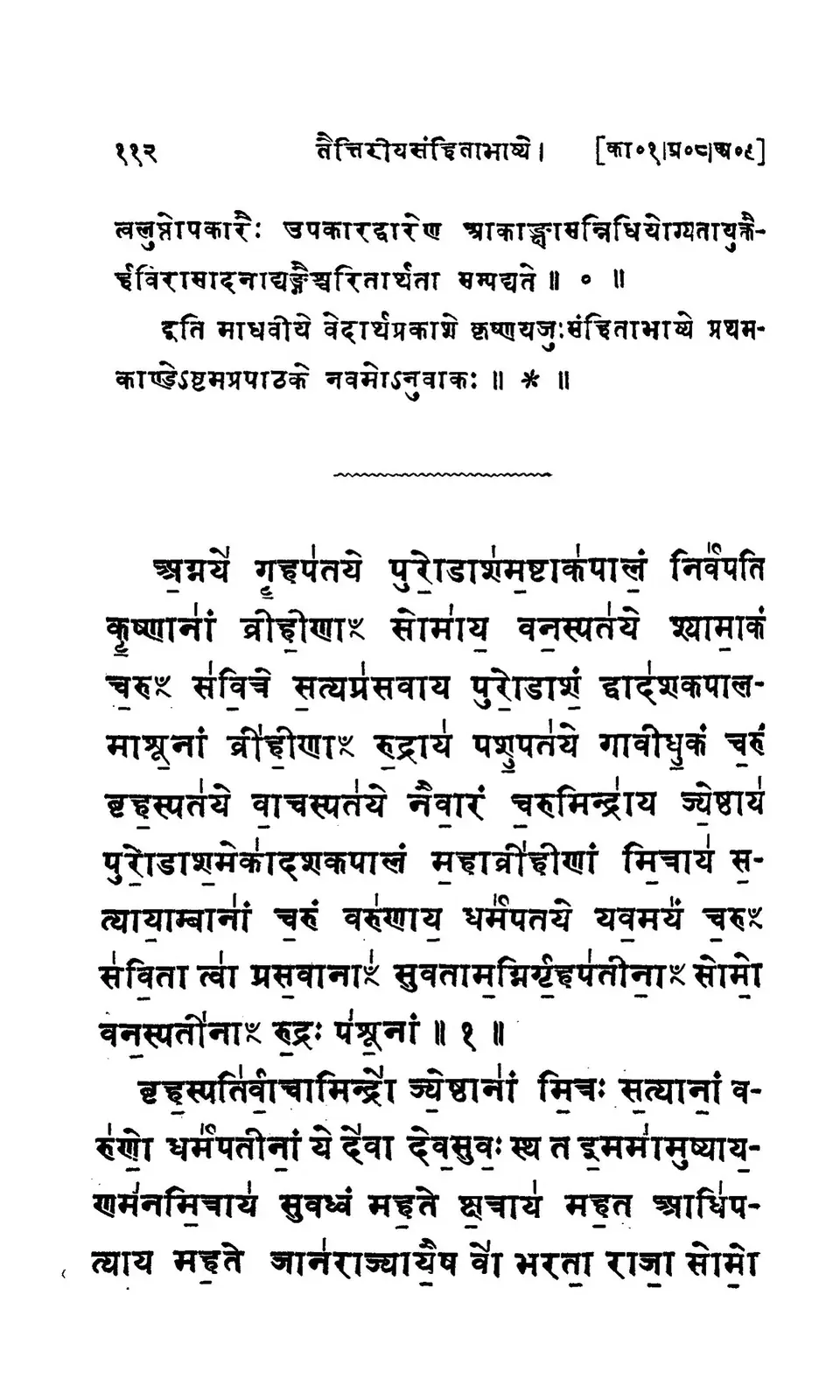
The Sanhitá of the Black Yajur Veda, with the commentary of Mádhava Áchárya, Vol. II: Kánda I, Prapáthaka VIII - Kánda II (Bibliotheca Indica) (ed. E. B. Cowell), Calcutta (C. B. Lewis, Baptist Mission Press), 1866, p. 2saumyáṁ śyāmākáṃ carúṃ vā́so dákṣiṇā"a pot of shyamaka for Soma; the fee is a garment" (our translation)
TS 1.8.1.2 (TITUS)
आग्रयणं भवति
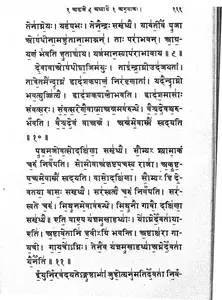 The printed page
The Taittiríya Bráhmana of the Black Yajur Veda, with the commentary of Sáyanáchárya, Vol. I (Bibliotheca Indica) (ed. Rájendralála Mitra), Calcutta, 1859, p. 111āgrayaṇáṃ bʰavati"there is a first-fruits offering" (TB I.6.1.9) (our translation)
TB I.6.1.9-11 (TITUS)
Thereupon he performs the offering of first-fruitsSB V.2.3.9-10 · printed p. 46The Sanskrit of this lineअथाग्रयणेष्ट्या यजते
- Why
- The Taittiriya Brahmana: by this pot the sacrificer makes palatable for himself what ripens on unploughed land. The Shatapatha: the king wishes to be consecrated by this offering too, "for it is for the plants that he who is consecrated, is consecrated".
From the text (3)
अकृष्टपच्यम् एवास्मै स्वदयति
The printed page
The Taittiríya Bráhmana of the Black Yajur Veda, with the commentary of Sáyanáchárya, Vol. I (Bibliotheca Indica) (ed. Rájendralála Mitra), Calcutta, 1859, p. 111akr̥ṣṭapacyám evā́smai svadayati"he makes palatable for him what ripens without ploughing" (our translation)
TB I.6.1.9-11 (TITUS)
May I be consecrated by this (offering) alsoSB V.2.3.9-10 · printed p. 46The Sanskrit of this lineअनयापि सूया इति
it is for the plants that he who is consecrated, is consecratedSB V.2.3.9-10 · printed p. 46The Sanskrit of this lineओषधीर्वा एष सूयमानो ऽभि सूयते
- How
- A pot (caru) of shyamaka is offered to Soma; the priest's fee is a garment, "for a garment by its deity belongs to Soma".
From the text (2)
सौम्यꣳ श्यामाकं चरुं वासो दक्षिणा
The printed page
The Sanhitá of the Black Yajur Veda, with the commentary of Mádhava Áchárya, Vol. II: Kánda I, Prapáthaka VIII - Kánda II (Bibliotheca Indica) (ed. E. B. Cowell), Calcutta (C. B. Lewis, Baptist Mission Press), 1866, p. 2saumyáṁ śyāmākáṃ carúṃ vā́so dákṣiṇā"a pot of shyamaka for Soma; the fee is a garment" (our translation)
TS 1.8.1.2 (TITUS)
सौम्यꣳ हि देवतया वासः समृद्ध्यै
The printed page
The Taittiríya Bráhmana of the Black Yajur Veda, with the commentary of Sáyanáchárya, Vol. I (Bibliotheca Indica) (ed. Rájendralála Mitra), Calcutta, 1859, p. 111saumyám̐ hí devátayā vā́saḥ sámr̥ddʰyai"for a garment by its deity belongs to Soma; (it serves) for success" (our translation)
TB I.6.1.9-11 (TITUS)
- When
- Early in the royal consecration: in the Shatapatha order it comes after the cake for Indra and Agni offered on the following day, and before the seasonal offerings.
From the text (3)
And on the following day he prepares a cake on twelve potsherds for Indra and AgniSB V.2.3.9-10 · printed p. 46The Sanskrit of this lineअथ श्वो भूते । ऐन्द्राग्नं द्वादशकपालम् पुरोडाशं निर्वपति
Thereupon he performs the offering of first-fruitsSB V.2.3.9-10 · printed p. 46The Sanskrit of this lineअथाग्रयणेष्ट्या यजते
Thereupon he performs the Seasonal offeringsSB V.2.3.9-10 · printed p. 46The Sanskrit of this lineअथ चातुर्मास्यैर्यजते
- Who performs it
- The sacrificer is "he who is consecrated", the king.
From the text (2)
it is for the plants that he who is consecrated, is consecratedSB V.2.3.9-10 · printed p. 46The Sanskrit of this lineओषधीर्वा एष सूयमानो ऽभि सूयते
as much as he (the king) rules overSB V.3.3.3 (a later day of the same royal consecration) · printed p. 69The Sanskrit of this lineयावतोयावत ईष्टे
- Its meaning
- The Taittiriya Brahmana names Soma "king of what ripens without ploughing", which is why the shyamaka pot goes to Soma.
From the text (1)
सोमो वा अकृष्टपचस्य राजा
The printed page
The Taittiríya Bráhmana of the Black Yajur Veda, with the commentary of Sáyanáchárya, Vol. I (Bibliotheca Indica) (ed. Rájendralála Mitra), Calcutta, 1859, p. 111sómo vā́ akr̥ṣṭapacyásya {AS akr̥ṣṭapacásya } rā́jā"Soma is king of what ripens without ploughing" ({AS ...} is a variant reading in the e-text) (our translation)
TB I.6.1.9-11 (TITUS)
Sources: Taittiriya Samhita · TS I.8.1.2 · tr. Arthur Berriedale Keith · The Veda of the Black Yajus School entitled Taittiriya Sanhita, Part 1 (Kandas I-III), Harvard Oriental Series 18, 1914 | Taittiriya Samhita (Sanskrit) · TS 1.8.1.2 (TITUS) · Taittiriya-Samhita, TITUS e-text (ed. A. Weber 1871-72; TITUS version J. Gippert) | Taittiriya Brahmana (Sanskrit) · TB I.6.1.9-11 (TITUS) · Taittiriya-Brahmana, TITUS e-text | Shatapatha Brahmana · SB V.2.3.9-10 · tr. Julius Eggeling · The Satapatha-Brahmana, Part III, Sacred Books of the East 41, Oxford 1894 | Maitrayani Samhita (Sanskrit) · MS II.6.2 (GRETIL) · Maitrayani Samhita, GRETIL plain text (ed. L. von Schroeder) | Kathaka Samhita (Sanskrit) · KS XV.1 (TITUS) · Kathaka-Samhita, TITUS e-text (ed. L. von Schroeder) | Shatapatha Brahmana · SB V.3.3.3 (a later day of the same royal consecration) · tr. Julius Eggeling · The Satapatha-Brahmana, Part III, Sacred Books of the East 41, Oxford 1894
Shrauta rite within the royal consecration (rājasūya), grain offering
Royal consecration: offerings to the "Divine Quickeners", with a pot of shyamaka for Soma, lord of the forest
rājasūya: devasū-havīṃṣi (somāya vanaspataye śyāmākaś caruḥ)
Barnyard millet · śyāmāka
- What is offered
- A pot of shyamaka for Soma as "lord of the forest" (Soma Vanaspati), one of eight grain offerings to the "Divine Quickeners"; each deity receives a different grain.
From the text (3)
to Soma, lord of the forest, an oblation of milletTS I.8.10.1-2 · printed p. 121 (PDF p. 293)
सोमाय वनस्पतये श्यामाकं चरुꣳ
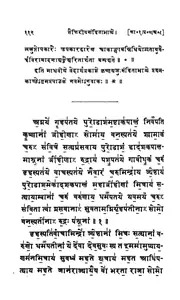 The printed page
The Sanhitá of the Black Yajur Veda, with the commentary of Mádhava Áchárya, Vol. II: Kánda I, Prapáthaka VIII - Kánda II (Bibliotheca Indica) (ed. E. B. Cowell), Calcutta (C. B. Lewis, Baptist Mission Press), 1866, p. 112sómāya vánaspátaye śyāmākáṃ carúṁ"for Soma, lord of the forest, a pot of shyamaka" (our translation)
TS 1.8.10.1 (TITUS)
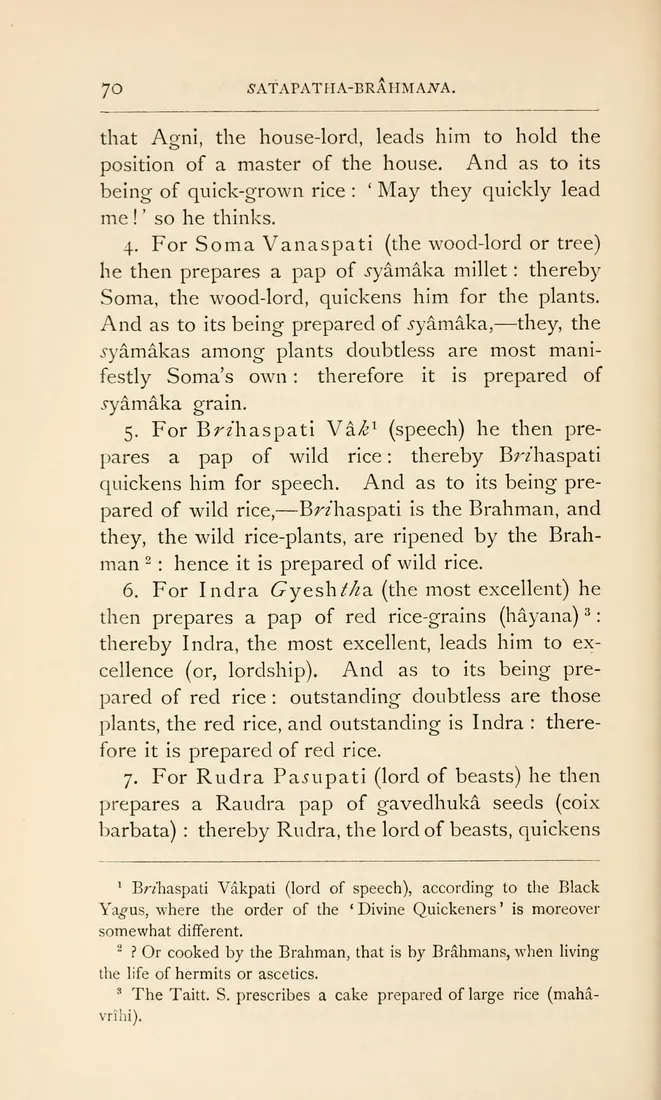
he then prepares a pap of syâmâka milletSB V.3.3.4 · printed p. 70 (PDF p. 102)
- Why
- The Shatapatha: "thereby Soma, the wood-lord, quickens him for the plants". In the formula spoken afterwards the king is quickened by "Soma for trees".
From the text (2)
thereby Soma, the wood-lord, quickens him for the plantsSB V.3.3.4 · printed p. 70 (PDF p. 102)
Agni for householders, Soma for treesSB V.3.3.11 · printed p. 71The Sanskrit of this lineअग्निर्गृहपतीनां सोमो वनस्पतीनाम्
- How
- The shyamaka is cooked as a pot (pap) and offered in the series of eight. Afterwards the priest takes the sacrificer by the right arm and speaks the formula "May Savitr quicken thee ... Soma for trees ...".
From the text (3)
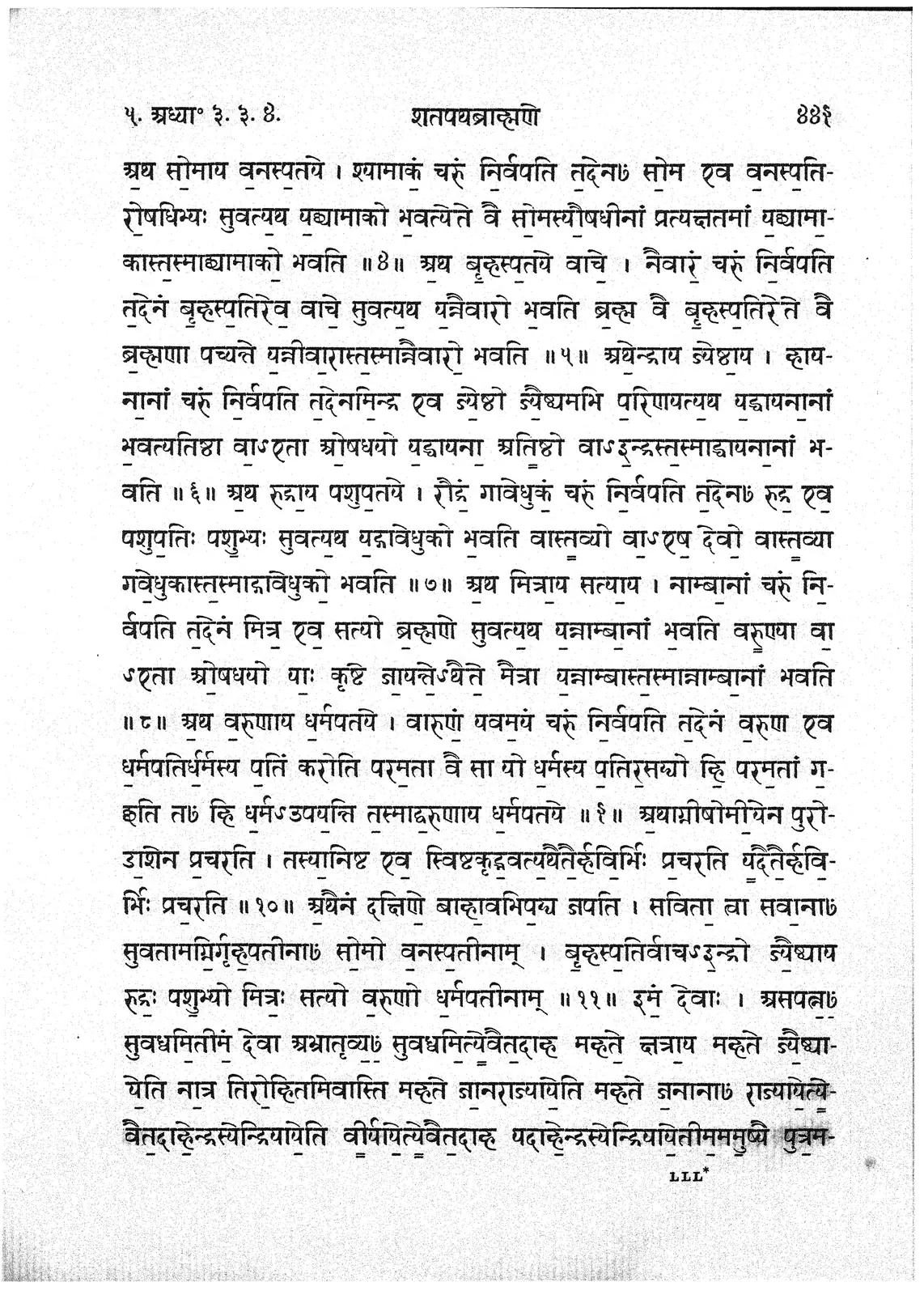
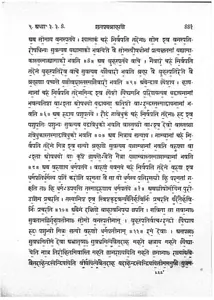
अथ सोमाय वनस्पतये । श्यामाकं चरुं निर्वपति
 The printed page
The Çatapatha-Brâhmaṇa in the Mâdhyandina-Çâkhâ with extracts from the commentaries of Sâyaṇa, Harisvâmin and Dvivedagaṅga [series label White Yajurve (ed. Albrecht Weber), Berlin: Ferd. Dümmler's Verlagsbuchhandlung; London: Williams and Norgate, 1855, p. 449atha somāya vanaspataye | śyāmākaṃ carum nirvapati"Then for Soma, lord of the forest, he offers a pot of shyamaka." (our translation)
SB 5.3.3.4 (GRETIL)
taking hold of him (the Sacrificer) by the right arm, he muttersSB V.3.3.11 · printed p. 71The Sanskrit of this lineअथैनं दक्षिणे बाहावभिपद्य जपति
takes the sacrificer by the handTS I.8.10.1-2 · printed p. 121 (PDF p. 293) · translator’s note
- When
- On the day of preparation of the consecration (abhiṣecanīya) ceremony. Eggeling notes that this ceremony takes five days and that its initiation falls about the middle of March.
From the text (3)
On the day of preparationSB V.3.3.1-3 and Eggeling's note on the consecration ceremony · printed pp. 68-70The Sanskrit of this lineस उपवसथे
requires for its performance five daysSB V.3.3.1-3 and Eggeling's note on the consecration ceremony · printed pp. 68-70 · translator’s note
(about the middle of March)SB V.3.3.1-3 and Eggeling's note on the consecration ceremony · printed pp. 68-70 · translator’s note
- Who performs it
- The king being consecrated is the sacrificer; a priest speaks the formula over him.
From the text (2)
as much as he (the king) rules overSB V.3.3.1-3 and Eggeling's note on the consecration ceremony · printed pp. 68-70The Sanskrit of this lineयावतोयावत ईष्टे
taking hold of him (the Sacrificer) by the right arm, he muttersSB V.3.3.11 · printed p. 71The Sanskrit of this lineअथैनं दक्षिणे बाहावभिपद्य जपति
- Its meaning
- The Shatapatha explains why shyamaka is used: the shyamaka plants are "most manifestly Soma's own".
From the text (1)
the syâmâkas among plants doubtless are most manifestly Soma's ownSB V.3.3.4 · printed p. 70 (PDF p. 102)
Sources: Taittiriya Samhita · TS I.8.10.1-2 · tr. Arthur Berriedale Keith · The Veda of the Black Yajus School entitled Taittiriya Sanhita, Part 1 (Kandas I-III), Harvard Oriental Series 18, 1914 | Taittiriya Samhita (Sanskrit) · TS 1.8.10.1 (TITUS) · Taittiriya-Samhita, TITUS e-text (ed. A. Weber 1871-72; TITUS version J. Gippert) | Shatapatha Brahmana · SB V.3.3.4 · tr. Julius Eggeling · The Satapatha-Brahmana, Part III, Sacred Books of the East 41, Oxford 1894 | Shatapatha Brahmana · SB V.3.3.1-3 and Eggeling's note on the consecration ceremony · tr. Julius Eggeling · The Satapatha-Brahmana, Part III, Sacred Books of the East 41, Oxford 1894 | Shatapatha Brahmana · SB V.3.3.11 · tr. Julius Eggeling · The Satapatha-Brahmana, Part III, Sacred Books of the East 41, Oxford 1894 | Shatapatha Brahmana (Sanskrit) · SB 5.3.3.4 (GRETIL) · Satapatha-Brahmana (Madhyandina) book 5, GRETIL | Maitrayani Samhita (Sanskrit) · MS II.6.6 (GRETIL) · Maitrayani Samhita, GRETIL plain text (ed. L. von Schroeder) | Kathaka Samhita (Sanskrit) · KS XV.5 (TITUS) · Kathaka-Samhita, TITUS e-text (ed. L. von Schroeder)
Shrauta wish offering (kāmyeṣṭi)
Wish offering for harmony with one's equals: a pot of shyamaka for Soma with the Rudras
saṃjñāneṣṭi (somāya rudravate śyāmākaś caruḥ)
Barnyard millet · śyāmāka
- What is offered
- In a set of four offerings for harmony, Soma with the Rudras receives a pot of shyamaka (Maitrayani Samhita); Indra with the Maruts receives a cake of wild rice, Varuna with the Adityas a pot of barley.
From the text (1)
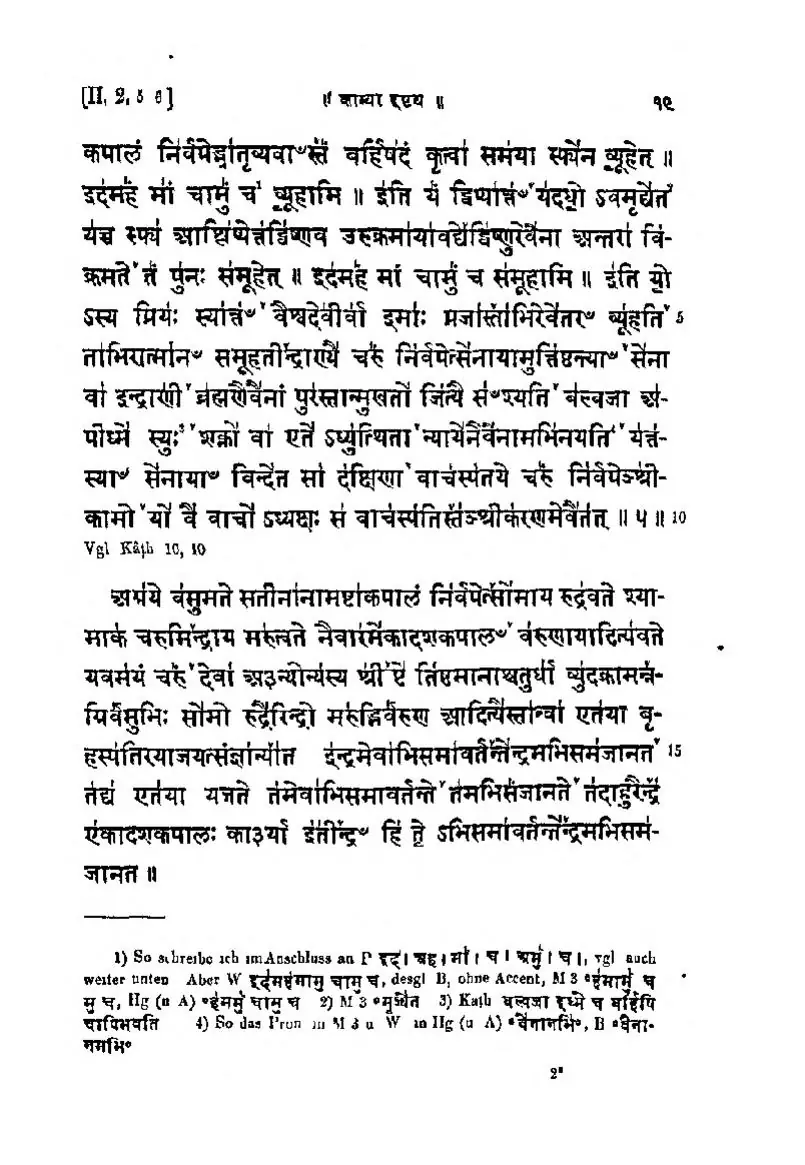
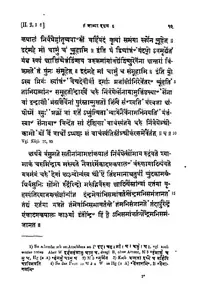
सोमाय रुद्रवते श्यामाकं चरुम् इन्द्राय मरुत्वते नैवारम् एकादशकपालं वरुणायादित्यवते यवमयं चरुं
 The printed page
Māitrāyaṇī Saṃhitā, herausgegeben von Dr. Leopold von Schroeder. Zweites Buch (gedruckt auf Kosten der Deutschen Morgenländischen Gesellschaft) (ed. Leopold von Schroeder), Leipzig (in Commission bei F. A. Brockhaus), 1883, p. 19somāya rudravate śyāmākaṃ carum indrāya marutvate naivāram ekādaśakapālaṃ varuṇāyādityavate yavamayaṃ caruṃ"for Soma with the Rudras a pot of shyamaka, for Indra with the Maruts a cake of wild rice on eleven potsherds, for Varuna with the Adityas a pot of barley" (our translation)
MS II.2.6 (GRETIL)
- Why
- Whoever sacrifices with this offering, (his fellows) turn to him and agree on him (Maitrayani). The Taittiriya parallel, which does not name the grain, says he becomes the best of his fellows.
From the text (2)
तद् य एतया यजते तम् एवाभिसमावर्तन्ते तम् अभिसंजानते
The printed page
Māitrāyaṇī Saṃhitā, herausgegeben von Dr. Leopold von Schroeder. Zweites Buch (gedruckt auf Kosten der Deutschen Morgenländischen Gesellschaft) (ed. Leopold von Schroeder), Leipzig (in Commission bei F. A. Brockhaus), 1883, p. 19tad ya etayā yajate tam evābhisamāvartante tam abhisaṃjānate"So whoever sacrifices with this, to him they turn, on him they agree." (our translation)
MS II.2.6 (GRETIL)
he becomes the best of his fellowsTS II.2.11.5-6 (parallel; the grain is not named) · printed pp. 159-160
- How
- Four offerings together: a cake on eight potsherds for Agni with the Vasus, the pot of shyamaka for Soma with the Rudras, a cake of wild rice on eleven potsherds for Indra with the Maruts, and a pot of barley for Varuna with the Adityas.
From the text (2)
अग्नये वसुमते सतीनानाम् अष्टाकपालं निर्वपेत्
The printed page
Māitrāyaṇī Saṃhitā, herausgegeben von Dr. Leopold von Schroeder. Zweites Buch (gedruckt auf Kosten der Deutschen Morgenländischen Gesellschaft) (ed. Leopold von Schroeder), Leipzig (in Commission bei F. A. Brockhaus), 1883, p. 19agnaye vasumate satīnānām aṣṭākapālaṃ nirvapet"For Agni with the Vasus he should offer a cake of satīna grain on eight potsherds." (our translation)
MS II.2.6 (GRETIL)
सोमाय रुद्रवते श्यामाकं चरुम् इन्द्राय मरुत्वते नैवारम् एकादशकपालं वरुणायादित्यवते यवमयं चरुं
The printed page
Māitrāyaṇī Saṃhitā, herausgegeben von Dr. Leopold von Schroeder. Zweites Buch (gedruckt auf Kosten der Deutschen Morgenländischen Gesellschaft) (ed. Leopold von Schroeder), Leipzig (in Commission bei F. A. Brockhaus), 1883, p. 19somāya rudravate śyāmākaṃ carum indrāya marutvate naivāram ekādaśakapālaṃ varuṇāyādityavate yavamayaṃ caruṃ"for Soma with the Rudras a pot of shyamaka, for Indra with the Maruts a cake of wild rice on eleven potsherds, for Varuna with the Adityas a pot of barley" (our translation)
MS II.2.6 (GRETIL)
- When
- The text names no season or date
- Who performs it
- One who is at variance with his fellows; a priest has him offer it (Taittiriya parallel).
From the text (1)
at variance with his fellows he should cause to offer with the verse for harmonyTS II.2.11.5-6 (parallel; the grain is not named) · printed pp. 159-160
- Its meaning
- The story behind it: the gods, unwilling to accept one another's lead, split into four groups; Brihaspati had them sacrifice with this offering, and they came together.
From the text (2)
देवा अन्योन्यस्य श्रैष्ठ्ये तिष्ठमानाश् चतुर्धा व्युदक्रामन्न्
The printed page
Māitrāyaṇī Saṃhitā, herausgegeben von Dr. Leopold von Schroeder. Zweites Buch (gedruckt auf Kosten der Deutschen Morgenländischen Gesellschaft) (ed. Leopold von Schroeder), Leipzig (in Commission bei F. A. Brockhaus), 1883, p. 19devā anyonyasya śraiṣṭhye tiṣṭhamānāś caturdhā vyudakrāmann"The gods, standing on their own pre-eminence over one another, went apart in four groups." (our translation)
MS II.2.6 (GRETIL)
तान् वा एतया बृहस्पतिर् अयाजयत्
The printed page
Māitrāyaṇī Saṃhitā, herausgegeben von Dr. Leopold von Schroeder. Zweites Buch (gedruckt auf Kosten der Deutschen Morgenländischen Gesellschaft) (ed. Leopold von Schroeder), Leipzig (in Commission bei F. A. Brockhaus), 1883, p. 19tān vā etayā bṛhaspatir ayājayat"Brihaspati made them sacrifice with this (offering)." (our translation)
MS II.2.6 (GRETIL)
Sources: Maitrayani Samhita (Sanskrit) · MS II.2.6 (GRETIL) · Maitrayani Samhita, GRETIL plain text (ed. L. von Schroeder) | Taittiriya Samhita · TS II.2.11.5-6 (parallel; the grain is not named) · tr. Arthur Berriedale Keith · The Veda of the Black Yajus School entitled Taittiriya Sanhita, Part 1 (Kandas I-III), Harvard Oriental Series 18, 1914
Shrauta offering to a lunar mansion (nakṣatreṣṭi)
Offering to the lunar mansion Mrigashirsha: shyamaka cooked in milk for Soma
nakṣatreṣṭi: somāya mṛgaśīrṣāya śyāmākaś caruḥ payasi
Barnyard millet · śyāmāka
- What is offered
- A pot of shyamaka cooked in milk, offered to Soma and to the lunar mansion Mrigashirsha.
From the text (1)
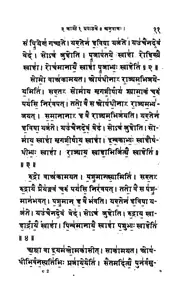
स एतꣳ सोमाय मृगशीर्षाय श्यामाकं चरुं पयसि निरवपत्
 The printed page
The Taittiríya Bráhmana of the Black Yajur Veda, with the commentary of Sáyanáchárya, Vol. III (Bibliotheca Indica) (ed. Rájendralála Mitra), Calcutta (Baptist Mission Press), 1863, p. 11sá etám̐ sómāya mr̥gaśīrṣā́ya śyāmākáṃ carúṃ páyasi níravapat"He offered this pot of shyamaka in milk to Soma, to Mrigashirsha." (our translation)
TB III.1.4.3 (TITUS)
- Why
- Whoever sacrifices with this oblation wins kingship over his equals.
From the text (2)
समानानाꣳ ह वै राज्यम् अभिजयति
The printed page
The Taittiríya Bráhmana of the Black Yajur Veda, with the commentary of Sáyanáchárya, Vol. III (Bibliotheca Indica) (ed. Rájendralála Mitra), Calcutta (Baptist Mission Press), 1863, p. 11samānā́nām̐ ha vái rājyám abʰíjayati"He wins kingship over his equals ..." (our translation)
TB III.1.4.3 (TITUS)
य एतेन हविषा यजते
The printed page
The Taittiríya Bráhmana of the Black Yajur Veda, with the commentary of Sáyanáchárya, Vol. III (Bibliotheca Indica) (ed. Rájendralála Mitra), Calcutta (Baptist Mission Press), 1863, p. 11yá eténa havíṣā yájate"... who sacrifices with this oblation." (our translation)
TB III.1.4.3 (TITUS)
- How
- The shyamaka is cooked in milk and offered with the calls "to Soma svaha, to Mrigashirsha svaha, to the Invakas svaha, to the plants svaha, to kingship svaha, to victory svaha".
From the text (3)
सोमाय स्वाहा मृगशीर्षाय स्वाहा
The printed page
The Taittiríya Bráhmana of the Black Yajur Veda, with the commentary of Sáyanáchárya, Vol. III (Bibliotheca Indica) (ed. Rájendralála Mitra), Calcutta (Baptist Mission Press), 1863, p. 11sómāya svā́hā mr̥gaśīrṣā́ya svā́hā"to Soma svaha, to Mrigashirsha svaha" (our translation)
TB III.1.4.3 (TITUS)
इन्वकाभ्यः स्वाहौषधीभ्यः स्वाहा
The printed page
The Taittiríya Bráhmana of the Black Yajur Veda, with the commentary of Sáyanáchárya, Vol. III (Bibliotheca Indica) (ed. Rájendralála Mitra), Calcutta (Baptist Mission Press), 1863, p. 11invakā́bʰyaḥ svā́hā _óṣadʰībʰyaḥ svā́hā"to the Invakas svaha, to the plants svaha" (our translation)
TB III.1.4.3 (TITUS)
राज्याय स्वाहाभिजित्यै स्वाहेति
The printed page
The Taittiríya Bráhmana of the Black Yajur Veda, with the commentary of Sáyanáchárya, Vol. III (Bibliotheca Indica) (ed. Rájendralála Mitra), Calcutta (Baptist Mission Press), 1863, p. 11rājyā́ya svā́hā _abʰíjityai svā́hā _íti"to kingship svaha, to victory svaha" (our translation)
TB III.1.4.3 (TITUS)
- When
- The text names the lunar mansion that receives the offering but gives no date for performing it
- Who performs it
- Whoever sacrifices with this oblation, and whoever knows it thus.
From the text (2)
य एतेन हविषा यजते
The printed page
The Taittiríya Bráhmana of the Black Yajur Veda, with the commentary of Sáyanáchárya, Vol. III (Bibliotheca Indica) (ed. Rájendralála Mitra), Calcutta (Baptist Mission Press), 1863, p. 11yá eténa havíṣā yájate"he who sacrifices with this oblation" (our translation)
TB III.1.4.3 (TITUS)
य उ चैनद् एवं वेद
The printed page
The Taittiríya Bráhmana of the Black Yajur Veda, with the commentary of Sáyanáchárya, Vol. III (Bibliotheca Indica) (ed. Rájendralála Mitra), Calcutta (Baptist Mission Press), 1863, p. 11yá u ca _enad eváṃ véda"and he who knows it thus" (our translation)
TB III.1.4.3 (TITUS)
- Its meaning
- Origin story: Soma wished to win kingship over the plants, offered this pot, and won it.
From the text (2)
ओषधीनाꣳ राज्यम् अभिजयेयम् इति
The printed page
The Taittiríya Bráhmana of the Black Yajur Veda, with the commentary of Sáyanáchárya, Vol. III (Bibliotheca Indica) (ed. Rájendralála Mitra), Calcutta (Baptist Mission Press), 1863, p. 11óṣadʰīnām̐ rājyám abʰíjayeyam íti"(Soma desired:) 'May I win kingship over the plants.'" (our translation)
TB III.1.4.3 (TITUS)
ततो वै स ओषधीनाꣳ राज्यम् अभ्यजयत्
The printed page
The Taittiríya Bráhmana of the Black Yajur Veda, with the commentary of Sáyanáchárya, Vol. III (Bibliotheca Indica) (ed. Rájendralála Mitra), Calcutta (Baptist Mission Press), 1863, p. 11táto vái sá óṣadʰīnām̐ rājyám abʰyàjayat"Then he won kingship over the plants." (our translation)
TB III.1.4.3 (TITUS)
Sources: Taittiriya Brahmana (Sanskrit) · TB III.1.4.3 (TITUS) · Taittiriya-Brahmana, TITUS e-text
Shrauta rite (fire-altar building, agnicayana): ghee offering with a litany
The "stream of wealth" at the completion of the fire altar: millets named in the litany
vasor dhārā (agnicayana)
Foxtail millet · priyaṅguBarnyard millet · śyāmāka
- What is offered
- The millets are named, not offered: while a long unbroken stream of ghee is poured into the fire, the litany asks that the sacrificer's grains, among them priyangu (foxtail millet), shyamaka (barnyard millet) and a grain called anu (identification uncertain), "prosper through the sacrifice".
From the text (3)
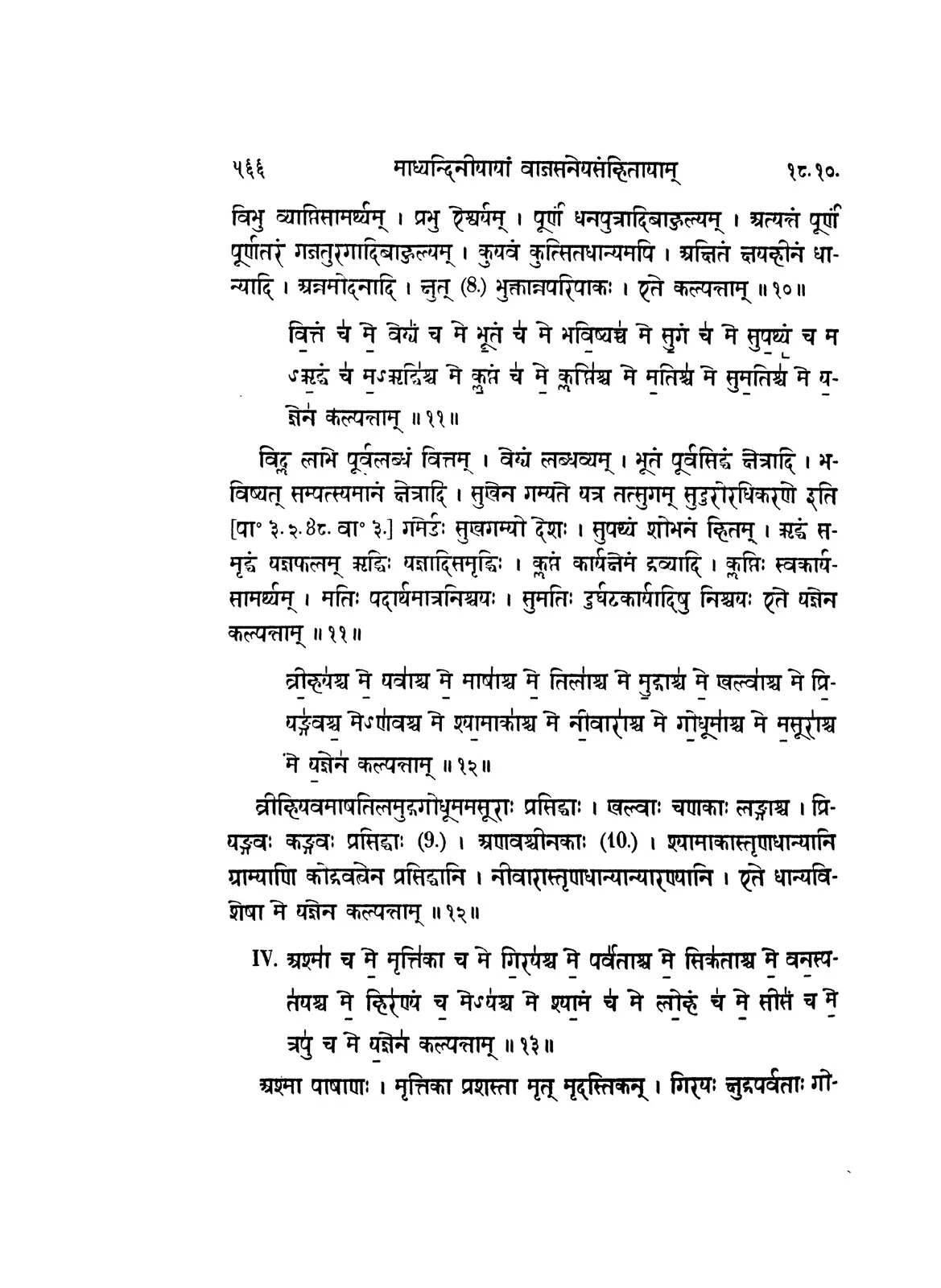
प्रियङ्गवश्च मेऽणवश्च मे श्यामाकाश्च मे
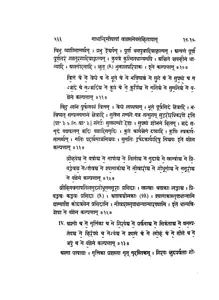 The printed page
The Vâjasaneyi-Sanhitâ in the Mâdhyandina- and the Kâṇva-Çâkhâ with the commentary of Mahîdhara (ed. Albrecht Weber), Berlin: Ferd. Dümmler's Verlagsbuchhandlung; London: Williams and Norgate, 1852, p. 566priyáṅgavaś ca mé ṇavaś ca me śyāmā́kāś ca me"and my priyangu, and my anu, and my shyamaka" (our translation)
VS 18.12 (TITUS)
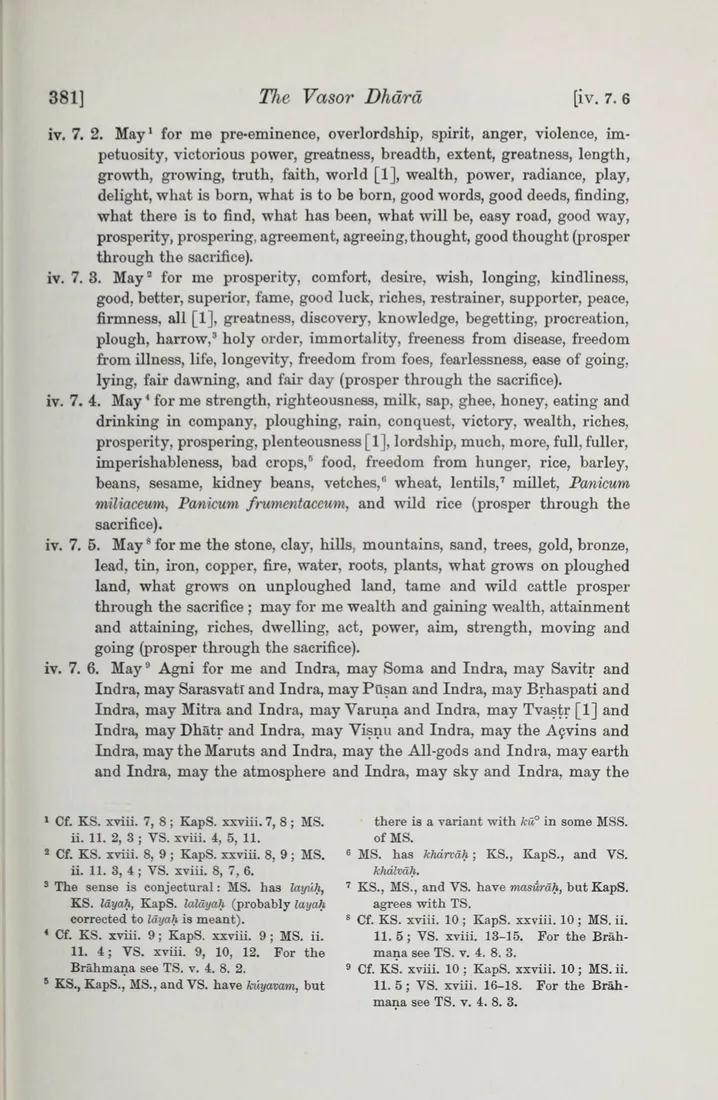
millet, Panicum miliaceum, Panicum frumentaceum, and wild rice (prosper through the sacrifice)TS IV.7.4.2 · printed p. 381 (PDF p. 104)
and my millet and my Panicum MilliaceumVS XVIII.12 · Book XVIII, verse 12 (page number not legible in the scan text)
- Why
- The formulas ask that each thing named "prosper by sacrifice". The Shatapatha says the sacrificer thereby gratifies Agni; Eggeling explains that the sacrificer makes the objects of desire named in the formulas accrue to himself.
From the text (3)
and my wheat and my lentils prosper by sacrificeVS XVIII.12 · Book XVIII, verse 12 (page number not legible in the scan text)
in like manner this (Sacrificer) offers to him this shower, and gratifies him therebySB IX.3.2.1-2 and Eggeling's notes · printed pp. 213-214The Sanskrit of this lineतथैवास्मा अयमेतां धाराम् प्रगृह्णाति तयैनम् प्रीणाति
he makes the objects of desire mentioned in the formulasSB IX.3.2.1-2 and Eggeling's notes · printed pp. 213-214 · translator’s note
- How
- An unbroken stream of ghee is poured into the fire from a large ladle of udumbara wood while the formulas are recited.
From the text (2)
of clarified butter poured from a large ladle of Udumbara wood, while the Adhvaryu recites the formulasGriffith's note at the head of VS Book XVIII · Book XVIII, introductory note · translator’s note
With ghee taken in five ladlings, and an offering-ladle of udumbara woodSB IX.3.2.1-2 and Eggeling's notes · printed pp. 213-214The Sanskrit of this lineआज्येन पञ्चगृहीतेनौदुम्बर्या स्रुचा
- When
- When the fire altar has been completed (in the fire-altar rite, agnicayana).
From the text (2)
That whole Agni has now been completedSB IX.3.2.1-2 and Eggeling's notes · printed pp. 213-214The Sanskrit of this lineअत्रैष सर्वो ऽग्निः संस्कृतः
on the completion of the Fire-altarGriffith's note at the head of VS Book XVIII · Book XVIII, introductory note · translator’s note
- Who performs it
- The sacrificer pours the stream; the Adhvaryu priest recites the formulas (Griffith).
From the text (2)
The Sacrificer offers an uninterruptedGriffith's note at the head of VS Book XVIII · Book XVIII, introductory note · translator’s note
of clarified butter poured from a large ladle of Udumbara wood, while the Adhvaryu recites the formulasGriffith's note at the head of VS Book XVIII · Book XVIII, introductory note · translator’s note
- Its meaning
- Griffith calls the rite "the Stream or Shower of Riches"; the Shatapatha calls it Agni's consecration (abhiṣeka).
From the text (2)
the Stream or Shower of RichesGriffith's note at the head of VS Book XVIII · Book XVIII, introductory note · translator’s note
this is his (Agni’s) AbhishekaSB IX.3.2.1-2 and Eggeling's notes · printed pp. 213-214The Sanskrit of this lineअभिषेक एवास्यैष
Sources: Vajasaneyi Samhita (White Yajurveda) · VS XVIII.12 · tr. Ralph T. H. Griffith · The Texts of the White Yajurveda, Benares: Lazarus, 1899 | Vajasaneyi Samhita (translator's note) · Griffith's note at the head of VS Book XVIII · tr. Ralph T. H. Griffith · The Texts of the White Yajurveda, Benares: Lazarus, 1899 | Taittiriya Samhita · TS IV.7.4.2 · tr. Arthur Berriedale Keith · The Veda of the Black Yajus School entitled Taittiriya Sanhita, Part 2 (Kandas IV-VII), Harvard Oriental Series 19, 1914 | Vajasaneyi Samhita (Sanskrit) · VS 18.12 (TITUS) · Vajasaneyi-Samhita (Madhyandina), TITUS e-text | Taittiriya Samhita (Sanskrit) · TS 4.7.4.2 (TITUS) · Taittiriya-Samhita, TITUS e-text (ed. A. Weber 1871-72; TITUS version J. Gippert) | Shatapatha Brahmana · SB IX.3.2.1-2 and Eggeling's notes · tr. Julius Eggeling · The Satapatha-Brahmana, Part IV, Sacred Books of the East 43, Oxford 1897
Shrauta rite (fire-altar building, agnicayana): sowing of seed
Building the fire altar: sowing seeds of fourteen plants on the ploughed altar site
agnicayana: oṣadhivapana
Foxtail millet · priyaṅguBarnyard millet · śyāmāka
- What is offered
- Seeds of fourteen plants are sown on the ploughed site of the fire altar: seven cultivated, among them priyangu (foxtail millet) and anu (identification uncertain), and seven wild, among them shyamaka (barnyard millet) and the wild grasses jartila and gavidhuka (identification uncertain).
From the text (3)
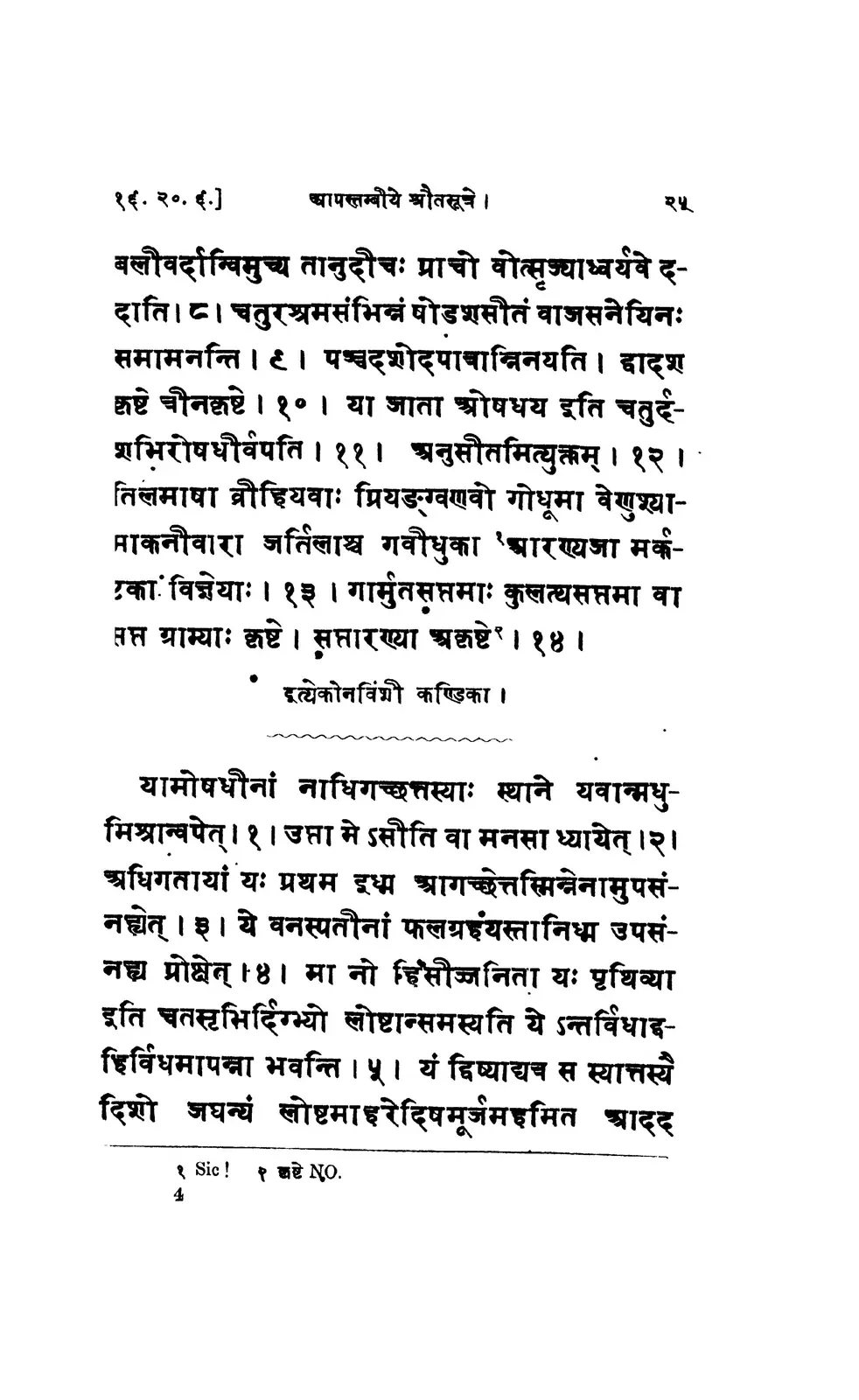
तिलमाषा व्रीहियवाः प्रियङ्ग्वणवो गोधूमा वेणुश्यामाकनीवारा जर्तिलाश्च गवीधुका
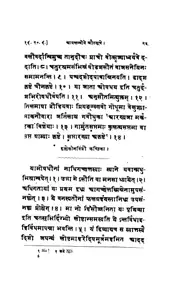 The printed page
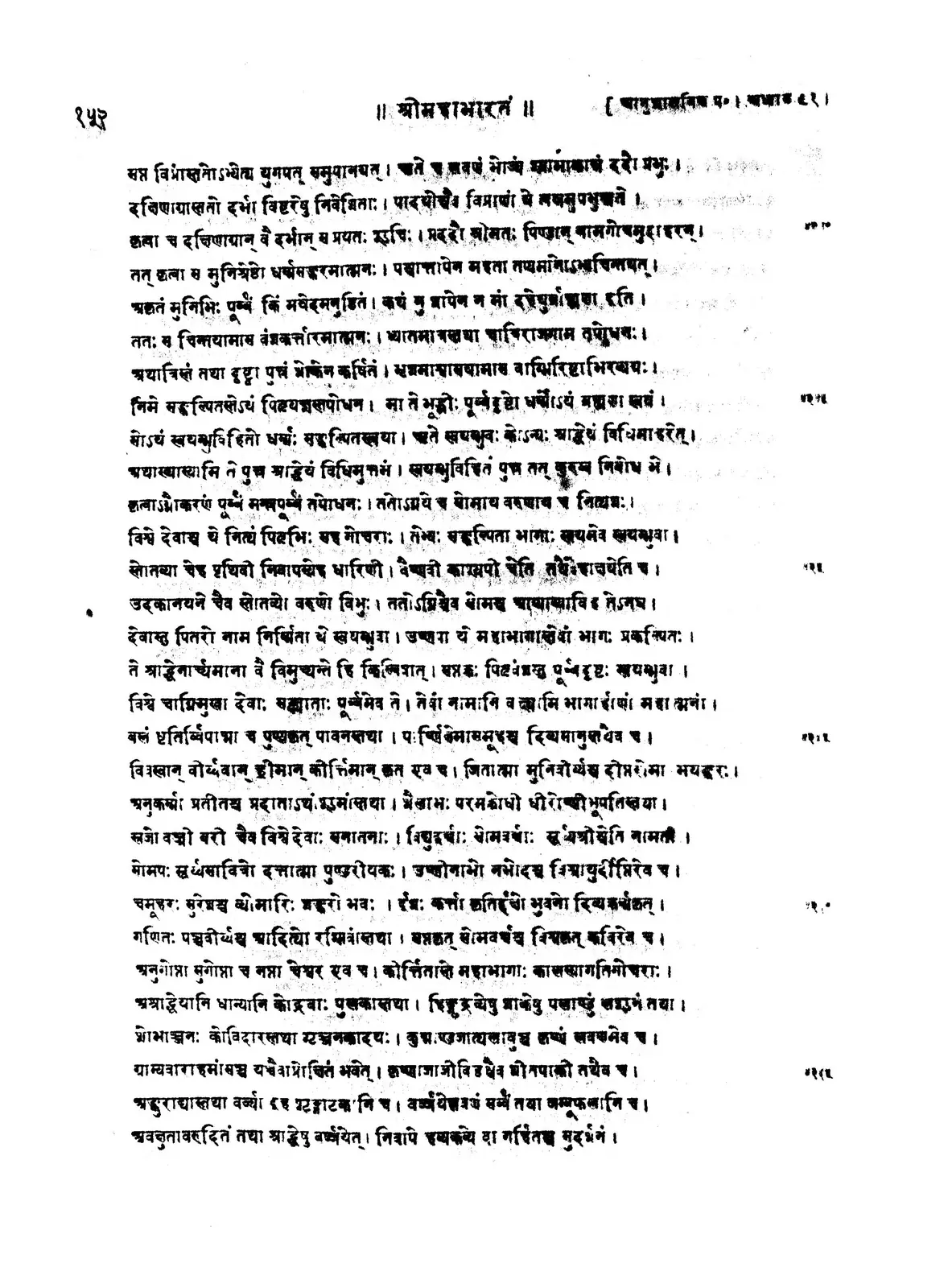
The Śrauta Sútra of Ápastamba belonging to the Taittiríya Saṃhitá (Bibliotheca Indica; text volume, no commentary) (ed. Richard Garbe), Calcutta (Baptist Mission Press, for the Asiatic Society, 57 Park Street), 1902, p. 25tilamāṣā vrīhiyavāḥ priyaṅgvaṇavo godʰūmā veṇuśyāmākanīvārā jartilaśca gavīdʰukā"sesame and beans, rice and barley, priyangu and anu, wheat; bamboo seed, shyamaka, wild rice, jartila and gavidhuka" (our translation)
ApSS XVI.19.2-14 (TITUS)
गार्मुतसप्तमाः कुलत्थसप्तमा वा सप्त ग्राम्याः कृष्टे
The printed page
The Śrauta Sútra of Ápastamba belonging to the Taittiríya Saṃhitá (Bibliotheca Indica; text volume, no commentary) (ed. Richard Garbe), Calcutta (Baptist Mission Press, for the Asiatic Society, 57 Park Street), 1902, p. 25gārmutasaptamāḥ kulattʰasaptamā vā sapta grāmyāḥ kr̥ṣṭe"the seven cultivated (kinds), with garmut or kulattha as the seventh, on the ploughed (ground)" (our translation)
ApSS XVI.19.2-14 (TITUS)
सप्तारण्या अकृष्टे
The printed page
The Śrauta Sútra of Ápastamba belonging to the Taittiríya Saṃhitá (Bibliotheca Indica; text volume, no commentary) (ed. Richard Garbe), Calcutta (Baptist Mission Press, for the Asiatic Society, 57 Park Street), 1902, p. 25saptāraṇyā akr̥ṣṭe"the seven wild (kinds) on the unploughed (ground)" (our translation)
ApSS XVI.19.2-14 (TITUS)
- Why
- The Taittiriya: "the domesticated plants are seven, the wild are seven; (verily they serve) to win both sets". The Shatapatha: all herbs means all food, so he puts all kinds of food into Agni; sowing on ploughed and unploughed ground makes food ripen on both.
From the text (3)
the domesticated plants are seven, the wild are seven; (verily they serve) to win both setsTS V.2.5.5 · printed p. 409 (PDF p. 132)
all herbs means all food ; he thus puts all (kinds of) food into himSB VII.2.4.13-17 · printed pp. 337-338The Sanskrit of this lineसर्वमेव तदन्नं यत्सर्वौषधं सर्वमेवास्मिन्नेतदन्नं दधाति
hence food ripens both on ploughed, and on unploughed, groundSB VII.2.4.13-17 · printed pp. 337-338The Sanskrit of this lineकृष्टे चाकृष्टे च वपति तस्मात्कृष्टे चाकृष्टे चान्नम् पच्यते
- How
- The seed is sown with fourteen verses beginning "yā jātā oṣadhayaḥ", from a four-cornered udumbara vessel: the cultivated kinds on the ploughed ground, the wild kinds on the unploughed ground (Apastamba).
From the text (5)
या जाता ओषधय इति चतुर्दशभिरोषधीर्वपति
The printed page
The Śrauta Sútra of Ápastamba belonging to the Taittiríya Saṃhitá (Bibliotheca Indica; text volume, no commentary) (ed. Richard Garbe), Calcutta (Baptist Mission Press, for the Asiatic Society, 57 Park Street), 1902, p. 25yā jātā oṣadʰaya iti caturdaśabʰiroṣadʰīrvapati"With fourteen (verses) beginning 'yā jātā oṣadhayaḥ' he sows the plants." (our translation)
ApSS XVI.19.2-14 (TITUS)
With fourteen verses he scattersTS V.2.5.5 · printed p. 409 (PDF p. 132)
By means of the udumbara jar (he sows the seed)SB VII.2.4.13-17 · printed pp. 337-338The Sanskrit of this lineऔदुम्बरेण चमसेन
गार्मुतसप्तमाः कुलत्थसप्तमा वा सप्त ग्राम्याः कृष्टे
The printed page
The Śrauta Sútra of Ápastamba belonging to the Taittiríya Saṃhitá (Bibliotheca Indica; text volume, no commentary) (ed. Richard Garbe), Calcutta (Baptist Mission Press, for the Asiatic Society, 57 Park Street), 1902, p. 25gārmutasaptamāḥ kulattʰasaptamā vā sapta grāmyāḥ kr̥ṣṭe"the seven cultivated (kinds), with garmut or kulattha as the seventh, on the ploughed (ground)" (our translation)
ApSS XVI.19.2-14 (TITUS)
सप्तारण्या अकृष्टे
The printed page
The Śrauta Sútra of Ápastamba belonging to the Taittiríya Saṃhitá (Bibliotheca Indica; text volume, no commentary) (ed. Richard Garbe), Calcutta (Baptist Mission Press, for the Asiatic Society, 57 Park Street), 1902, p. 25saptāraṇyā akr̥ṣṭe"the seven wild (kinds) on the unploughed (ground)" (our translation)
ApSS XVI.19.2-14 (TITUS)
- When
- While the fire altar is being built, after the altar site has been ploughed and watered.
From the text (3)
लाङ्गलं पवीरवमिति द्वाभ्यां कृषति
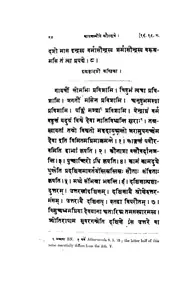 The printed page
The Śrauta Sútra of Ápastamba belonging to the Taittiríya Saṃhitá (Bibliotheca Indica; text volume, no commentary) (ed. Richard Garbe), Calcutta (Baptist Mission Press, for the Asiatic Society, 57 Park Street), 1902, p. 24lāṅgalaṃ pavīravamiti dvābʰyāṃ kr̥ṣati"With two (verses) beginning 'lāṅgalaṃ pavīravam' he ploughs." (our translation)
ApSS XVI.19.2-14 (TITUS)
Fifteen jarfuls of water he pours outSB VII.2.4.13-17 · printed pp. 337-338The Sanskrit of this lineपञ्चदशोदचमसान्निनयति
He then sows all (kinds of) herb (-seed)SB VII.2.4.13-17 · printed pp. 337-338The Sanskrit of this lineअथ सर्वौषधं वपति
- Who performs it
- The texts say only "he" sows; the person for whom the altar is built is called "he who piles the fire".
From the text (1)
If he who piles the fireTS V.2.5.5 · printed p. 409 (PDF p. 132)
- Its meaning
- The Shatapatha adds a lifelong vow: the builder gives up one of the sown kinds of food and does not eat it as long as he lives. In Apastamba's list shyamaka counts among the wild plants and priyangu among the cultivated ones.
From the text (2)
Let him omit one of those kinds of food, and not eat thereof as long as he livesSB VII.2.4.13-17 · printed pp. 337-338The Sanskrit of this lineतेषामेकमन्नमुद्धरेत्तस्य नाश्नीयाद्यावज्जीवम्
तिलमाषा व्रीहियवाः प्रियङ्ग्वणवो गोधूमा वेणुश्यामाकनीवारा जर्तिलाश्च गवीधुका
The printed page
The Śrauta Sútra of Ápastamba belonging to the Taittiríya Saṃhitá (Bibliotheca Indica; text volume, no commentary) (ed. Richard Garbe), Calcutta (Baptist Mission Press, for the Asiatic Society, 57 Park Street), 1902, p. 25tilamāṣā vrīhiyavāḥ priyaṅgvaṇavo godʰūmā veṇuśyāmākanīvārā jartilaśca gavīdʰukā"sesame and beans, rice and barley, priyangu and anu, wheat; bamboo seed, shyamaka, wild rice, jartila and gavidhuka" (our translation)
ApSS XVI.19.2-14 (TITUS)
Sources: Apastamba Srauta Sutra (Sanskrit) · ApSS XVI.19.2-14 (TITUS) · Apastamba-Srautasutra, TITUS e-text (ed. R. Garbe) | Taittiriya Samhita · TS V.2.5.5 · tr. Arthur Berriedale Keith · The Veda of the Black Yajus School entitled Taittiriya Sanhita, Part 2 (Kandas IV-VII), Harvard Oriental Series 19, 1914 | Shatapatha Brahmana · SB VII.2.4.13-17 · tr. Julius Eggeling · The Satapatha-Brahmana, Part III, Sacred Books of the East 41, Oxford 1894
Grihya (household) rite: marriage
Marriage: plants and grains for the consecrated water-jar
vivāha: praṇītodakumbha
Barnyard millet · śyāmākaFoxtail millet · priyaṅgu
- What is offered
- In the marriage rite, shyamaka (barnyard millet) and priyangu (foxtail millet) are named, with shami, durva grass and white mustard, among the plants and grains used when the water-jar is consecrated and carried forward.
From the text (2)
शमीशमकश्यामाकानां प्रियङ्गुदूर्वागौरसर्षपाणां
śamīśamakaśyāmākānāṃ priyaṅgudūrvāgaurasarṣapāṇāṃ"of shami, shamaka, shyamaka, priyangu, durva grass and white mustard" (our translation)
VarGS 14.6-12 (GRETIL numbering)
सहिरण्यापो ऽभिमन्त्र्य प्रणीतोदकुम्भं प्रणयेत्
sahiraṇyāpo 'bhimantrya praṇītodakumbhaṃ praṇayet"having consecrated water containing gold, he should carry forward the water-jar" (our translation)
VarGS 14.6-12 (GRETIL numbering)
- Why
- the text gives no purpose
- How
- On a clean spot of ground, with these plants (as available) and other grains, water containing gold is consecrated with Vedic verses, and the water-jar is carried forward.
From the text (2)
शुचौ भूमिप्रदेशे
śucau bhūmipradeśe"on a clean spot of ground" (our translation)
VarGS 14.6-12 (GRETIL numbering)
सहिरण्यापो ऽभिमन्त्र्य प्रणीतोदकुम्भं प्रणयेत्
sahiraṇyāpo 'bhimantrya praṇītodakumbhaṃ praṇayet"having consecrated water containing gold, he should carry forward the water-jar" (our translation)
VarGS 14.6-12 (GRETIL numbering)
- When
- During the wedding, before the parched-grain (lāja) oblations and the taking of the bride's hand.
From the text (2)
तं लाजाहुतीषु हूयमानासु भ्राता ब्रह्मचारी वोद्गृह्य धारयेद् दक्षिणतश्च
taṃ lājāhutīṣu hūyamānāsu bhrātā brahmacārī vodgṛhya dhārayed dakṣiṇataśca"While the parched-grain oblations are being offered, a brother or a Vedic student should lift it and hold it, on the south side." (our translation)
VarGS 14.6-12 (GRETIL numbering)
गृह्णामि ते सौभगत्वाय हस्तं
gṛhṇāmi te saubhagatvāya hastaṃ"I take your hand for good fortune" (the hand-taking verse that follows) (our translation)
VarGS 14.6-12 (GRETIL numbering)
- Who performs it
- The rite is the wedding performed by the groom (upayantā); the text names a brother or a Vedic student as the one who holds the water-jar.
From the text (2)
पुरस्तात्प्रत्यङ्मुख उपयन्ता
purastāt pratyaṅmukha upayantā"the groom, in front (of her), facing west" (VarGS 14.12, before the hand-taking) (our translation)
VarGS 14.6-12 (GRETIL numbering)
तं लाजाहुतीषु हूयमानासु भ्राता ब्रह्मचारी वोद्गृह्य धारयेद् दक्षिणतश्च
taṃ lājāhutīṣu hūyamānāsu bhrātā brahmacārī vodgṛhya dhārayed dakṣiṇataśca"While the parched-grain oblations are being offered, a brother or a Vedic student should lift it and hold it, on the south side." (our translation)
VarGS 14.6-12 (GRETIL numbering)
- Its meaning
- The text gives no meaning or significance for these plants
Sources: Varaha Grihya Sutra (Sanskrit) · VarGS 14.6-12 (GRETIL numbering) · Varaha-Grhyasutra, GRETIL
Rule for fire offerings (homa)
Grains set out for the regular fire offerings
homa-dravya (atharvaveda-pariśiṣṭa 23, yajñapātralakṣaṇa)
Foxtail millet · priyaṅguBarnyard millet · śyāmāka
- What is offered
- Kernels of priyangu (foxtail millet) and shyamaka (barnyard millet), with barley, rice, large rice and sesame, are listed as offering materials to be set out "as enjoined by the Veda".
From the text (2)
यवव्रीहिमहाव्रीहिप्रयङ्गूणां हि तण्डुलाः
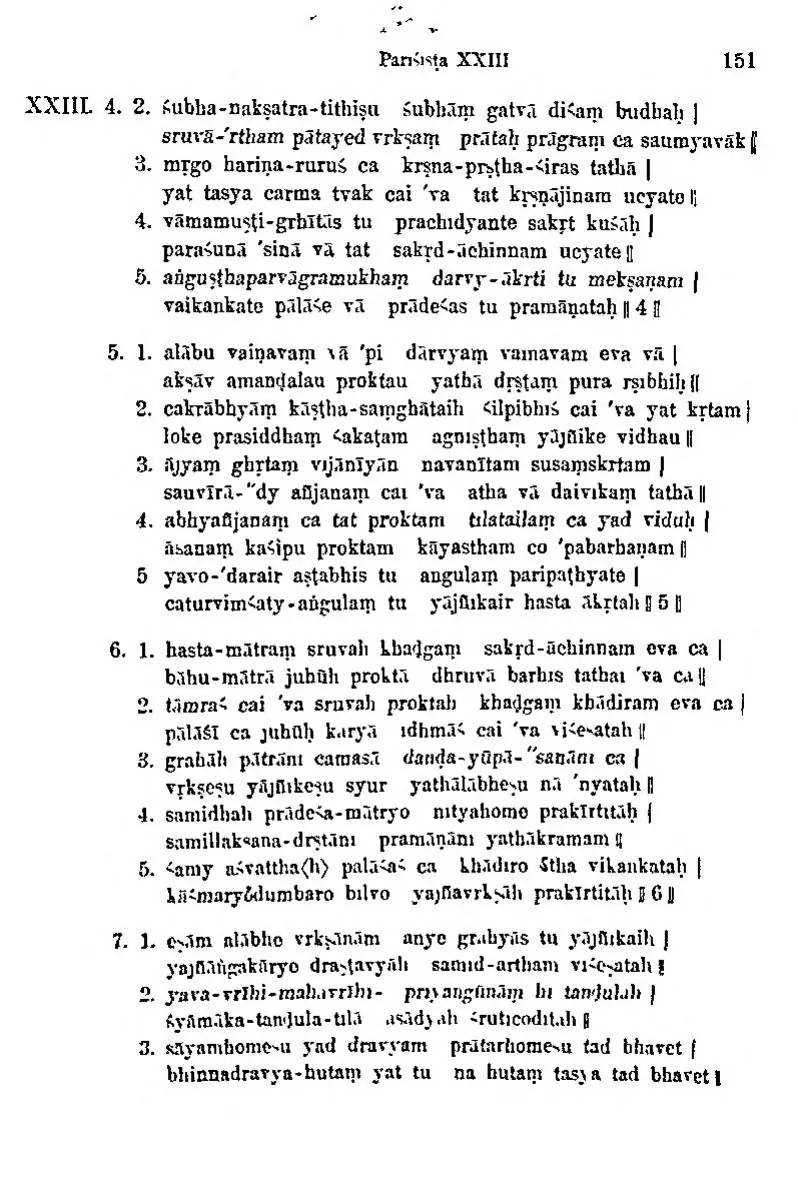
 The printed page
The Pariśiṣṭas of the Atharvaveda, Volume I: Text and critical apparatus (Part I, Pariśiṣṭas I-XXXVI, bound with Parts II-III) (ed. George Melville Bolling and Julius von Negelein), Leipzig (Otto Harrassowitz), 1909, p. 151yavavrīhimahāvrīhiprayaṅgūṇāṃ hi taṇḍulāḥ"the kernels of barley, rice, large rice and priyangu" (our translation)
AVParis 23.7.2-3 (yajñapātralakṣaṇa)
श्यामाकतण्डुलतिला आसाद्याः श्रुतिचोदिताः
The printed page
The Pariśiṣṭas of the Atharvaveda, Volume I: Text and critical apparatus (Part I, Pariśiṣṭas I-XXXVI, bound with Parts II-III) (ed. George Melville Bolling and Julius von Negelein), Leipzig (Otto Harrassowitz), 1909, p. 151śyāmākataṇḍulatilā āsādyāḥ śruticoditāḥ"kernels of shyamaka and sesame are to be set out, (as) enjoined by the Veda" (our translation)
AVParis 23.7.2-3 (yajñapātralakṣaṇa)
- Why
- the text gives no purpose
- How
- Set out as husked kernels for the offering; whatever substance is used in the evening offerings is to be used in the morning offerings too.
From the text (2)
श्यामाकतण्डुलतिला आसाद्याः श्रुतिचोदिताः
The printed page
The Pariśiṣṭas of the Atharvaveda, Volume I: Text and critical apparatus (Part I, Pariśiṣṭas I-XXXVI, bound with Parts II-III) (ed. George Melville Bolling and Julius von Negelein), Leipzig (Otto Harrassowitz), 1909, p. 151śyāmākataṇḍulatilā āsādyāḥ śruticoditāḥ"kernels of shyamaka and sesame are to be set out" (our translation)
AVParis 23.7.2-3 (yajñapātralakṣaṇa)
सायंहोमेषु यद् द्रव्यं प्रातर्होमेषु तद् भवेत्
The printed page
The Pariśiṣṭas of the Atharvaveda, Volume I: Text and critical apparatus (Part I, Pariśiṣṭas I-XXXVI, bound with Parts II-III) (ed. George Melville Bolling and Julius von Negelein), Leipzig (Otto Harrassowitz), 1909, p. 151sāyaṃhomeṣu yad dravyaṃ prātarhomeṣu tad bhavet"What substance is in the evening offerings, that shall be in the morning offerings." (our translation)
AVParis 23.7.2-3 (yajñapātralakṣaṇa)
- When
- The evening and morning fire offerings.
From the text (1)
सायंहोमेषु यद् द्रव्यं प्रातर्होमेषु तद् भवेत्
The printed page
The Pariśiṣṭas of the Atharvaveda, Volume I: Text and critical apparatus (Part I, Pariśiṣṭas I-XXXVI, bound with Parts II-III) (ed. George Melville Bolling and Julius von Negelein), Leipzig (Otto Harrassowitz), 1909, p. 151sāyaṃhomeṣu yad dravyaṃ prātarhomeṣu tad bhavet"What substance is in the evening offerings, that shall be in the morning offerings." (our translation)
AVParis 23.7.2-3 (yajñapātralakṣaṇa)
- Who performs it
- The text says it was taught for the benefit of Brahmins (and of their sons and pupils).
From the text (1)
ब्राह्मणानां हितार्थाय पुत्रशिष्यहिताय च
 The printed page
The Pariśiṣṭas of the Atharvaveda, Volume I: Text and critical apparatus (Part I, Pariśiṣṭas I-XXXVI, bound with Parts II-III) (ed. George Melville Bolling and Julius von Negelein), Leipzig (Otto Harrassowitz), 1909, p. 154brāhmaṇānāṃ hitārthāya putraśiṣyahitāya ca"for the benefit of Brahmins, and for the benefit of sons and pupils" (our translation)
AVParis 23.7.2-3 (yajñapātralakṣaṇa)
- Its meaning
- The chapter is a manual of sacrificial vessels and materials.
From the text (1)
अथातो यज्ञपात्राणां लक्षणं योनिर् एव च
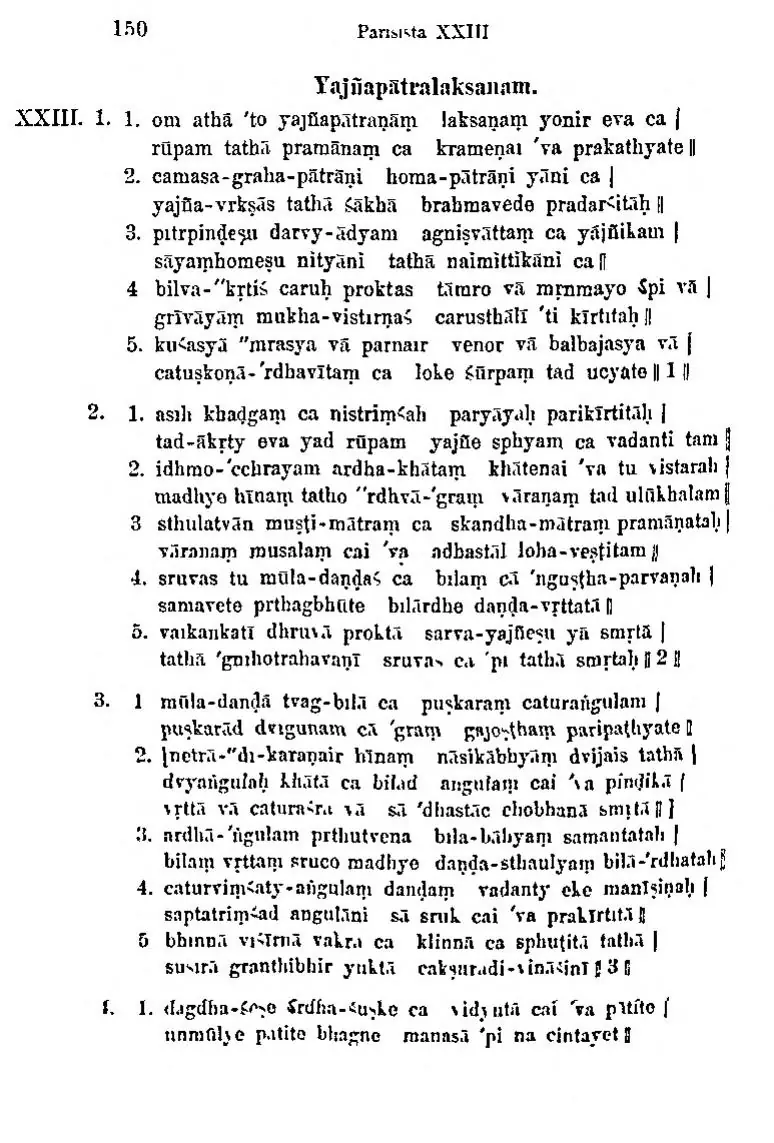
 The printed page
The Pariśiṣṭas of the Atharvaveda, Volume I: Text and critical apparatus (Part I, Pariśiṣṭas I-XXXVI, bound with Parts II-III) (ed. George Melville Bolling and Julius von Negelein), Leipzig (Otto Harrassowitz), 1909, p. 150athāto yajñapātrāṇāṃ lakṣaṇaṃ yonir eva ca"Now then (are described) the marks and origin of the sacrificial vessels ..." (our translation)
AVParis 23.7.2-3 (yajñapātralakṣaṇa)
Sources: Atharvaveda Parisishta 23 (Sanskrit) · AVParis 23.7.2-3 (yajñapātralakṣaṇa) · Atharvaveda-Parisistas, GRETIL
Temple/home worship (pūjā), Vaishnava ritual manual (16th century)
Worship of Vishnu: shyamaka in the water offered for washing the deity's feet
pūjā: pādya
Barnyard millet · śyāmāka
- What is offered
- Shyamaka grain is put into the vessel of water for washing the deity's feet (pādya), together with lotus, durva grass and viṣṇupatrī: "four substances".
From the text (2)
पाद्यपात्रे च कमलं दूर्वा श्यामाकम् एव च
pādyapātre ca kamalaṃ dūrvā śyāmākam eva ca"And in the vessel for foot-water (he should put) lotus, durva grass and shyamaka ..." (our translation)
Haribhaktivilasa 5.40-44 (DCS)
निक्षिपेद् विष्णुपत्रीं चेत्य् एवं द्रव्यचतुष्टयम्
nikṣiped viṣṇupatrīṃ cety evaṃ dravyacatuṣṭayam"... and viṣṇupatrī; thus the four substances." (our translation)
Haribhaktivilasa 5.40-44 (DCS)
- Why
- the text gives no purpose
- How
- The grain is placed in the foot-water vessel with the other three substances.
From the text (1)
निक्षिपेद् विष्णुपत्रीं चेत्य् एवं द्रव्यचतुष्टयम्
nikṣiped viṣṇupatrīṃ cety evaṃ dravyacatuṣṭayam"he should put in ... viṣṇupatrī; thus the four substances" (our translation)
Haribhaktivilasa 5.40-44 (DCS)
- When
- During worship (arcana), when the vessels for the offerings are prepared.
From the text (1)
न्यसेद् अर्चनकाले तु कृष्णस्यातीव वल्लभम्
nyased arcanakāle tu kṛṣṇasyātīva vallabham"at the time of worship he should set (it) down, (a thing) very dear to Krishna" (5.40, of the water-pot) (our translation)
Haribhaktivilasa 5.40-44 (DCS)
- Who performs it
- The worshipper (sādhaka) who prepares the vessels.
From the text (1)
कुशाग्रतिलदूर्वाश् च सिद्धार्थान् अपि साधकः
kuśāgratiladūrvāś ca siddhārthān api sādhakaḥ"the worshipper (puts) kusha tips, sesame, durva and white mustard (into the arghya vessel)" (5.42) (our translation)
Haribhaktivilasa 5.40-44 (DCS)
- Its meaning
- The text gives no meaning for the shyamaka in the foot-water
Sources: Haribhaktivilasa (Sanskrit) · Haribhaktivilasa 5.40-44 (DCS) · Haribhaktivilasa (Gopala Bhatta, 16th century), Digital Corpus of Sanskrit (O. Hellwig) CoNLL-U, one line per verse
Foxtail millet priyaṅgu
Priyaṅgu is cooked in milk for the Maruts and for Rudra, named in the stream of wealth at the fire altar, sown on the altar site, and its young shoots go into a king’s great anointing.
Shrauta wish offering (kāmyeṣṭi)
Wish offering to the Maruts: priyangu cooked in the milk of a speckled cow
kāmyeṣṭi: mārutaḥ praiyaṅgavaś caruḥ (pṛśnyai dugdhe)
Foxtail millet · priyaṅgu
- What is offered
- Priyangu (foxtail millet) cooked as a pot (caru) in the milk of a speckled cow, offered to the Maruts.
From the text (3)
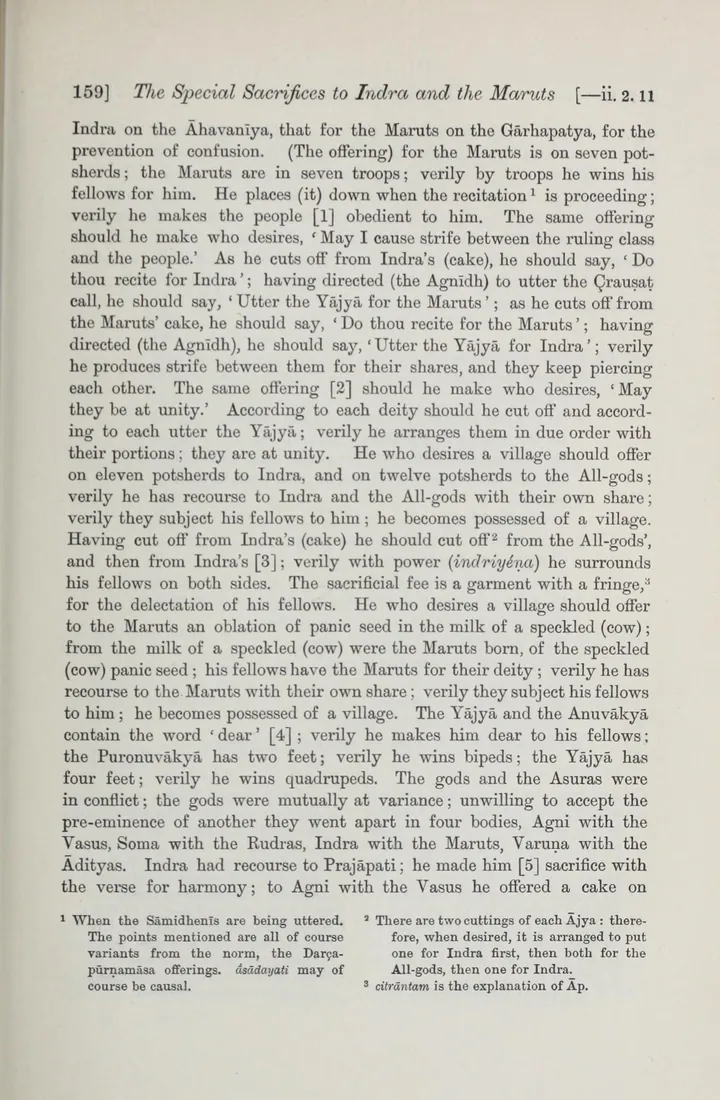
should offer to the Maruts an oblation of panic seed in the milk of a speckled (cow)TS II.2.11.4 · printed p. 159 (PDF p. 331)
पृश्नियै दुग्धे प्रैयंगवं चरुं निर् वपेन् मरुद्भ्यो
 The printed page
The Sanhitá of the Black Yajur Veda, with the commentary of Mádhava Áchárya, Vol. II: Kánda I, Prapáthaka VIII - Kánda II (Bibliotheca Indica) (ed. E. B. Cowell), Calcutta (C. B. Lewis, Baptist Mission Press), 1866, p. 369pŕ̥śniyai dugdʰé práiyaṃgavaṃ carúṃ nír vapen marúdbʰyo"in the milk of a speckled (cow) he should offer a pot of priyangu to the Maruts" (our translation)
TS 2.2.11.4 (TITUS)
मारुतं चरुं निर्वपेत् पयसि प्रैयङ्गवं
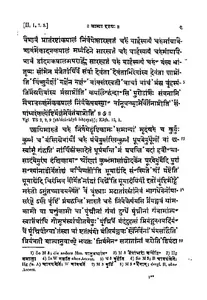 The printed page
Māitrāyaṇī Saṃhitā, herausgegeben von Dr. Leopold von Schroeder. Zweites Buch (gedruckt auf Kosten der Deutschen Morgenländischen Gesellschaft) (ed. Leopold von Schroeder), Leipzig (in Commission bei F. A. Brockhaus), 1883, p. 9mārutaṃ caruṃ nirvapet payasi praiyaṅgavaṃ"He should offer to the Maruts a pot of priyangu in milk." (our translation)
MS II.1.8 (GRETIL)
- Why
- "He who desires a village" offers it, and "he becomes possessed of a village". The Maitrayani adds: or one who desires cattle.
From the text (3)
He who desires a village should offerTS II.2.11.4 · printed p. 159 (PDF p. 331)
he becomes possessed of a villageTS II.2.11.4 · printed p. 159 (PDF p. 331)
ग्रामकामो वा पशुकामो वा
The printed page
Māitrāyaṇī Saṃhitā, herausgegeben von Dr. Leopold von Schroeder. Zweites Buch (gedruckt auf Kosten der Deutschen Morgenländischen Gesellschaft) (ed. Leopold von Schroeder), Leipzig (in Commission bei F. A. Brockhaus), 1883, p. 9grāmakāmo vā paśukāmo vā"one who desires a village or one who desires cattle" (our translation)
MS II.1.8 (GRETIL)
- How
- The priyangu is cooked in the milk of a speckled cow and offered to the Maruts; the offering and invitation verses contain the word "dear" (priya), which the Maitrayani says makes him dear to his kinsmen.
From the text (3)
should offer to the Maruts an oblation of panic seed in the milk of a speckled (cow)TS II.2.11.4 · printed p. 159 (PDF p. 331)
The Yajya and the Anuvakya contain the wordTS II.2.11.4 · printed p. 159 (PDF p. 331)
प्रियवती याज्यानुवाक्ये भवतः प्रियम् एनं सजातानां करोति
The printed page
Māitrāyaṇī Saṃhitā, herausgegeben von Dr. Leopold von Schroeder. Zweites Buch (gedruckt auf Kosten der Deutschen Morgenländischen Gesellschaft) (ed. Leopold von Schroeder), Leipzig (in Commission bei F. A. Brockhaus), 1883, p. 9priyavatī yājyānuvākye bhavataḥ priyam enaṃ sajātānāṃ karoti"The offering and invitation verses contain the word 'dear'; he makes him dear to his kinsmen." (our translation)
MS II.1.8 (GRETIL)
- When
- The text names no season or date (a wish offering, made when the wish arises)
- Who performs it
- One who desires a village (grāmakāma).
From the text (2)
He who desires a village should offerTS II.2.11.4 · printed p. 159 (PDF p. 331)
ग्रामकामः
The printed page
The Sanhitá of the Black Yajur Veda, with the commentary of Mádhava Áchárya, Vol. II: Kánda I, Prapáthaka VIII - Kánda II (Bibliotheca Indica) (ed. E. B. Cowell), Calcutta (C. B. Lewis, Baptist Mission Press), 1866, p. 369grā́makāmaḥ"one who desires a village" (our translation)
TS 2.2.11.4 (TITUS)
- Its meaning
- The Taittiriya explains the choice: the Maruts were born from the milk of the speckled cow, and so was panic seed; and one's fellows have the Maruts as their deity. The Maitrayani: what the speckled cow gave as milk became priyangu.
From the text (3)
from the milk of a speckled (cow) were the Maruts born, of the speckled (cow) panic seedTS II.2.11.4 · printed p. 159 (PDF p. 331)
his fellows have the Maruts for their deityTS II.2.11.4 · printed p. 159 (PDF p. 331)
पृश्निर् वै यद् अदुहत् स प्रियङ्गुर् अभवद्
The printed page
Māitrāyaṇī Saṃhitā, herausgegeben von Dr. Leopold von Schroeder. Zweites Buch (gedruckt auf Kosten der Deutschen Morgenländischen Gesellschaft) (ed. Leopold von Schroeder), Leipzig (in Commission bei F. A. Brockhaus), 1883, p. 9pṛśnir vai yad aduhat sa priyaṅgur abhavad"What the speckled (cow) gave as milk became priyangu." (our translation)
MS II.1.8 (GRETIL)
Sources: Taittiriya Samhita · TS II.2.11.4 · tr. Arthur Berriedale Keith · The Veda of the Black Yajus School entitled Taittiriya Sanhita, Part 1 (Kandas I-III), Harvard Oriental Series 18, 1914 | Taittiriya Samhita (Sanskrit) · TS 2.2.11.4 (TITUS) · Taittiriya-Samhita, TITUS e-text (ed. A. Weber 1871-72; TITUS version J. Gippert) | Maitrayani Samhita (Sanskrit) · MS II.1.8 (GRETIL) · Maitrayani Samhita, GRETIL plain text (ed. L. von Schroeder) | Kathaka Samhita (Sanskrit) · KS X.11 (TITUS) · Kathaka-Samhita, TITUS e-text (ed. L. von Schroeder)
Shrauta offering to a lunar mansion (nakṣatreṣṭi)
Offering to the lunar mansion Ardra: priyangu cooked in milk for Rudra
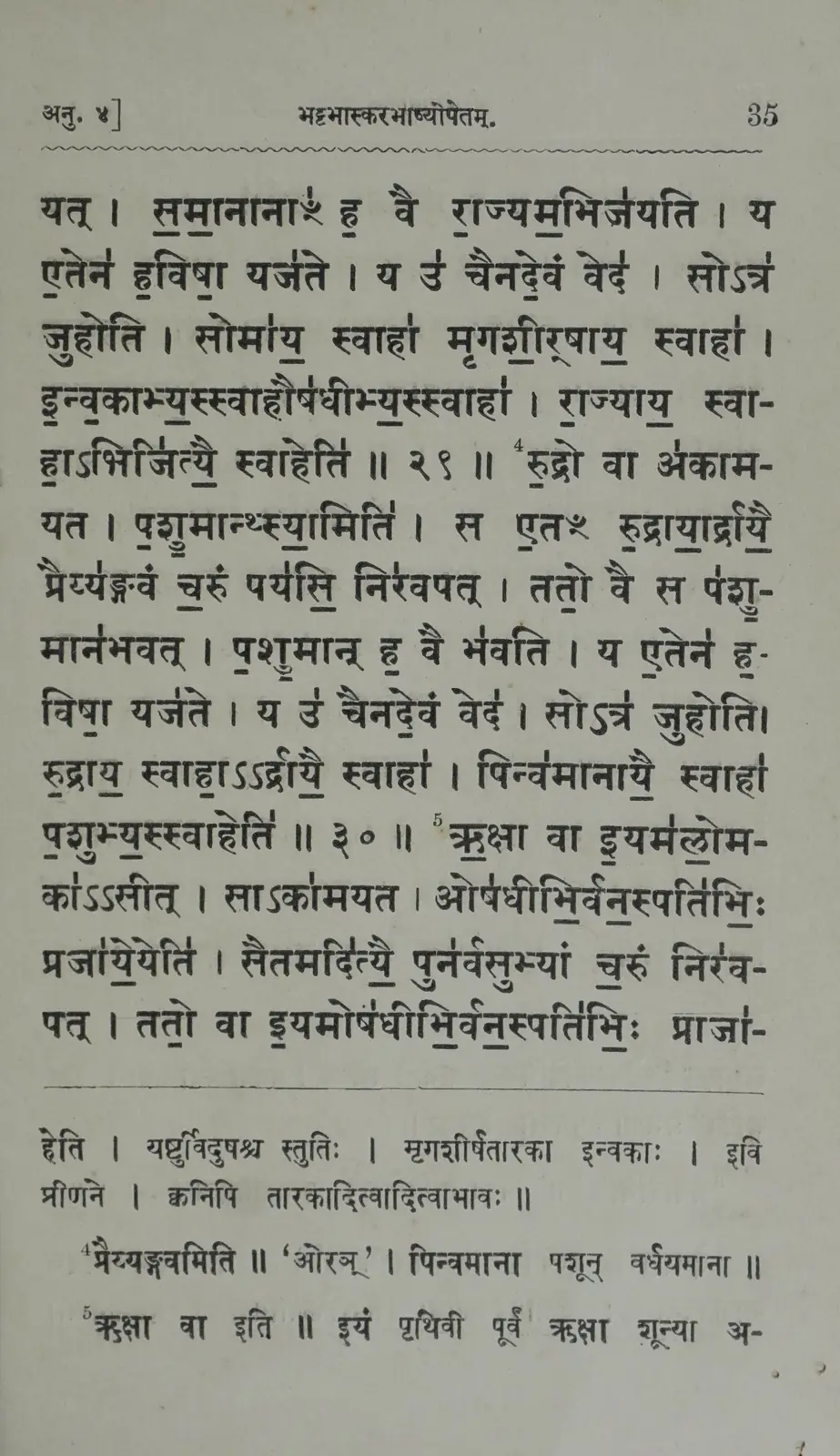
nakṣatreṣṭi: rudrāyārdrāyai praiyaṅgavaś caruḥ payasi
Foxtail millet · priyaṅgu
- What is offered
- A pot of priyangu cooked in milk, offered to Rudra and to the lunar mansion Ardra.
From the text (1)
स एतꣳ रुद्रायार्द्रायै प्रैय्यङ्गवं चरुं पयसि निरवपत्
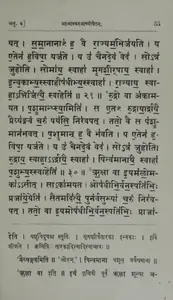 The printed page
The Taittiríya Bráhmana with the commentary of Bhaṭṭa Bhāskara Miśra, Aṣṭaka III, Part I (prapāṭhakas 1-7) (Bibliotheca Sanskrita, Government Oriental (ed. A. Mahadeva Sastri and L. Srinivasacharya), Mysore (Government Branch Press), 1911, p. 35sá etám̐ rudrā́ya _ārdrā́yai práiyaṃgavaṃ {BS práiyyaṅgavaṃ } carúṃ páyasi níravapat"He offered this pot of priyangu in milk to Rudra, to Ardra." (our translation)
TB III.1.4.4 (TITUS)
- Why
- Whoever sacrifices with this oblation becomes rich in cattle.
From the text (2)
पशुमान् ह वै भवति
The printed page
The Taittiríya Bráhmana with the commentary of Bhaṭṭa Bhāskara Miśra, Aṣṭaka III, Part I (prapāṭhakas 1-7) (Bibliotheca Sanskrita, Government Oriental (ed. A. Mahadeva Sastri and L. Srinivasacharya), Mysore (Government Branch Press), 1911, p. 35paśumā́n ha vái bʰavati"He becomes rich in cattle ..." (our translation)
TB III.1.4.4 (TITUS)
य एतेन हविषा यजते
The printed page
The Taittiríya Bráhmana with the commentary of Bhaṭṭa Bhāskara Miśra, Aṣṭaka III, Part I (prapāṭhakas 1-7) (Bibliotheca Sanskrita, Government Oriental (ed. A. Mahadeva Sastri and L. Srinivasacharya), Mysore (Government Branch Press), 1911, p. 35yá eténa havíṣā yájate"... who sacrifices with this oblation." (our translation)
TB III.1.4.4 (TITUS)
- How
- The priyangu is cooked in milk and offered with the calls "to Rudra svaha, to Ardra svaha, to her who swells (with milk) svaha, to the cattle svaha".
From the text (2)
रुद्राय स्वाहाऽऽर्द्रायै स्वाहा
The printed page
The Taittiríya Bráhmana with the commentary of Bhaṭṭa Bhāskara Miśra, Aṣṭaka III, Part I (prapāṭhakas 1-7) (Bibliotheca Sanskrita, Government Oriental (ed. A. Mahadeva Sastri and L. Srinivasacharya), Mysore (Government Branch Press), 1911, p. 35rudrā́ya svā́hā _ārdrā́yai svā́hā"to Rudra svaha, to Ardra svaha" (our translation)
TB III.1.4.4 (TITUS)
पिन्वमानायै स्वाहा पशुभ्यस्स्वाहेति
The printed page
The Taittiríya Bráhmana with the commentary of Bhaṭṭa Bhāskara Miśra, Aṣṭaka III, Part I (prapāṭhakas 1-7) (Bibliotheca Sanskrita, Government Oriental (ed. A. Mahadeva Sastri and L. Srinivasacharya), Mysore (Government Branch Press), 1911, p. 35pínvamānāyai svā́hā paśúbʰyaḥ svā́hā _íti"to her who swells (with milk) svaha, to the cattle svaha" (our translation)
TB III.1.4.4 (TITUS)
- When
- The text names the lunar mansion that receives the offering but gives no date for performing it
- Who performs it
- Whoever sacrifices with this oblation, and whoever knows it thus.
From the text (2)
य एतेन हविषा यजते
The printed page
The Taittiríya Bráhmana with the commentary of Bhaṭṭa Bhāskara Miśra, Aṣṭaka III, Part I (prapāṭhakas 1-7) (Bibliotheca Sanskrita, Government Oriental (ed. A. Mahadeva Sastri and L. Srinivasacharya), Mysore (Government Branch Press), 1911, p. 35yá eténa havíṣā yájate"he who sacrifices with this oblation" (our translation)
TB III.1.4.4 (TITUS)
य उ च एनद् एवं वेद
The printed page
The Taittiríya Bráhmana with the commentary of Bhaṭṭa Bhāskara Miśra, Aṣṭaka III, Part I (prapāṭhakas 1-7) (Bibliotheca Sanskrita, Government Oriental (ed. A. Mahadeva Sastri and L. Srinivasacharya), Mysore (Government Branch Press), 1911, p. 35yá u ca _enad eváṃ véda"and he who knows it thus" (our translation)
TB III.1.4.4 (TITUS)
- Its meaning
- Origin story: Rudra wished to be rich in cattle and offered this pot of priyangu.
From the text (1)
पशुमान्थ्स्यामिति
The printed page
The Taittiríya Bráhmana with the commentary of Bhaṭṭa Bhāskara Miśra, Aṣṭaka III, Part I (prapāṭhakas 1-7) (Bibliotheca Sanskrita, Government Oriental (ed. A. Mahadeva Sastri and L. Srinivasacharya), Mysore (Government Branch Press), 1911, p. 35paśumā́nt syām íti"(Rudra desired:) 'May I be rich in cattle.'" (our translation)
TB III.1.4.4 (TITUS)
Sources: Taittiriya Brahmana (Sanskrit) · TB III.1.4.4 (TITUS) · Taittiriya-Brahmana, TITUS e-text
Domestic fire rite taught in the Upanishad
The mantha rite: a mash of ten cultivated grains
mantha (śrīmantha)
Foxtail millet · priyaṅgu
- What is offered
- A mash (mantha) of the ten cultivated grains, among them priyangu (foxtail millet) and anu (identification uncertain), ground and moistened with curds, honey and ghee.
From the text (4)
There are ten kinds of village (cultivated) seedsBAU VI.3.1-13 (Kanva) = SB XIV.9.3 · printed pp. 209-215The Sanskrit of this lineदश ग्राम्याणि धान्यानि भवन्ति
millet and panic seedBAU VI.3.1-13 (Kanva) = SB XIV.9.3 · printed pp. 209-215The Sanskrit of this lineअणुप्रियंगवो
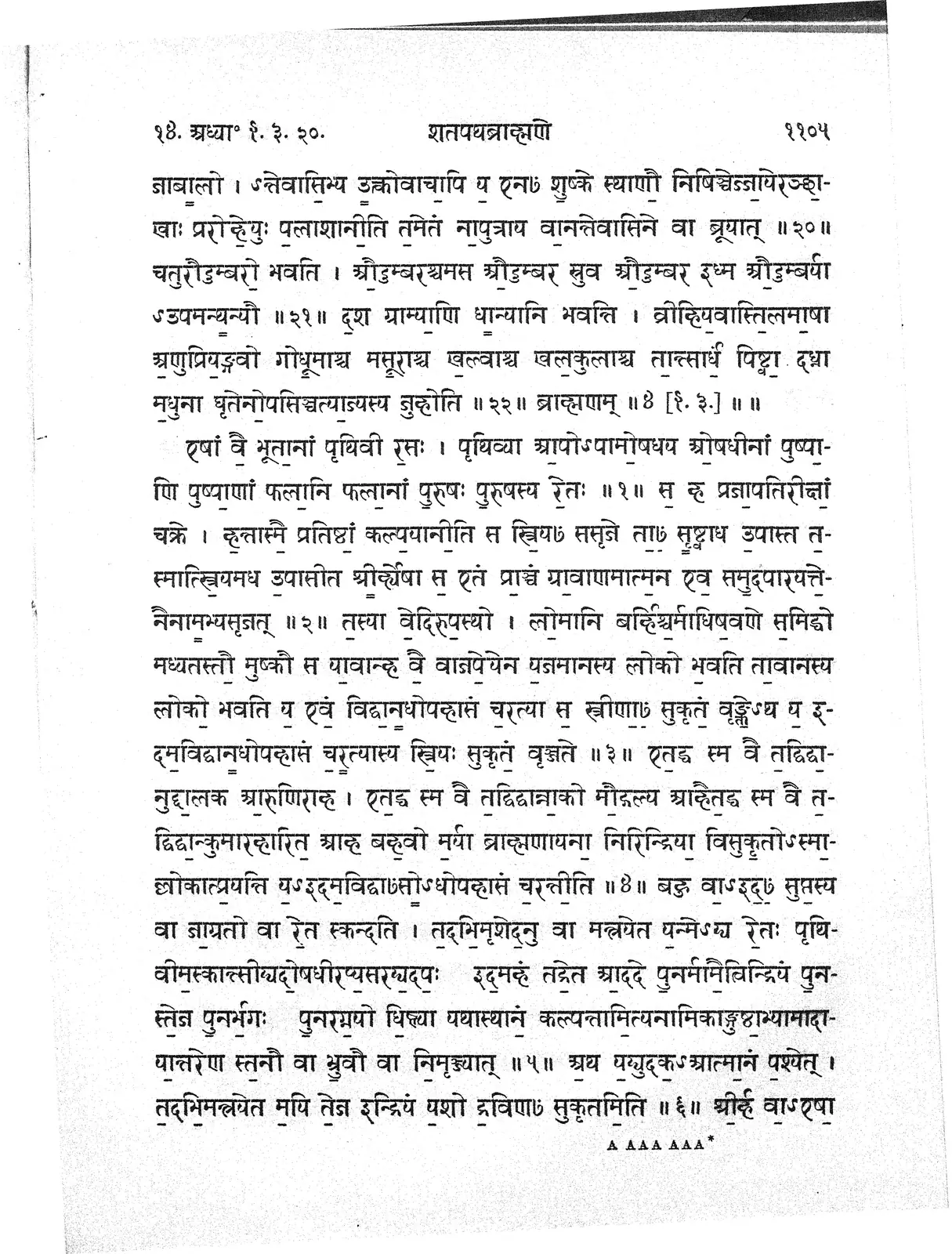
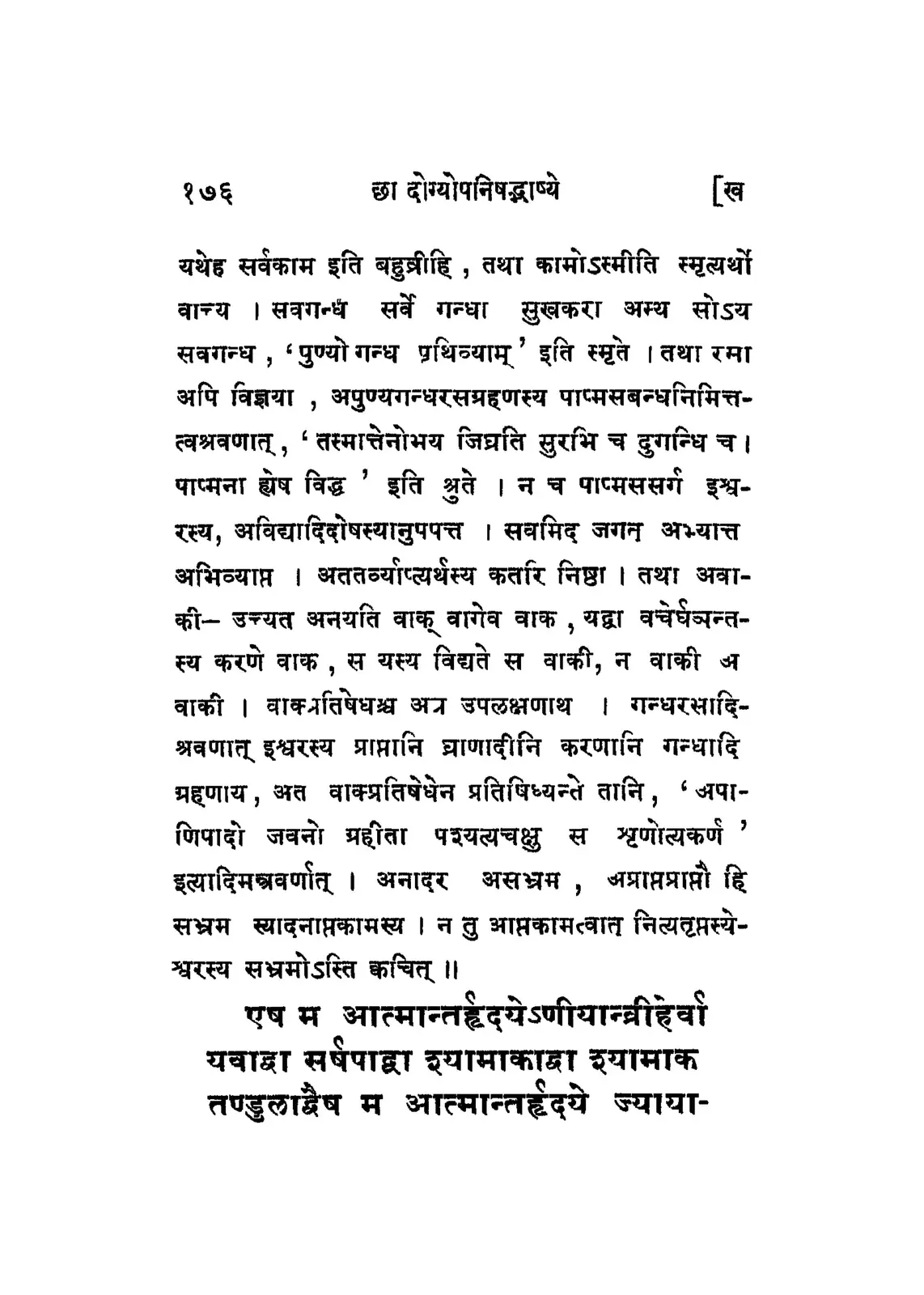
व्रीहियवास्तिलमाषा अणुप्रियङ्गवो गोधूमाश्च
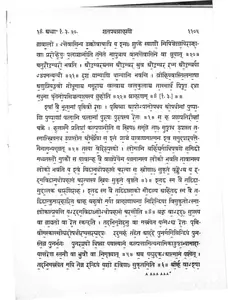 The printed page
The Çatapatha-Brâhmaṇa in the Mâdhyandina-Çâkhâ with extracts from the commentaries of Sâyaṇa, Harisvâmin and Dvivedagaṅga [series label White Yajurve (ed. Albrecht Weber), Berlin: Ferd. Dümmler's Verlagsbuchhandlung; London: Williams and Norgate, 1855, p. 1105vrīhiyavāstilamāṣā aṇupriyaṅgavo godhūmāśca"rice and barley, sesame and beans, anu and priyangu, and wheat" (our translation)
SB 14.9.3.22 (GRETIL)
ground these he sprinkles them with curds (dadhi), honey, and gheeBAU VI.3.1-13 (Kanva) = SB XIV.9.3 · printed pp. 209-215
- Why
- "If a man wishes to reach greatness" (Max Muller adds: wealth for performing sacrifices).
From the text (1)
If a man wishes to reach greatness (wealth for performing sacrifices)BAU VI.3.1-13 (Kanva) = SB XIV.9.3 · printed pp. 209-215The Sanskrit of this lineस यः कामयेत महत् प्राप्नुयाम्
- How
- He keeps a twelve-day observance, lays the fire and offers ghee with "svaha" to a series of deities and powers, each time dropping what remains into the mash; at the end he eats the mash.
From the text (3)
he performs the upasad rule during twelve daysBAU VI.3.1-13 (Kanva) = SB XIV.9.3 · printed pp. 209-215The Sanskrit of this lineद्वादशाहम् उपसद्व्रती
pours ghee into the fire, and throws what remains into the Mantha (mortar)BAU VI.3.1-13 (Kanva) = SB XIV.9.3 · printed pp. 209-215The Sanskrit of this lineअग्नौ हुत्वा मन्थे संस्रवम् अवनयति
Then he eats itBAU VI.3.1-13 (Kanva) = SB XIV.9.3 · printed pp. 209-215The Sanskrit of this lineअथैनम् आचामति
- When
- The observance begins on an auspicious day of the bright half of the month during the sun's northern course; the offering is made on a day under a "male" lunar mansion.
From the text (2)
beginning on an auspicious day of the light half of the moon during the northern progress of the sunBAU VI.3.1-13 (Kanva) = SB XIV.9.3 · printed pp. 209-215The Sanskrit of this lineउदगयन आपूर्यमाणपक्षस्य पुण्याहे
on a day, presided over by a male star (nakshatra)BAU VI.3.1-13 (Kanva) = SB XIV.9.3 · printed pp. 209-215The Sanskrit of this lineपुंसा नक्षत्रेण
- Who performs it
- A man who wishes to reach greatness, at his own house fire; Max Muller notes that the rite is domestic (smārta).
From the text (2)
If a man wishes to reach greatness (wealth for performing sacrifices)BAU VI.3.1-13 (Kanva) = SB XIV.9.3 · printed pp. 209-215The Sanskrit of this lineस यः कामयेत महत् प्राप्नुयाम्
As the whole act is considered smartaBAU VI.3.1-13 (Kanva) = SB XIV.9.3 · printed pp. 209-215 · translator’s note
- Its meaning
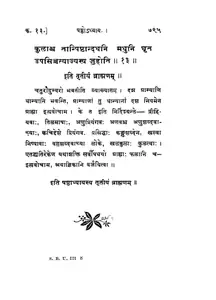
- The teaching is to be passed on only to a son or a pupil. Sankara notes that priyangu is the grain known as kangu.
From the text (2)
to any one, except to a son or to a pupilBAU VI.3.1-13 (Kanva) = SB XIV.9.3 · printed pp. 209-215The Sanskrit of this lineतम् एतं नापुत्राय वानन्तेवासिने वा ब्रूयात्
प्रियङ्गवः प्रसिद्धाः कङ्गुशब्देन
 The printed page
The Works of Sri Sankaracharya (Sri Vani Vilas edition), Vol. 10: Upanishad-bhashya part 7 - Brihadaranyaka adhyayas 5-6, Nrisimhapurvatapani (mula te (ed. Sri Vani Vilas Press edition (no individual editor named in the scan metadata)), Srirangam (Sri Vani Vilas Press), 1910, p. 795priyaṅgavaḥ prasiddhāḥ kaṅguśabdena"priyangu is known by the word kangu" (our translation)
Sankara on BAU 6.3.13 (GRETIL)
Sources: Brihadaranyaka Upanishad · BAU VI.3.1-13 (Kanva) = SB XIV.9.3 · tr. F. Max Muller · The Upanishads, Part II, Sacred Books of the East 15, Oxford 1884 | Shatapatha Brahmana XIV (Sanskrit) · SB 14.9.3.22 (GRETIL) · Satapatha-Brahmana book 14, GRETIL | Sankara's commentary on the Brihadaranyaka Upanishad (Sanskrit) · Sankara on BAU 6.3.13 (GRETIL) · Brhadaranyaka-Upanisad (Kanva) with Sankara's commentary, GRETIL
Royal consecration rite (anointing)
The great anointing of a king: young shoots of priyangu among the anointing materials
aindra mahābhiṣeka
Foxtail millet · priyaṅgu
- What is offered
- Young green shoots of four plants, rice, large rice, priyangu (panic seed) and barley, are gathered as materials for the great anointing of a king.
From the text (2)
the green shoots of rice, large rice, panic seed and barleyAB VIII.15-17 · printed pp. 331-333
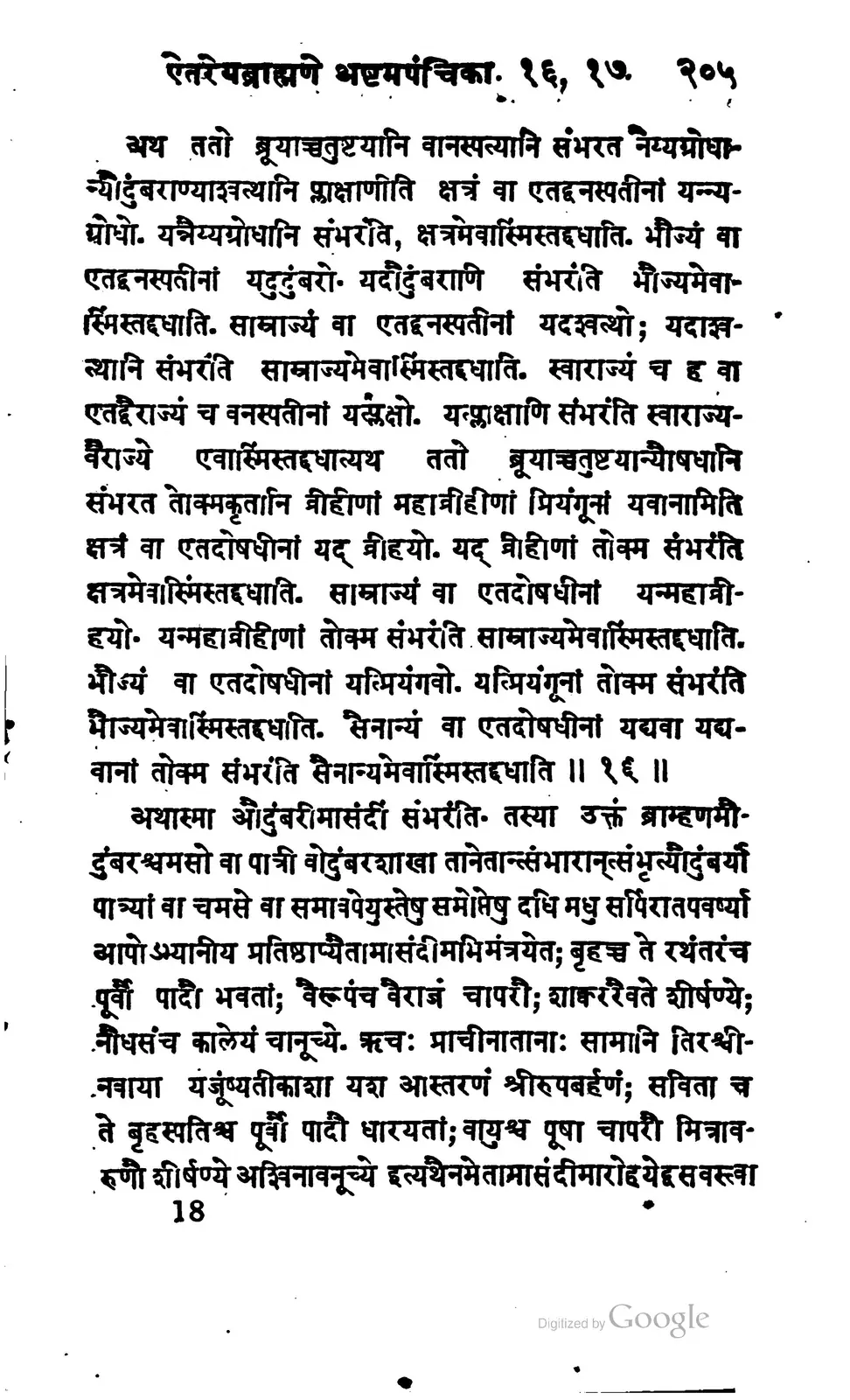
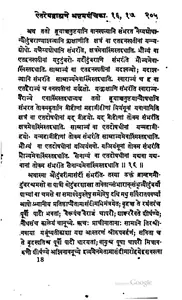
तोक्मकृतानि व्रीहीणाम् महाव्रीहीणाम् प्रियंगूनां यवानाम्
 The printed page
The Aitareya Brahmanam of the Rigveda ... edited, translated and explained by Martin Haug. Vol. I: Sanskrit text, with preface, introductory essay, an (ed. Martin Haug), Bombay (Government Central Book Depot; London: Truebner), 1863, p. 205tokmakr̥tāni vrīhīṇām mahāvrīhīṇām priyaṃgūnāṃ yavānām"as young shoots: of rice, of large rice, of priyangu, of barley" (our translation)
AB 8.16 (TITUS)
- Why
- "In that they bring together the green shoots of panic seeds, verily thus he confers upon him paramount rule."
From the text (2)
in that they bring together the green shoots of panic seeds, verily thus he confers upon him paramount ruleAB VIII.15-17 · printed pp. 331-333
भौज्यं वा एतद् ओषधीनां यत् प्रियंगवो
The printed page
The Aitareya Brahmanam of the Rigveda ... edited, translated and explained by Martin Haug. Vol. I: Sanskrit text, with preface, introductory essay, an (ed. Martin Haug), Bombay (Government Central Book Depot; London: Truebner), 1863, p. 205bʰaujyaṃ vā etad oṣadʰīnāṃ yat priyaṃgavo"Priyangu is the bhaujya (Keith: paramount rule) of the plants." (our translation)
AB 8.16 (TITUS)
- How
- The shoots, with products of four sacred trees, are put together in an udumbara bowl or goblet, mixed with curds, honey, melted butter and rain water, and the king is anointed with the mixture.
From the text (3)
they should throw them together in the bowl or goblet of UdumbaraAB VIII.15-17 · printed pp. 331-333
he should put curds, honey, melted butter, and water of the rains with sunshineAB VIII.15-17 · printed pp. 331-333
he should anoint him with this great anointing of IndraAB VIII.15-17 · printed pp. 331-333The Sanskrit of this lineएतेनैन्द्रेण महाभिषेकेण क्षत्रियं शापयित्वा ऽभिषिञ्चेद्
- When
- The text gives no season or date
- Who performs it
- A Kshatriya (king) "who knows thus" and desires these powers; he is anointed with "this great anointing of Indra".
From the text (2)
If a Ksatriya who knows thus desireAB VIII.15-17 · printed pp. 331-333The Sanskrit of this lineस य इछेद् एवंवित् क्षत्रियो
he should anoint him with this great anointing of IndraAB VIII.15-17 · printed pp. 331-333The Sanskrit of this lineएतेनैन्द्रेण महाभिषेकेण क्षत्रियं शापयित्वा ऽभिषिञ्चेद्
- Its meaning
- Each of the four plants stands for a kind of royal power; priyangu stands for "paramount rule".
From the text (1)
Panic seeds are the paramount rule of the plantsAB VIII.15-17 · printed pp. 331-333
Sources: Aitareya Brahmana · AB VIII.15-17 · tr. Arthur Berriedale Keith · Rigveda Brahmanas: the Aitareya and Kausitaki Brahmanas, Harvard Oriental Series 25, 1920 | Aitareya Brahmana (Sanskrit) · AB 8.16 (TITUS) · Aitareya-Brahmana, TITUS e-text
Also in: The "stream of wealth" at the completion of the fire altar: millets named in the litany
Also in: Building the fire altar: sowing seeds of fourteen plants on the ploughed altar site
Also in: Marriage: plants and grains for the consecrated water-jar
Also in: Grains set out for the regular fire offerings
Stories from the scriptures
How the texts themselves tell it: the Vedas, the Upanishads, the Mahabharata and the Puranas. Each story is retold sentence by sentence from its verses, which you can open below it.
narrative (origin story told inside a Vedic offering)
The Maruts, the speckled cow and the origin of priyangu
foxtail millet
The Taittiriya Samhita explains why priyangu is cooked in the milk of a speckled cow and offered to the Maruts. From the milk of the speckled cow the Maruts were born, and from the speckled cow came priyangu, which Keith translates as "panic seed". So a man who wishes for a village offers the Maruts priyangu cooked in that milk. His fellows, the text says, have the Maruts for their deity: he approaches the Maruts with their own share, and they make his fellows subject to him. The verses spoken at the offering contain the word "dear", and so he is made dear to his fellows. The Maitrayani Samhita tells the same origin in its own words: what the speckled one gave as milk became priyangu; the speckled one is this earth, or Speech, and the priyangu grains are her milk.
The verses (11)
should offer to the Maruts an oblation of panic seed in the milk of a speckled (cow)Taittiriya Samhita TS II.2.11.4 · printed p. 159 (PDF p. 331)
from the milk of a speckled (cow) were the Maruts born, of the speckled (cow) panic seedTaittiriya Samhita TS II.2.11.4 · printed p. 159 (PDF p. 331)
He who desires a village should offerTaittiriya Samhita TS II.2.11.4 · printed p. 159 (PDF p. 331)
his fellows have the Maruts for their deityTaittiriya Samhita TS II.2.11.4 · printed p. 159 (PDF p. 331)
verily he has recourse to the Maruts with their own shareTaittiriya Samhita TS II.2.11.4 · printed p. 159 (PDF p. 331)
verily they subject his fellows to himTaittiriya Samhita TS II.2.11.4 · printed p. 159 (PDF p. 331)
The Yajya and the Anuvakya contain the wordTaittiriya Samhita TS II.2.11.4 · printed p. 159 (PDF p. 331)
verily he makes him dear to his fellowsTaittiriya Samhita TS II.2.11.4 · printed p. 159 (PDF p. 331)
पृश्नियै दुग्धे प्रैयंगवं चरुं निर् वपेन् मरुद्भ्यो ग्रामकामः
The printed page
The Sanhitá of the Black Yajur Veda, with the commentary of Mádhava Áchárya, Vol. II: Kánda I, Prapáthaka VIII - Kánda II (Bibliotheca Indica) (ed. E. B. Cowell), Calcutta (C. B. Lewis, Baptist Mission Press), 1866, p. 369pŕ̥śniyai dugdʰé práiyaṃgavaṃ carúṃ nír vapen marúdbʰyo grā́makāmaḥ"In the milk of a speckled (cow) he should offer a pot of priyangu to the Maruts, (he who is) desirous of a village." (our translation)
Taittiriya Samhita (Sanskrit) TS 2.2.11.4 (TITUS)
पृश्निर् वै यद् अदुहत् स प्रियङ्गुर् अभवद्
The printed page
Māitrāyaṇī Saṃhitā, herausgegeben von Dr. Leopold von Schroeder. Zweites Buch (gedruckt auf Kosten der Deutschen Morgenländischen Gesellschaft) (ed. Leopold von Schroeder), Leipzig (in Commission bei F. A. Brockhaus), 1883, p. 9pṛśnir vai yad aduhat sa priyaṅgur abhavad"What the speckled one (Prishni) gave as milk, that became priyangu." (our translation)
Maitrayani Samhita (Sanskrit) MS II.1.8 (GRETIL)
इयं वै पृश्निर् वाग् वा तस्या वा एतत् पयो यत् प्रियङ्गवः
The printed page
Māitrāyaṇī Saṃhitā, herausgegeben von Dr. Leopold von Schroeder. Zweites Buch (gedruckt auf Kosten der Deutschen Morgenländischen Gesellschaft) (ed. Leopold von Schroeder), Leipzig (in Commission bei F. A. Brockhaus), 1883, p. 9iyaṃ vai pṛśnir vāg vā tasyā vā etat payo yat priyaṅgavaḥ"This (earth) is the speckled one, or Speech; the priyangu grains are her milk." (our translation)
Maitrayani Samhita (Sanskrit) MS II.1.8 (GRETIL)
Source: Taittiriya Samhita, Taittiriya Samhita II.2.11.4; parallel Maitrayani Samhita II.1.8 · tr. Arthur Berriedale Keith · The Veda of the Black Yajus School entitled Taittiriya Sanhita, Part 1 (Kandas I-III), Harvard Oriental Series 18, 1914 · printed p. 159 (PDF p. 331)
narrative (two origin stories)
Soma's wish and Rudra's wish: shyamaka and priyangu cooked in milk
barnyard milletfoxtail millet
The Taittiriya Brahmana tells two short stories, one after the other. Soma once desired: "May I win the kingship of the plants." He offered a pot of shyamaka cooked in milk to Soma and to Mrigashirsha, and so he won the kingship of the plants. Whoever sacrifices with this oblation, the text says, wins kingship over his equals, and the offering is made with the words "svaha to Soma, svaha to Mrigashirsha". Rudra too desired: "May I be rich in cattle." He offered a pot of priyangu cooked in milk to Rudra and to Ardra, and he became rich in cattle. Mrigashirsha (also called Invaka) and Ardra are nakshatras, the lunar mansions: Mrigashirsha is the little group of stars in Orion's head, and Ardra a brilliant star.
The verses (16)
सोमो वा अकामयत
The printed page
The Taittiríya Bráhmana of the Black Yajur Veda, with the commentary of Sáyanáchárya, Vol. III (Bibliotheca Indica) (ed. Rájendralála Mitra), Calcutta (Baptist Mission Press), 1863, p. 11sómo vā́ akāmayata"Soma desired:" (our translation)
Taittiriya Brahmana (Sanskrit) TB III.1.4.3 (TITUS)
ओषधीनाꣳ राज्यम् अभिजयेयम् इति
The printed page
The Taittiríya Bráhmana of the Black Yajur Veda, with the commentary of Sáyanáchárya, Vol. III (Bibliotheca Indica) (ed. Rájendralála Mitra), Calcutta (Baptist Mission Press), 1863, p. 11óṣadʰīnām̐ rājyám abʰíjayeyam íti"May I win the kingship of the plants." (our translation)
Taittiriya Brahmana (Sanskrit) TB III.1.4.3 (TITUS)
स एतꣳ सोमाय मृगशीर्षाय श्यामाकं चरुं पयसि निरवपत्
The printed page
The Taittiríya Bráhmana of the Black Yajur Veda, with the commentary of Sáyanáchárya, Vol. III (Bibliotheca Indica) (ed. Rájendralála Mitra), Calcutta (Baptist Mission Press), 1863, p. 11sá etám̐ sómāya mr̥gaśīrṣā́ya śyāmākáṃ carúṃ páyasi níravapat"He offered this pot (caru) of shyamaka, (cooked) in milk, to Soma, to Mrigashirsha." (our translation)
Taittiriya Brahmana (Sanskrit) TB III.1.4.3 (TITUS)
ततो वै स ओषधीनाꣳ राज्यम् अभ्यजयत्
The printed page
The Taittiríya Bráhmana of the Black Yajur Veda, with the commentary of Sáyanáchárya, Vol. III (Bibliotheca Indica) (ed. Rájendralála Mitra), Calcutta (Baptist Mission Press), 1863, p. 11táto vái sá óṣadʰīnām̐ rājyám abʰyàjayat"Then he won the kingship of the plants." (our translation)
Taittiriya Brahmana (Sanskrit) TB III.1.4.3 (TITUS)
समानानाꣳ ह वै राज्यम् अभिजयति
The printed page
The Taittiríya Bráhmana of the Black Yajur Veda, with the commentary of Sáyanáchárya, Vol. III (Bibliotheca Indica) (ed. Rájendralála Mitra), Calcutta (Baptist Mission Press), 1863, p. 11samānā́nām̐ ha vái rājyám abʰíjayati"He wins kingship over his equals ..." (our translation)
Taittiriya Brahmana (Sanskrit) TB III.1.4.3 (TITUS)
य एतेन हविषा यजते
The printed page
The Taittiríya Bráhmana of the Black Yajur Veda, with the commentary of Sáyanáchárya, Vol. III (Bibliotheca Indica) (ed. Rájendralála Mitra), Calcutta (Baptist Mission Press), 1863, p. 11yá eténa havíṣā yájate"... who sacrifices with this oblation." (our translation)
Taittiriya Brahmana (Sanskrit) TB III.1.4.3-4 (TITUS)
सोमाय स्वाहा मृगशीर्षाय स्वाहा
The printed page
The Taittiríya Bráhmana of the Black Yajur Veda, with the commentary of Sáyanáchárya, Vol. III (Bibliotheca Indica) (ed. Rájendralála Mitra), Calcutta (Baptist Mission Press), 1863, p. 11sómāya svā́hā mr̥gaśīrṣā́ya svā́hā"Svaha to Soma, svaha to Mrigashirsha." (our translation)
Taittiriya Brahmana (Sanskrit) TB III.1.4.3 (TITUS)
रुद्रो वा अकामयत
The printed page
The Taittiríya Bráhmana with the commentary of Bhaṭṭa Bhāskara Miśra, Aṣṭaka III, Part I (prapāṭhakas 1-7) (Bibliotheca Sanskrita, Government Oriental (ed. A. Mahadeva Sastri and L. Srinivasacharya), Mysore (Government Branch Press), 1911, p. 35rudró vā́ akāmayata"Rudra desired:" (our translation)
Taittiriya Brahmana (Sanskrit) TB III.1.4.4 (TITUS)
पशुमान्त् स्याम् इति
The printed page
The Taittiríya Bráhmana with the commentary of Bhaṭṭa Bhāskara Miśra, Aṣṭaka III, Part I (prapāṭhakas 1-7) (Bibliotheca Sanskrita, Government Oriental (ed. A. Mahadeva Sastri and L. Srinivasacharya), Mysore (Government Branch Press), 1911, p. 35paśumā́nt syām íti"May I be rich in cattle." (our translation)
Taittiriya Brahmana (Sanskrit) TB III.1.4.4 (TITUS)
स एतꣳ रुद्राय आर्द्रायै प्रैयंगवं चरुं पयसि निरवपत्
The printed page
The Taittiríya Bráhmana with the commentary of Bhaṭṭa Bhāskara Miśra, Aṣṭaka III, Part I (prapāṭhakas 1-7) (Bibliotheca Sanskrita, Government Oriental (ed. A. Mahadeva Sastri and L. Srinivasacharya), Mysore (Government Branch Press), 1911, p. 35sá etám̐ rudrā́ya _ārdrā́yai práiyaṃgavaṃ {BS práiyyaṅgavaṃ } carúṃ páyasi níravapat"He offered this pot of priyangu, (cooked) in milk, to Rudra, to Ardra." ({BS ...} is a variant reading printed in the e-text) (our translation)
Taittiriya Brahmana (Sanskrit) TB III.1.4.4 (TITUS)
ततो वै स पशुमान् अभवत्
The printed page
The Taittiríya Bráhmana with the commentary of Bhaṭṭa Bhāskara Miśra, Aṣṭaka III, Part I (prapāṭhakas 1-7) (Bibliotheca Sanskrita, Government Oriental (ed. A. Mahadeva Sastri and L. Srinivasacharya), Mysore (Government Branch Press), 1911, p. 35táto vái sá paśumā́n abʰavat"Then he became rich in cattle." (our translation)
Taittiriya Brahmana (Sanskrit) TB III.1.4.4 (TITUS)
also called Invaka or InvagaVedic Index of Names and Subjects, vol. I Vedic Index, s.v. Naksatra (no. 3, Mrgasirsa) · vol. I, pp. 415-416
being the name of the little group of stars in Orion's headVedic Index of Names and Subjects, vol. I Vedic Index, s.v. Naksatra (no. 2-3) · vol. I, pp. 415-416
Ardra, ' moist,' is the name of the brilliant starVedic Index of Names and Subjects, vol. I Vedic Index, s.v. Naksatra (no. 4, Ardra) · vol. I, p. 416
Naksatras (lunar mansions)Vedic Index of Names and Subjects, vol. I Vedic Index, s.v. Graha · vol. I, p. 244
head of Orion that make up the Naksatra MrgasirasVedic Index of Names and Subjects, vol. II Vedic Index, s.v. Mrga · vol. II, pp. 171-172
Source: Taittiriya Brahmana (Sanskrit), Taittiriya Brahmana III.1.4.3-4 (TITUS numbering 3.1.4.29-30) · Taittiriya-Brahmana, TITUS e-text
narrative (origin story of an offering)
How the quarrelling gods were reunited, with a pot of shyamaka for Soma
barnyard millet
The Maitrayani Samhita tells of a time when the gods would not grant one another first place and went apart in four groups: Agni with the Vasus, Soma with the Rudras, Indra with the Maruts and Varuna with the Adityas. Brihaspati made them sacrifice with this offering; the Taittiriya version calls it the sacrifice "with the verse for harmony". Each group had its own portion: a cake of satina on eight potsherds for Agni with the Vasus, a pot of shyamaka for Soma with the Rudras, a cake of wild rice on eleven potsherds for Indra with the Maruts, and a pot of barley for Varuna with the Adityas. Then they turned towards Indra and agreed on him. So, the text says, whoever sacrifices with this offering, to him they turn and on him they agree. The Taittiriya Samhita tells the same story with Prajapati as the one Indra turns to, and it does not name the grain of Soma's pot.
The verses (9)
देवा अन्योन्यस्य श्रैष्ठ्ये तिष्ठमानाश् चतुर्धा व्युदक्रामन्न् अग्निर् वसुभिः सोमो रुद्रैर् इन्द्रो मरुद्भिर् वरुण आदित्यैस्
The printed page
Māitrāyaṇī Saṃhitā, herausgegeben von Dr. Leopold von Schroeder. Zweites Buch (gedruckt auf Kosten der Deutschen Morgenländischen Gesellschaft) (ed. Leopold von Schroeder), Leipzig (in Commission bei F. A. Brockhaus), 1883, p. 19devā anyonyasya śraiṣṭhye tiṣṭhamānāś caturdhā vyudakrāmann agnir vasubhiḥ somo rudrair indro marudbhir varuṇa ādityais"The gods, each standing on his own pre-eminence over the others, went apart in four groups: Agni with the Vasus, Soma with the Rudras, Indra with the Maruts, Varuna with the Adityas." (our translation)
Maitrayani Samhita (Sanskrit) MS II.2.6 (GRETIL)
तान् वा एतया बृहस्पतिर् अयाजयत्
The printed page
Māitrāyaṇī Saṃhitā, herausgegeben von Dr. Leopold von Schroeder. Zweites Buch (gedruckt auf Kosten der Deutschen Morgenländischen Gesellschaft) (ed. Leopold von Schroeder), Leipzig (in Commission bei F. A. Brockhaus), 1883, p. 19tān vā etayā bṛhaspatir ayājayat"Brihaspati made them sacrifice with this (offering)." (our translation)
Maitrayani Samhita (Sanskrit) MS II.2.6 (GRETIL)
अग्नये वसुमते सतीनानाम् अष्टाकपालं निर्वपेत् सोमाय रुद्रवते श्यामाकं चरुम् इन्द्राय मरुत्वते नैवारम् एकादशकपालं वरुणायादित्यवते यवमयं चरुं
The printed page
Māitrāyaṇī Saṃhitā, herausgegeben von Dr. Leopold von Schroeder. Zweites Buch (gedruckt auf Kosten der Deutschen Morgenländischen Gesellschaft) (ed. Leopold von Schroeder), Leipzig (in Commission bei F. A. Brockhaus), 1883, p. 19agnaye vasumate satīnānām aṣṭākapālaṃ nirvapet somāya rudravate śyāmākaṃ carum indrāya marutvate naivāram ekādaśakapālaṃ varuṇāyādityavate yavamayaṃ caruṃ"For Agni with the Vasus he should offer a cake of satina on eight potsherds; for Soma with the Rudras a pot of shyamaka; for Indra with the Maruts a cake of wild rice on eleven potsherds; for Varuna with the Adityas a pot of barley." (our translation)
Maitrayani Samhita (Sanskrit) MS II.2.6 (GRETIL)
इन्द्रम् एवाभिसमावर्तन्तेन्द्रम् अभिसमजानत
The printed page
Māitrāyaṇī Saṃhitā, herausgegeben von Dr. Leopold von Schroeder. Zweites Buch (gedruckt auf Kosten der Deutschen Morgenländischen Gesellschaft) (ed. Leopold von Schroeder), Leipzig (in Commission bei F. A. Brockhaus), 1883, p. 19indram evābhisamāvartantendram abhisamajānata"They turned towards Indra; they agreed on Indra." (our translation)
Maitrayani Samhita (Sanskrit) MS II.2.6 (GRETIL)
तद् य एतया यजते तम् एवाभिसमावर्तन्ते तम् अभिसंजानते
The printed page
Māitrāyaṇī Saṃhitā, herausgegeben von Dr. Leopold von Schroeder. Zweites Buch (gedruckt auf Kosten der Deutschen Morgenländischen Gesellschaft) (ed. Leopold von Schroeder), Leipzig (in Commission bei F. A. Brockhaus), 1883, p. 19tad ya etayā yajate tam evābhisamāvartante tam abhisaṃjānate"So whoever sacrifices with this, to him they turn, on him they agree." (our translation)
Maitrayani Samhita (Sanskrit) MS II.2.6 (GRETIL)
unwilling to accept the pre-eminence of another they went apart in four bodiesTaittiriya Samhita TS II.2.11.5 (parallel) · printed p. 159 (PDF p. 331)
Indra had recourse to PrajapatiTaittiriya Samhita TS II.2.11.5 (parallel) · printed p. 159 (PDF p. 331)
sacrifice with the verse for harmonyTaittiriya Samhita TS II.2.11.5 (parallel) · printed p. 159 (PDF p. 331)
सोमाय रुद्रवते चरुम् इन्द्राय मरुत्वते पुरोडाशम्
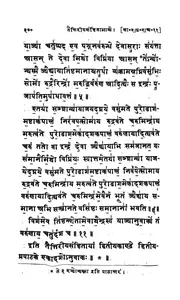 The printed page
The Sanhitá of the Black Yajur Veda, with the commentary of Mádhava Áchárya, Vol. II: Kánda I, Prapáthaka VIII - Kánda II (Bibliotheca Indica) (ed. E. B. Cowell), Calcutta (C. B. Lewis, Baptist Mission Press), 1866, p. 370sómāya rudrávate carúm índrāya marútvate puroḍā́śam"for Soma with the Rudras a pot (caru), for Indra with the Maruts a cake" (no grain is named for the pot) (our translation)
Taittiriya Samhita (Sanskrit) TS 2.2.11.6 (TITUS, parallel)
Source: Maitrayani Samhita (Sanskrit), Maitrayani Samhita II.2.6; parallel Taittiriya Samhita II.2.11.5-6 · Maitrayani Samhita, GRETIL plain text (ed. L. von Schroeder)
teaching (not a narrative)
Shandilya's teaching: the self smaller than a grain of millet
barnyard millet
Shandilya's teaching, found both in the Chandogya Upanishad and in the Shatapatha Brahmana, compares the self within the heart with tiny grains. The self within the heart, it says, is smaller than a grain of rice or of barley, smaller than a mustard seed, smaller than a grain of shyamaka or even the kernel of a shyamaka grain. Yet this same self within the heart is greater than the earth, greater than the sky, greater than heaven, greater than all these worlds. The Shatapatha version names rice, barley, the shyamaka grain and its kernel, and calls this self the golden Person within. Both passages close with the words "thus spoke Shandilya". Translators differ on the grain: Max Muller wrote "canary seed", Eggeling wrote "millet", and the Monier-Williams dictionary gives shyamaka as a cultivated millet, Panicum frumentaceum.
The verses (10)
एष म आत्मा अन्तर्हृदये ऽणीयान् व्रीहेर् वा यवाद् वा सर्षपाद् वा श्यामाकाद् वा श्यामाकतण्डुलाद् वा
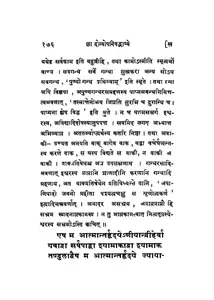 The printed page
The Works of Sri Sankaracharya (Sri Vani Vilas edition), Vol. 6: Upanishad-bhashya part 3 - Taittiriya, Chhandogya 1-3 (mula text with Sankara's (ed. Sri Vani Vilas Press edition (no individual editor named in the scan metadata)), Srirangam (Sri Vani Vilas Press), 1910, p. 176eṣa ma ātmā antarhṛdaye 'ṇīyān vrīher vā yavād vā sarṣapād vā śyāmākād vā śyāmākataṇḍulād vā"This self of mine within the heart is smaller than a grain of rice, or barley, or a mustard seed, or a shyamaka grain, or the kernel of a shyamaka grain." (our translation)
Chandogya Upanishad (Sanskrit, with Shankara commentary) ChU III.14.3 (GRETIL)
एष म आत्मा अन्तर्हृदये ज्यायान् पृथिव्या ज्यायान् अन्तरिक्षाज् ज्यायान् दिवो ज्यायान् एभ्यो लोकेभ्यः
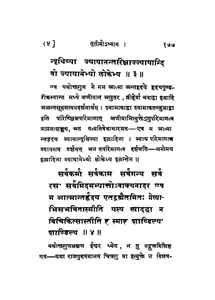 The printed page
The Works of Sri Sankaracharya (Sri Vani Vilas edition), Vol. 6: Upanishad-bhashya part 3 - Taittiriya, Chhandogya 1-3 (mula text with Sankara's (ed. Sri Vani Vilas Press edition (no individual editor named in the scan metadata)), Srirangam (Sri Vani Vilas Press), 1910, p. 177eṣa ma ātmā antarhṛdaye jyāyān pṛthivyā jyāyān antarikṣāj jyāyān divo jyāyān ebhyo lokebhyaḥ"This self of mine within the heart is greater than the earth, greater than the mid-air, greater than heaven, greater than these worlds." (our translation)
Chandogya Upanishad (Sanskrit, with Shankara commentary) ChU III.14.3 (GRETIL)
इति ह स्माह शाण्डिल्यः
The printed page
The Works of Sri Sankaracharya (Sri Vani Vilas edition), Vol. 6: Upanishad-bhashya part 3 - Taittiriya, Chhandogya 1-3 (mula text with Sankara's (ed. Sri Vani Vilas Press edition (no individual editor named in the scan metadata)), Srirangam (Sri Vani Vilas Press), 1910, p. 177iti ha smāha śāṇḍilyaḥ"Thus spoke Shandilya." (our translation)
Chandogya Upanishad (Sanskrit, with Shankara commentary) ChU III.14.4 (GRETIL)
He is my self within the heart, smaller than a corn of riceChandogya Upanishad ChU III.14.3 · p. 48
smaller than a canary seed or the kernel of a canary seedChandogya Upanishad ChU III.14.3 · p. 48
greater than the earth, greater than the sky, greater than heaven, greater than all these worldsChandogya Upanishad ChU III.14.3 · p. 48
यथा व्रीहिर्वा यवो वा श्यामाको वा श्यामाकतण्डुलो वैवमयमन्तरात्मन्पुरुषो हिरण्मयो
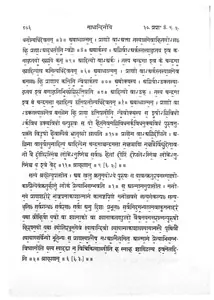 The printed page
The Çatapatha-Brâhmaṇa in the Mâdhyandina-Çâkhâ with extracts from the commentaries of Sâyaṇa, Harisvâmin and Dvivedagaṅga [series label White Yajurve (ed. Albrecht Weber), Berlin: Ferd. Dümmler's Verlagsbuchhandlung; London: Williams and Norgate, 1855, p. 806yathā vrīhirvā yavo vā śyāmāko vā śyāmākataṇḍulo vaivamayamantarātmanpuruṣo hiraṇmayo"As a grain of rice, or of barley, or a shyamaka grain, or the kernel of a shyamaka grain, so is this golden Person within the self." (our translation)
Shatapatha Brahmana (Sanskrit), book 10 SB 10.6.3.2 (GRETIL)
ह स्माह शाण्डिल्य एवमेतदिति
The printed page
The Çatapatha-Brâhmaṇa in the Mâdhyandina-Çâkhâ with extracts from the commentaries of Sâyaṇa, Harisvâmin and Dvivedagaṅga [series label White Yajurve (ed. Albrecht Weber), Berlin: Ferd. Dümmler's Verlagsbuchhandlung; London: Williams and Norgate, 1855, p. 806ha smāha śāṇḍilya evametaditi"(thus) spoke Shandilya: so it is." (our translation)
Shatapatha Brahmana (Sanskrit), book 10 SB 10.6.3.2 (GRETIL)
even as a grain of rice, or a grain of barley, or a grain of millet, or the smallest granule of milletShatapatha Brahmana SB X.6.3.2 · p. 400
a kind of cultivated millet ( Panicum FrumentaceumMonier-Williams, Sanskrit-English Dictionary (1899), entry SyAmAka Monier-Williams s.v. syAmAka · p. 1095
Source: Chandogya Upanishad, Chandogya Upanishad III.14.3-4; parallel Shatapatha Brahmana X.6.3.2 · tr. F. Max Muller · The Upanishads, Part I, Sacred Books of the East 1, Oxford 1879 · p. 48
narrative
Nimi's first offering to the ancestors: a meal of shyamaka
barnyard millet
In the Mahabharata, Yudhishthira asks who first conceived the shraddha, the offering to the ancestors, and Bhishma tells him how it began. In the line of the sage Atri was born Dattatreya; his son was Nimi, and Nimi's son Shrimat, after a full thousand years of severe austerities, passed away. Nimi was filled with grief, thinking continually of his son; then, with his mind collected, he conceived the idea of a shraddha. On the new-moon day he invited Brahmanas, seated them on kusha grass, and gave seven of them a meal of shyamaka, without salt. Afterwards he was troubled, fearing he had done something that no scripture had laid down. He thought of the founder of his line, and Atri came and comforted him: this rite, Atri said, is an offering in honour of the ancestors, laid down by Brahma himself in days of old.
The verses (19)
Bhishma said, 'Listen to me, O ruler of men, as I tell thee how the Sraddha was introducedMahabharata Anusasana Parva, Section XCI · p. 151The Sanskrit of this lineभीष्म उवाच । यथा श्राद्धं संप्रवृत्तं यस्मिन् काले यद् आत्मकम् । येन संकल्पितं चैव तन् मे शृणु जनाधिप
Yudhishthira said, 'By whom was the Sraddha first conceivedMahabharata Anusasana Parva, Section XCI · p. 151The Sanskrit of this lineयुधिष्ठिर उवाच । केन संकल्पितं श्राद्धं कस्मिन् काले किम् आत्मकम्
In Atri's race was born a Muni of the name of DattatreyaMahabharata Anusasana Parva, Section XCI · p. 151The Sanskrit of this lineतस्य वंशे महाराज दत्तात्रेय इति स्मृतः
Dattatreya got a son of the name of NimiMahabharata Anusasana Parva, Section XCI · p. 151The Sanskrit of this lineदत्तात्रेयस्य पुत्रो ऽभून् निमिर् नाम तपोधनः
Nimi got a son named SrimatMahabharata Anusasana Parva, Section XCI · p. 151The Sanskrit of this lineनिमेश् चाप्य् अभवत् पुत्रः श्रीमान् नाम श्रिया वृतः
Upon the expiration of a full thousand years, Srimat, having undergone the severest austerities, succumbed to the influence of TimeMahabharata Anusasana Parva, Section XCI · p. 152The Sanskrit of this lineपूर्णे वर्षसहस्रान्ते स कृत्वा दुष्करं तपः । कालधर्मपरीतात्मा निधनं समुपागतः
became filled with great grief, thinking continually of the loss of his sonMahabharata Anusasana Parva, Section XCI · p. 152The Sanskrit of this lineसंतापम् अगमत् तीव्रं पुत्रशोकपरायणः
With concentrated attention he then conceived the idea of a SraddhaMahabharata Anusasana Parva, Section XCI · p. 152The Sanskrit of this lineततः संचिन्तयाम् आस श्राद्धकल्पं समाहितः
On the day of the New moon he invited a number of adorable BrahmanasMahabharata Anusasana Parva, Section XCI · p. 152The Sanskrit of this lineअमावास्यां महाप्राज्ञ विप्रान् आनाय्य पूजितान्
Nimi caused them to be seated on seats (of Kusa grass)Mahabharata Anusasana Parva, Section XCI · p. 152The Sanskrit of this lineदक्षिणावर्तिकाः सर्वा बृसीः स्वयम् अथाकरोत्
Approaching seven such BrahmanasMahabharata Anusasana Parva, Section XCI · p. 152
the puissant Nimi gave unto them food consisting of Syamaka rice, unmixed with saltMahabharata Anusasana Parva, Section XCI · p. 152
ऋते च लवणं भोज्यं श्यामाकान्नं ददौ प्रभुः
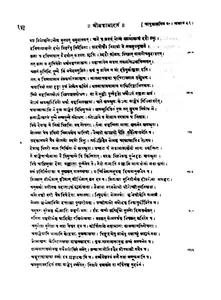 The printed page
Śrīmahābhārataṃ, caturthakhaṇḍaḥ (Anuśāsana to Svargārohaṇa parvans and Harivaṃśa) = The Mahabharata, an epic poem, Vol. IV (Calcutta edition) (ed. Pandits of the Asiatic Society of Bengal (archive.org metadata names 'Panchanan, Ramahari Nyaya' as editor)), Calcutta, 1839, p. 152ṛte ca lavaṇaṃ bhojyaṃ śyāmākānnaṃ dadau prabhuḥ"and the lord gave them food without salt: a meal of shyamaka." (our translation)
Mahabharata, book 13 (Sanskrit, critical edition) MBh 13.91.13cd (critical edition)
filled with regret at the idea of having achieved an act that had not (to his knowledge) been laid down in any of the scripturesMahabharata Anusasana Parva, Section XCI · p. 152
He then thought of the original progenitor of his raceMahabharata Anusasana Parva, Section XCI · p. 152
Atri endued with wealth of penances came thereMahabharata Anusasana Parva, Section XCI · p. 152
comforted him with agreeable counselsMahabharata Anusasana Parva, Section XCI · p. 152
this rite that thou hast conceived, is a sacrifice in honour of the PitrisMahabharata Anusasana Parva, Section XCI · p. 152
The Grandsire Brahman himself, in days of old, laid it down!Mahabharata Anusasana Parva, Section XCI · p. 152
Source: Mahabharata, Mahabharata XIII (Anushasana Parva), CE 13.91; Ganguli Section XCI · tr. Kisari Mohan Ganguli · The Mahabharata of Krishna-Dwaipayana Vyasa, 1883-1896 (sacred-texts.com redaction, archive.org compilation) · pp. 151-152
pilgrimage teaching (not a narrative)
The river Apaga, where a meal of shyamaka brings great merit
barnyard millet
The pilgrimage section (Tirtha-yatra) of the Mahabharata's Book of the Forest tells the pilgrim which holy places (tirthas) to visit next. One krosha east of the tirtha called Manusha, it says, flows a river named Apaga, frequented by the Siddhas. Whoever offers a meal of shyamaka there, in honour of the gods and the ancestors, gains great religious merit. And if one Brahmana is fed there, the text says, it is as if ten million had been fed. The Sanskrit speaks of a "meal of shyamaka" (shyamaka-bhojana), given in honour of the gods and the ancestors.
The verses (10)
Book 3: Vana Parva: Tirtha-yatra Parva: Section LXXXIIIMahabharata Vana Parva, Tirtha-yatra Parva, Section LXXXIII (heading) · p. 176
Distant by a krosa, O king, to the east of ManushaMahabharata Vana Parva, Section LXXXIII · p. 176
there is a river celebrated by the name of ApagaMahabharata Vana Parva, Section LXXXIII · p. 176
आपगा नाम विख्याता नदी सिद्धनिषेविता
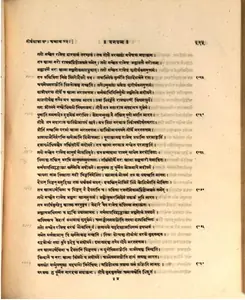 The printed page
The Mahábhárata, an epic poem, written by the celebrated Veda Vyása Rishi. Vol. I, containing Part I The Ádi Parva, II The Sabhá Parva, III The Vana P (ed. The learned Pandits attached to the establishment of the Education Committee (title page)), Calcutta (Education Committee's Press, Circular Road), 1834, p. 525āpagā nāma vikhyātā nadī siddhaniṣevitā"a river famed by the name Apaga, frequented by the Siddhas" (our translation)
Mahabharata, book 3 (Sanskrit, critical edition) MBh 3.81.55cd (critical edition)
The man that offereth there the syamaka grain in honour of the gods and the Pitris acquireth great religious meritMahabharata Vana Parva, Section LXXXIII · p. 176
श्यामाकभोजनं तत्र यः प्रयच्छति मानवः
The printed page
The Mahábhárata, an epic poem, written by the celebrated Veda Vyása Rishi. Vol. I, containing Part I The Ádi Parva, II The Sabhá Parva, III The Vana P (ed. The learned Pandits attached to the establishment of the Education Committee (title page)), Calcutta (Education Committee's Press, Circular Road), 1834, p. 525śyāmākabhojanaṃ tatra yaḥ prayacchati mānavaḥ"The man who gives a meal of shyamaka there ..." (our translation)
Mahabharata, book 3 (Sanskrit, critical edition) MBh 3.81.56ab (critical edition)
देवान् पितॄंश् च उद्दिश्य तस्य धर्मफलं महत्
The printed page
The Mahábhárata, an epic poem, written by the celebrated Veda Vyása Rishi. Vol. I, containing Part I The Ádi Parva, II The Sabhá Parva, III The Vana P (ed. The learned Pandits attached to the establishment of the Education Committee (title page)), Calcutta (Education Committee's Press, Circular Road), 1834, p. 525devān pitṝṃś ca uddiśya tasya dharmaphalaṃ mahat"... in honour of the gods and the ancestors, great is his reward of merit." (our translation)
Mahabharata, book 3 (Sanskrit, critical edition) MBh 3.81.56cd (critical edition)
And if one Brahmana is fed there, it becomes equivalent to feeding ten millions of BrahmanasMahabharata Vana Parva, Section LXXXIII · p. 176
एकस्मिन् भोजिते विप्रे कोटिर् भवति भोजिता
The printed page
The Mahábhárata, an epic poem, written by the celebrated Veda Vyása Rishi. Vol. I, containing Part I The Ádi Parva, II The Sabhá Parva, III The Vana P (ed. The learned Pandits attached to the establishment of the Education Committee (title page)), Calcutta (Education Committee's Press, Circular Road), 1834, p. 525ekasmin bhojite vipre koṭir bhavati bhojitā"When one Brahmin is fed (there), ten million are fed." (our translation)
Mahabharata, book 3 (Sanskrit, critical edition) MBh 3.81.56ef (critical edition)
should next proceed, O king, to the celebrated tirtha called ManushaMahabharata Vana Parva, Section LXXXIII · p. 176
Source: Mahabharata, Mahabharata III (Vana Parva, Tirtha-yatra), CE 3.81.55-56; Ganguli Section LXXXIII · tr. Kisari Mohan Ganguli · The Mahabharata of Krishna-Dwaipayana Vyasa, 1883-1896 (sacred-texts.com redaction, archive.org compilation) · p. 176
narrative (cosmogony)
The Vishnu Purana: how the first grains came to be grown
foxtail milletkodo milletbarnyard millet
The Vishnu Purana tells how people first came to grow grain. The beings Brahma created were at first endowed with righteousness and perfect faith, but in time, as sin grew, they began to suffer from heat and cold. So they built places of refuge, villages and cities, and then took to manual labour as a means of livelihood. They cultivated seventeen kinds of grain, among them rice, barley, wheat, anu, sesamum, priyangu, udara and koradusha, with many pulses. Wilson identifies kodrava as Paspalum and names chinaka as a sort of panic, Panicum miliaceum. Fourteen kinds, cultivated or wild, may be offered in sacrifice; besides rice, barley and the others they include shyamaka, which Wilson calls "a sort of panic", and nivara, wild rice. These grains, the Purana says, were produced for offering in sacrifice, and sacrifice, the cause of rain, is their origin too.
The verses (14)
were at first endowed with righteousness and perfect faithVishnu Purana VP I.6 · p. 45The Sanskrit of this lineसम्यक्छ्रद्धाः समाचारप्रवणा मुनिसत्तम
sin gaining strength, mortals were afflicted with pain, arising from susceptibility to contrasts, as heat and coldVishnu Purana VP I.6 · p. 45
They therefore constructed places of refugeVishnu Purana VP I.6 · p. 45
and formed villages and citiesVishnu Purana VP I.6 · p. 45
men next began to employ themselves in manual labour, as a means of livelihoodVishnu Purana VP I.6 · p. 46
the seventeen kinds of useful grain—rice, barley, wheat, millet, sesamum, panic, and various sorts ofVishnu Purana VP I.6 · p. 46
व्रीहयश् च यवाश् चैव गोधूमा अणवस् तिलाः
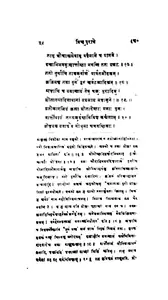 The printed page
Viṣṇupurāṇam, Śrīdharasvāmikṛta-Svaprakāśākhya-ṭīkāsahitam, saṃskṛtaṃ prakāśitaṃ ca Śrījīvānanda-Vidyāsāgara-Bhaṭṭācāryeṇa (Kalikātā, Sarasvatīyantra) (ed. Jīvānanda Vidyāsāgara Bhaṭṭācārya (with Śrīdharasvāmin's commentary)), Calcutta (Kalikātā, Sarasvatīyantra), 1882, p. 54vrīhayaś ca yavāś caiva godhūmā aṇavas tilāḥ"rice and barley, wheat, anu grains, sesamum" (our translation)
Vishnu Purana (Sanskrit, critical edition) ViP 1.6.21ab (critical edition)
प्रियंगवो ह्य् उदाराश् च कोरदूषाः सतीनकाः
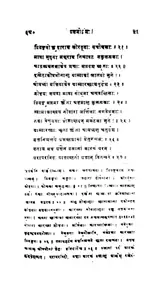 The printed page
Viṣṇupurāṇam, Śrīdharasvāmikṛta-Svaprakāśākhya-ṭīkāsahitam, saṃskṛtaṃ prakāśitaṃ ca Śrījīvānanda-Vidyāsāgara-Bhaṭṭācāryeṇa (Kalikātā, Sarasvatīyantra) (ed. Jīvānanda Vidyāsāgara Bhaṭṭācārya (with Śrīdharasvāmin's commentary)), Calcutta (Kalikātā, Sarasvatīyantra), 1882, p. 55priyaṃgavo hy udārāś ca koradūṣāḥ satīnakāḥ"priyangu, udara, koradusha and satinaka" (our translation)
Vishnu Purana (Sanskrit, critical edition) ViP 1.6.21cd (critical edition)
Kodrava (Paspalum kora); Chinaka, a sort of panic (P. miliaceum)Vishnu Purana VP I.6, Wilson's note on the seventeen grains · p. 46
there are fourteen kinds which may be offered in sacrificeVishnu Purana VP I.6 · p. 47
the others are, Syámáka, a sort of panic; Nivara, uncultivated riceVishnu Purana VP I.6 · p. 47
श्यामाकास् त्व् अथ नीवारा जर्तिलाः सगवेधुकाः
The printed page
Viṣṇupurāṇam, Śrīdharasvāmikṛta-Svaprakāśākhya-ṭīkāsahitam, saṃskṛtaṃ prakāśitaṃ ca Śrījīvānanda-Vidyāsāgara-Bhaṭṭācāryeṇa (Kalikātā, Sarasvatīyantra) (ed. Jīvānanda Vidyāsāgara Bhaṭṭācārya (with Śrīdharasvāmin's commentary)), Calcutta (Kalikātā, Sarasvatīyantra), 1882, p. 55śyāmākās tv atha nīvārā jartilāḥ sagavedhukāḥ"then shyamaka, nivara (wild rice), jartila and gavedhuka" (our translation)
Vishnu Purana (Sanskrit, critical edition) ViP 1.6.25ab (critical edition)
These, cultivated or wild, are the fourteen grains that were produced for purposes of offering in sacrificeVishnu Purana VP I.6 · p. 47
and sacrifice (the cause of rain) is their origin alsoVishnu Purana VP I.6 · p. 47
Source: Vishnu Purana, Vishnu Purana I.6 (critical edition 1.6.11-27) · tr. H. H. Wilson · The Vishnu Purana, a system of Hindu mythology and tradition, London, John Murray, 1840 · pp. 44-47 · one detail rests on the translator’s note
narrative (cosmogony)
Brahma milks the earth and the millets appear
foxtail milletkodo milletproso milletbarnyard millet
The Markandeya Purana tells how grain came to the earth. When the kalpa trees had utterly perished, people were distressed and suffered from thirst and hunger. Then, by their union with the earth, plants came into existence; but the people, lapsing into passion and covetousness, took possession of rivers, fields, mountains, trees and plants, and through that fault the plants perished before their eyes. Tormented by hunger, the people went to Brahma for refuge. Brahma, seeing that the earth had swallowed the plants, made Mount Sumeru the calf and milked the earth as a cow, and the cereals came into existence on the face of the earth. Among the seventeen kinds of cultivated grain that arose were priyangu, koradusha, which Pargiter calls "the modern kodo", and cinaka; among the fourteen kinds for sacrifice was shyamaka. But plants that are let go do not spring forth again, so Brahma devised a means of livelihood, and from then on the plants grew that ripen in ploughed land.
The verses (21)
When the kalpaMarkandeya Purana MP XLIX.55 · p. 243The Sanskrit of this lineनष्टेषु मधुना सार्धं कल्पवृक्षेष्वशेषतः
trees had utterly perished along with the honeyMarkandeya Purana MP XLIX.56 · p. 243The Sanskrit of this lineनष्टेषु मधुना सार्धं कल्पवृक्षेष्वशेषतः
were distressed by their afflictions, and suffered from thirst and hungerMarkandeya Purana MP XLIX.56 · p. 243The Sanskrit of this lineविषादव्याकुलास्ता वै प्रजास्तृष्णाक्षुधार्दिताः
lapsing into novel passion and covetousnessMarkandeya Purana MP XLIX.62 · p. 243
तेन दोषेण ता नेशुरौषध्यो मिषतां द्विज
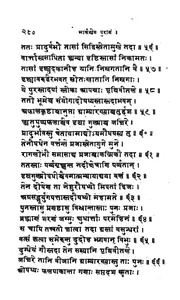 The printed page
Bibliotheca Indica: The Márcandeya Purána in the original Sanscrit, edited by Rev. K. M. Banerjea (ed. Rev. K. M. Banerjea (Krishna Mohan Banerjea), Second Professor of Bishop's College), Calcutta (Bishop's College Press), 1862, p. 280tena doṣeṇa tā neśurauṣadhyo miṣatāṃ dvija"Through that fault the plants perished before their eyes, O brahmin." (our translation)
Markandeya Purana (Sanskrit) MP 49.63ab (GRETIL)
Suffering from hunger, they resorted toMarkandeya Purana MP XLIX.64 · p. 244
ब्रह्माणं शरणं जग्मुः क्षुधार्ताः परमेष्ठिनम्
The printed page
Bibliotheca Indica: The Márcandeya Purána in the original Sanscrit, edited by Rev. K. M. Banerjea (ed. Rev. K. M. Banerjea (Krishna Mohan Banerjea), Second Professor of Bishop's College), Calcutta (Bishop's College Press), 1862, p. 280brahmāṇaṃ śaraṇaṃ jagmuḥ kṣudhārtāḥ parameṣṭhinam"Tormented by hunger, they went for refuge to Brahma, the highest one." (our translation)
Markandeya Purana (Sanskrit) MP 49.64cd (GRETIL)
स चापि तत्त्वतो ज्ञात्वा तदा ग्रस्तां वसुन्धराम्
The printed page
Bibliotheca Indica: The Márcandeya Purána in the original Sanscrit, edited by Rev. K. M. Banerjea (ed. Rev. K. M. Banerjea (Krishna Mohan Banerjea), Second Professor of Bishop's College), Calcutta (Bishop's College Press), 1862, p. 280sa cāpi tattvato jñātvā tadā grastāṃ vasundharām"He, knowing truly that the earth had swallowed (the plants) ..." (our translation)
Markandeya Purana (Sanskrit) MP 49.65ab (GRETIL)
वत्सं कृत्वा सुमेरुन्तु दुदोह भगवान् विभुः
The printed page
Bibliotheca Indica: The Márcandeya Purána in the original Sanscrit, edited by Rev. K. M. Banerjea (ed. Rev. K. M. Banerjea (Krishna Mohan Banerjea), Second Professor of Bishop's College), Calcutta (Bishop's College Press), 1862, p. 280vatsaṃ kṛtvā sumeruntu dudoha bhagavān vibhuḥ"... making Sumeru the calf, the mighty lord milked (her)." (our translation)
Markandeya Purana (Sanskrit) MP 49.65cd (GRETIL)
This earth-cow was then milked by him, the cereals came into existence on theMarkandeya Purana MP XLIX.66 · p. 244
प्रियङ्गवो ह्युदाराश्च कोरदूषाः सचीनकाः
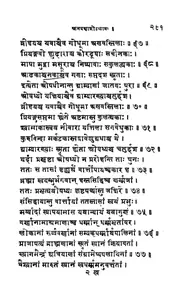 The printed page
Bibliotheca Indica: The Márcandeya Purána in the original Sanscrit, edited by Rev. K. M. Banerjea (ed. Rev. K. M. Banerjea (Krishna Mohan Banerjea), Second Professor of Bishop's College), Calcutta (Bishop's College Press), 1862, p. 281priyaṅgavo hyudārāśca koradūṣāḥ sacīnakāḥ"priyangu, udara, koradusha and cinaka" (our translation)
Markandeya Purana (Sanskrit) MP 49.68ab (GRETIL)
scrobiculatum, the modern kodoMarkandeya Purana MP XLIX.68, note on koradusha · p. 244
And there are fourteen kinds of plants for use in sacrificesMarkandeya Purana MP XLIX.70 · p. 245
श्यामाकास्त्वथ नीवारा यत्तिला सगवेधुकाः
The printed page
Bibliotheca Indica: The Márcandeya Purána in the original Sanscrit, edited by Rev. K. M. Banerjea (ed. Rev. K. M. Banerjea (Krishna Mohan Banerjea), Second Professor of Bishop's College), Calcutta (Bishop's College Press), 1862, p. 281śyāmākāstvatha nīvārā yattilā sagavedhukāḥ"then shyamaka, nivara (wild rice), yattila and gavedhuka" (our translation)
Markandeya Purana (Sanskrit) MP 49.71cd (GRETIL)
यदा प्रसृष्टा ओषध्यो न प्ररोहन्ति ताः पुनः
The printed page
Bibliotheca Indica: The Márcandeya Purána in the original Sanscrit, edited by Rev. K. M. Banerjea (ed. Rev. K. M. Banerjea (Krishna Mohan Banerjea), Second Professor of Bishop's College), Calcutta (Bishop's College Press), 1862, p. 281yadā prasṛṣṭā oṣadhyo na prarohanti tāḥ punaḥ"When the plants are let go, they do not grow again." (our translation)
Markandeya Purana (Sanskrit) MP 49.73ab (GRETIL)
do not spring forth againMarkandeya Purana MP XLIX.73 · p. 245
ततः स तासां वृद्ध्यर्थं वार्तोपायञ्चकार ह
The printed page
Bibliotheca Indica: The Márcandeya Purána in the original Sanscrit, edited by Rev. K. M. Banerjea (ed. Rev. K. M. Banerjea (Krishna Mohan Banerjea), Second Professor of Bishop's College), Calcutta (Bishop's College Press), 1862, p. 281tataḥ sa tāsāṃ vṛddhyarthaṃ vārtopāyañcakāra ha"Then, for their increase, he made the means of livelihood (cultivation)." (our translation)
Markandeya Purana (Sanskrit) MP 49.73cd (GRETIL)
ततः प्रभृत्यथौषध्यः कृष्टपच्यास्तु जज्ञिरे
The printed page
Bibliotheca Indica: The Márcandeya Purána in the original Sanscrit, edited by Rev. K. M. Banerjea (ed. Rev. K. M. Banerjea (Krishna Mohan Banerjea), Second Professor of Bishop's College), Calcutta (Bishop's College Press), 1862, p. 281tataḥ prabhṛtyathauṣadhyaḥ kṛṣṭapacyāstu jajñire"From then on the plants grew as ones that ripen in ploughed land." (our translation)
Markandeya Purana (Sanskrit) MP 49.74cd (GRETIL)
Panicum italicum, (Roxb. p 101.)Markandeya Purana MP XXXII, note on priyangu · p. 165
took possession of rivers and fields, mountains, and trees, shrubs and plantsMarkandeya Purana MP XLIX.62 · p. 243
by their union with the earth plants came into existenceMarkandeya Purana MP XLIX.59 · p. 243
Source: Markandeya Purana, Markandeya Purana, Canto XLIX (GRETIL 49.55-74) · tr. F. Eden Pargiter · The Markandeya Purana, Bibliotheca Indica, Calcutta, Asiatic Society, 1904 · pp. 243-245
narrative (classical drama, not scripture)
Shakuntala's fawn, reared on handfuls of shyamaka
barnyard millet
In Kalidasa's play Shakuntala, the heroine is leaving the home of Father Kanva. As she sets out, something tugs at her dress, and she asks who it is that keeps pulling at her, as if to hold her back. Kanva tells her it is the fawn she adopted as her own son, the fawn she had reared with handfuls of shyamaka; it will not leave her path. Shakuntala tells the little one that she is going away now, and that Father Kanva will take care of it. Translators render the grain in different ways: Monier-Williams notes that it is "rather the grain of a kind of Panic grass"; his verse translation says "grains of rice", and Ryder writes "corn".
The verses (10)
श्यामाकमुष्टिपरिवर्धितको जहाति सो ऽयं न पुत्रकृतकः पदवीं मृगस् ते
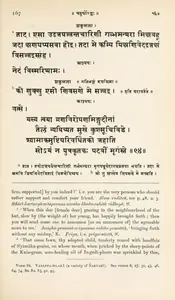 The printed page
Sakuntala, a Sanskrit drama in seven acts, by Kalidasa. The Deva-nagari recension of the text, edited with literal English translations of all the met (ed. Monier Williams (Monier Monier-Williams)), Oxford (Clarendon Press), 1876, p. 167śyāmākamuṣṭiparivardhitako jahāti so 'yaṃ na putrakṛtakaḥ padavīṃ mṛgas te"this fawn, your adopted son, reared on handfuls of shyamaka, will not leave your path" (our translation)
Kalidasa, Abhijnanashakuntalam (Sanskrit) Abhijnanashakuntalam IV.14 (GRETIL KSak_4.14)
को नु खल्वेष निवसने मे सज्जति
The printed page
Sakuntala, a Sanskrit drama in seven acts, by Kalidasa. The Deva-nagari recension of the text, edited with literal English translations of all the met (ed. Monier Williams (Monier Monier-Williams)), Oxford (Clarendon Press), 1876, p. 167ko nu khalv eṣa nivasane me sajjate"Who is this that clings to my garment?" (our translation)
Kalidasa, Abhijnanashakuntalam (Sanskrit) Abhijnanashakuntalam, Act IV (before verse 14)
Who is it that keeps pulling at my dress, as if to hinder meKalidasa, Shakuntala Shakuntala, Act IV
why should you follow me when I am going away from home?Kalidasa, Shakuntala Shakuntala, Act IV
tenderly reared with handfuls ofKalidasa, Sakuntala Sakuntala, Act IV, literal translation of verse 94 (= IV.14) · notes to verse 94 (page number not legible in scan text)
It is rather the grain of a kind of Panic grass, eaten by the Hindus.Kalidasa, Sakuntala Sakuntala, Act IV, note to verse 94 · notes to verse 94 (page number not legible in scan text)
The fawn who gladly nibbled cornKalidasa, Shakuntala Shakuntala, Act IV
and with grains of rice From thine own hand did'st daily nourish itKalidasa, Sakuntala Sakoontala, Act IV · p. 96
Now I am leaving you, and Father Kanva will take care of you.Kalidasa, Shakuntala Shakuntala, Act IV
इदानीमपि मया विरहितं त्वां तातश्चिन्तयिष्यति
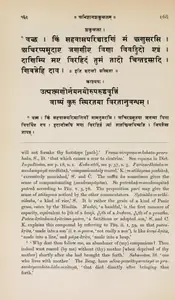 The printed page
Sakuntala, a Sanskrit drama in seven acts, by Kalidasa. The Deva-nagari recension of the text, edited with literal English translations of all the met (ed. Monier Williams (Monier Monier-Williams)), Oxford (Clarendon Press), 1876, p. 168idānīm api mayā virahitaṃ tvāṃ tātaś cintayiṣyati"Now, when I am gone from you, father will look after you." (our translation)
Kalidasa, Abhijnanashakuntalam (Sanskrit) Abhijnanashakuntalam, Act IV (after verse 14)
Source: Kalidasa, Shakuntala, Kalidasa, Abhijnanashakuntalam, Act IV, verse 14 · tr. Arthur W. Ryder · Kalidasa: Translations of Shakuntala and other works, London/New York 1912
How this page was made: every line comes from a passage in a public-domain translation (Keith, Eggeling, Oldenberg, Griffith,
Max Müller and others) or the Sanskrit e-texts of GRETIL and TITUS, with the reference and page. Where a text names no season or no purpose,
we say so and add nothing. Sanskrit is shown in its scholarly transliteration; “our translation” marks a passage with no
public-domain English. Rites that use only wild grasses we cannot identify are left out.