
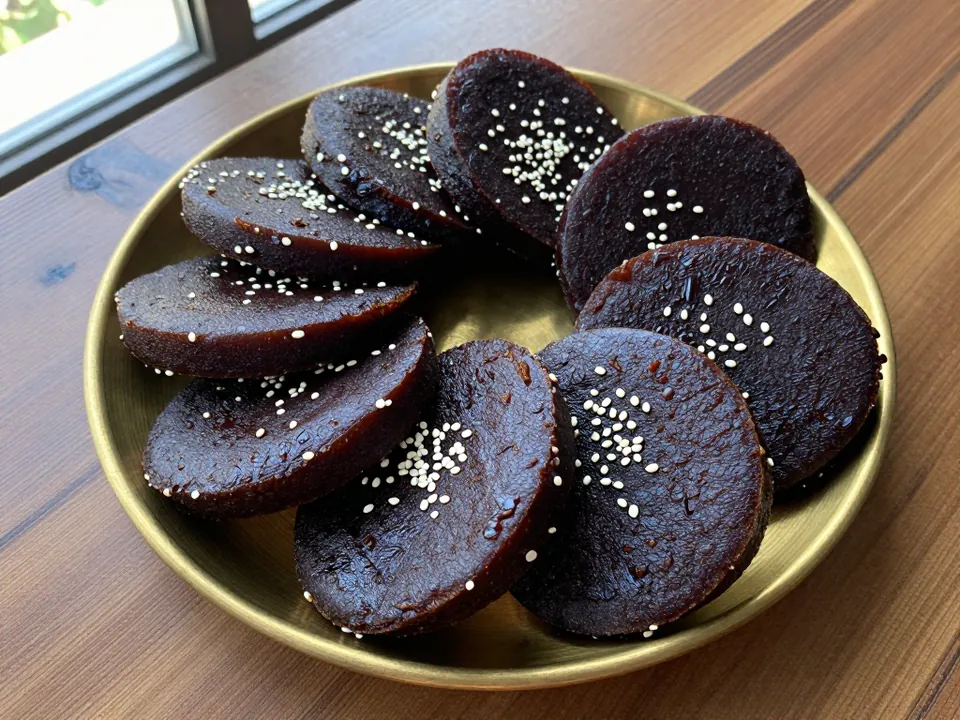
Ragi Arisa Pitha
Prep 10 min · Cook 20 min · Serves 3
Make
Ingredients
- finger millet (ragi) flour — 200 g (printed as 'Finger millet powder')
- rice flour — 200 g (printed as 'Rice powder')
- jaggery — 250 g
- sesame seeds — 100 g
- green cardamom powder — 1 tbsp
- water — 1 glass (printed as 'a glass of water', for the syrup)
- refined oil or ghee (for frying and for greasing the palms)
Method
- Put the jaggery and a glass of water in a medium pan and heat on a medium flame, stirring, until it turns into a thick, even syrup.
- In a bowl, mix the ragi flour and rice flour together well.
- Add the mixed flours to the syrup gradually, stirring all the time, until they come together as a smooth dough.
- Work in the sesame seeds and cardamom powder and move the dough to a bowl.
- Heat oil or ghee in a pan. Grease your palms, take a small portion of dough and press it into an oval of medium thickness.
- Shallow-fry the pithas on a medium flame until brown, lift them out onto a plate and serve.
Tips
- General practice: let the dough cool just enough to handle before shaping; it firms up as it cools.
- General practice: turn each pitha once so that both sides brown evenly.
Fresh atta: grind small, use soon
- Millets keep for months as whole grain; flour is best ground as it is needed, because it turns rancid. (FAO, Sorghum and millets in human nutrition (1995))
- Bajra changes fastest: its grain stores for months, but its milled flour has a very short shelf life. (ICAR-IIMR scientists, Food Chemistry Advances (2023) (DOI 10.1016/j.focha.2023.100190))
- In an Indian study, untreated bajra flour stayed within the quality limit only about 2 days at room temperature. (ICAR-IARI, Indian Journal of Agricultural Sciences (2016))
- Ragi flour keeps better than foxtail, barnyard or bajra flour (it carries less fat). (Planta (2024), review)
- Keep atta closed and cool: bajra flour kept best in polythene and worst in gunny sacks; grains should be dry and in airtight containers. (Chaudhary & Kapoor, J Sci Food Agric (1984); ICMR-NIN Dietary Guidelines (2024) (DOI 10.1002/jsfa.2740351113))
- Going off shows first as smell and taste — sour, musty or dusty, then bitter. (Lai & Varriano-Marston, Cereal Chemistry (1980))
So: buy the grain, grind a week’s worth at a time — less for bajra in summer.
Recipe from FSSAI, Shree Anna (Millets) Recipes, PDF p. 122 (printed p. 108), written in our own words.