
Jowar (sorghum)
Sorghum bicolorNames: ICAR-Indian Institute of Millets Research
Pictures
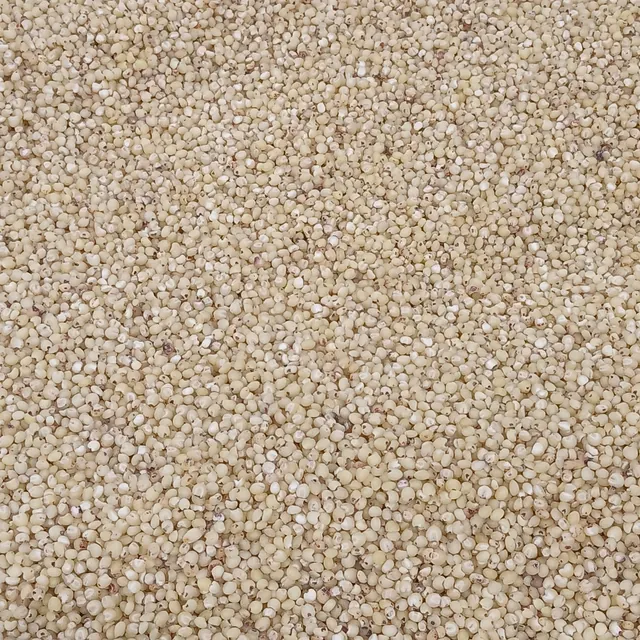
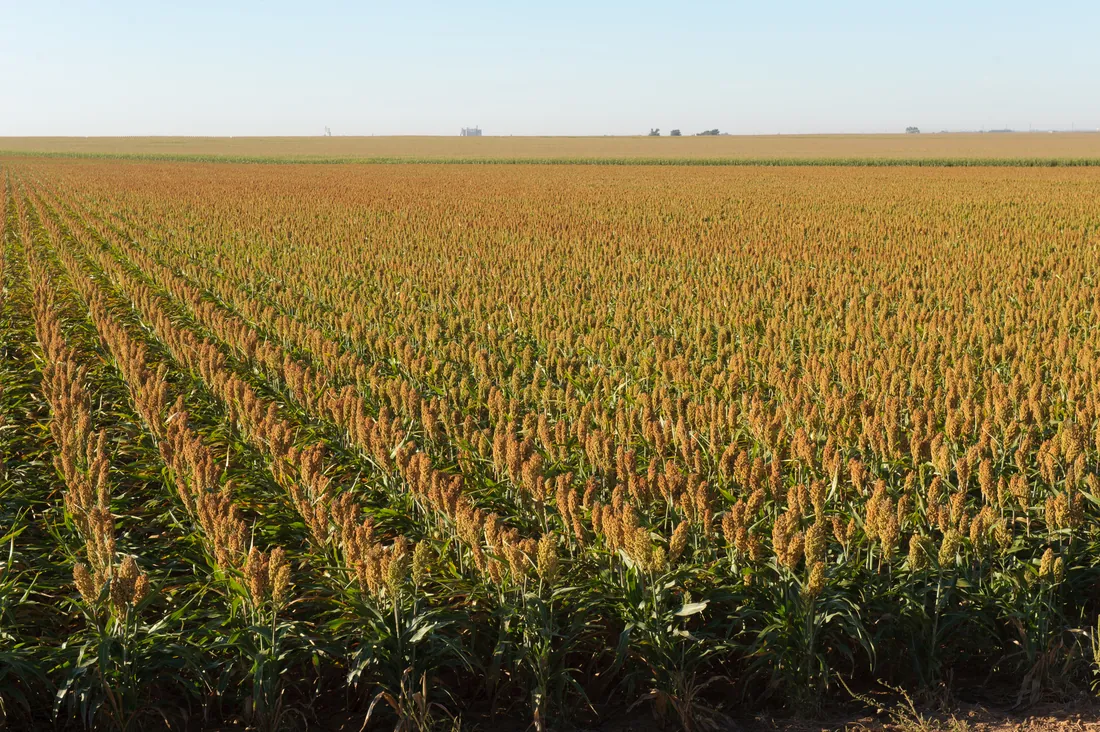
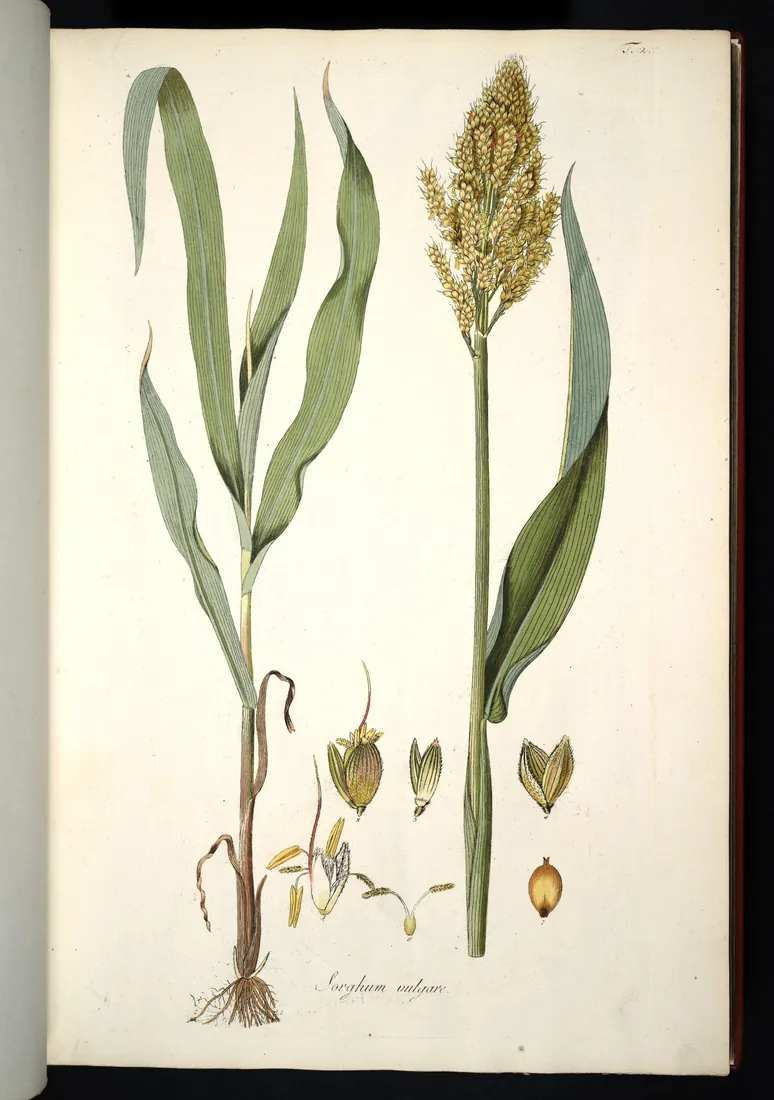
Nutrition of the raw grain, per 100 g
| Energy | 334 kcal |
| Protein | 9.97 g |
| Fat | 1.73 g |
| Carbohydrate (available) | 67.68 g |
| Dietary fibre (total) | 10.22 g |
| Calcium | 27.6 mg |
| Iron | 3.95 mg |
| Magnesium | 133 mg |
| Phosphorus | 274 mg |
| Zinc | 1.96 mg |
Source: Indian Food Composition Tables 2017, ICMR-National Institute of Nutrition, food code A005. Energy converted from kilojoules (1 kcal = 4.184 kJ).
Every nutrient in the raw grain — 93 values, per 100 g
Energy, protein, fat, carbohydrate, fibre9
| Water (moisture) | 9.01 g |
| Protein | 9.97 g |
| Ash (total minerals) | 1.39 g |
| Fat | 1.73 g |
| Dietary fibre (total) | 10.22 g |
| Insoluble fibre | 8.49 g |
| Soluble fibre | 1.73 g |
| Carbohydrate (available) | 67.68 g |
| Energy | 1398 kJ |
Starch and sugars6
| Available carbohydrate (starch + sugars) | 60.96 g |
| Starch | 59.7 g |
| Fructose | 0.57 g |
| Glucose | 0.1 g |
| Sucrose | 0.6 g |
| Free sugars (total) | 1.27 g |
Not detected in this grain (the table leaves it blank or zero): Maltose.
Minerals5
| Calcium | 27.6 mg |
| Magnesium | 133 mg |
| Phosphorus | 274 mg |
| Potassium | 328 mg |
| Sodium | 5.42 mg |
Trace elements8
Vitamins12
| Thiamine (B1) | 0.35 mg |
| Riboflavin (B2) | 0.14 mg |
| Niacin (B3) | 2.1 mg |
| Pantothenic acid (B5) | 0.27 mg |
| Vitamin B6 | 0.28 mg |
| Biotin (B7) | 0.7 µg |
| Folate (B9) | 39.42 µg |
| Vitamin D2 (ergocalciferol) | 3.96 µg |
| Vitamin E: alpha-tocopherol | 0.04 mg |
| Vitamin E: gamma-tocopherol | 0.27 mg |
| Vitamin E (alpha-tocopherol equivalents) | 0.06 mg |
| Vitamin K1 | 43.82 µg |
Not detected in this grain (the table leaves it blank or zero): Vitamin E: alpha-tocotrienol, Vitamin E: beta-tocopherol, Vitamin E: delta-tocopherol, Vitamin E: gamma-tocotrienol.
Carotenoids4
| Lutein | 9.08 µg |
| Zeaxanthin | 7.48 µg |
| Beta-carotene | 8.29 µg |
| Carotenoids (total) | 212 µg |
Amino acids18 · g per 100 g of protein
| Histidine | 2.07 g |
| Isoleucine | 3.45 g |
| Leucine | 12.03 g |
| Lysine | 2.31 g |
| Methionine | 1.52 g |
| Cystine | 1.06 g |
| Phenylalanine | 5.1 g |
| Threonine | 2.96 g |
| Tryptophan | 1.03 g |
| Valine | 4.51 g |
| Alanine | 9.19 g |
| Arginine | 3.96 g |
| Aspartic acid | 7.09 g |
| Glutamic acid | 21.54 g |
| Glycine | 3.08 g |
| Proline | 6.99 g |
| Serine | 4.02 g |
| Tyrosine | 3.61 g |
Fatty acids8
| Palmitic acid (C16:0) | 149 mg |
| Stearic acid (C18:0) | 14.22 mg |
| Oleic acid (C18:1) | 314 mg |
| Linoleic acid (C18:2, omega-6) | 508 mg |
| Alpha-linolenic acid (C18:3, omega-3) | 16.54 mg |
| Saturated fat (total) | 163 mg |
| Monounsaturated fat (total) | 314 mg |
| Polyunsaturated fat (total) | 524 mg |
Not detected in this grain (the table leaves it blank or zero): Arachidic acid (C20:0), Behenic acid (C22:0), Capric acid (C10:0), Eicosenoic acid (C20:1), Erucic acid (C22:1), Lauric acid (C12:0), Lignoceric acid (C24:0), Myristic acid (C14:0), Myristoleic acid (C14:1), Palmitoleic acid (C16:1).
Organic acids6
| Oxalate (total) | 28.38 mg |
| Oxalate (soluble) | 24.62 mg |
| Oxalate (insoluble) | 1.72 mg |
| Fumaric acid | 1.84 mg |
| Malic acid | 0.51 mg |
| Succinic acid | 3.88 mg |
Not detected in this grain (the table leaves it blank or zero): Citric acid, Quinic acid, Tartaric acid, cis-Aconitic acid.
Polyphenols11
| 3,4-Dihydroxybenzoic acid | 0.02 mg |
| 3-Hydroxybenzaldehyde | 0.02 mg |
| Protocatechuic acid | 0.07 mg |
| Vanillic acid | 1.76 mg |
| Gallic acid | 0.06 mg |
| p-Coumaric acid | 1.84 mg |
| Caffeic acid | 1.69 mg |
| Chlorogenic acid | 4.04 mg |
| Ferulic acid | 1.59 mg |
| Apigenin | 0.07 mg |
| Polyphenols (total) | 23.25 mg |
Not detected in this grain (the table leaves it blank or zero): Apigenin-7-O-neohesperidoside, Catechin, Cinnamic acid, Isorhamnetin, Kaempferol, Luteolin, Quercetin, Quercetin-3-galactoside, Quercetin-3-glucoside, Quercetin-3-rutinoside (rutin), Sinapic acid, o-Coumaric acid.
Phytosterols3
| Campesterol | 21.59 mg |
| Stigmasterol | 5.31 mg |
| Beta-sitosterol | 38.27 mg |
Other compounds3
Not detected in this grain (the table leaves it blank or zero): Saponins (total).
Source, one for the whole list: Indian Food Composition Tables 2017, ICMR-NIN. Values exactly as the table prints them; published values for the grain, not a laboratory test of our packs. Tap a name for what it is and does.
In the Vedas and Sanskrit texts
- Rājanighaṇṭu, Śālyādivarga 59-65 — Gives yāvanāla with synonyms (jūrṇāhvaya, devadhānya) and its white, red, tuvara and autumn kinds. (the Sanskrit text)
- Rājanighaṇṭu, Śālyādivarga 140-141 — Parched grains (dhānā) made from wheat and yāvanāla are described as a class. (the Sanskrit text)
- Rājanighaṇṭu, Śālyādivarga 145-146 — Flattened grains (cipiṭa) made from heated yāvanāla and śāli grain are named as a class. (the Sanskrit text)
- Rājanighaṇṭu, Śālyādivarga 149-150 — Heated half-ripe grains of mung, wheat, chickpea and yāvanāla are named as a class. (the Sanskrit text)
- Rājanighaṇṭu, Pānīyādivarga 98-106 — Juice of the yāvanāla stalk, a jaggery boiled from it, and a sugar called yāvanālī; stalk products, not grain. (the Sanskrit text)
Each line is our summary of the passage, with its reference. Health and medicinal statements in these texts are left out.
Where it comes from
- Sorghum cultivation originated in the eastern Sudanese savannah; Nigeria, the USA and Sudan are the largest producers today. (FAO, International Year of Millets 2023 - About)
- The earliest domesticated sorghum finds known are from India, e.g. Rojdi (Gujarat), and from Kawa in the Nubian Nile valley (first millennium BC). (Weber SA & Fuller DQ, 'Millets and their role in early agriculture')
In India’s old books
- Monier-Williams Sanskrit-English Dictionary: 'yava-nala m. Andropogon Bicolor or Sorghum, Susr.; barley-straw (?), W.' (Cologne Digital Sanskrit Dictionaries)
- Rajanighantu: 16.59 'yavanalo yavanalah sikhari vrttatandulah ...'; 16.61 'jurnahvayo devadhanyam jurnalo bijapuspakah ...' (synonym list of yavanala) (GRETIL)
- Civakacintamani: 'karuvi tenenat tungung kathirani yirungkodu thinaisuuz ...'; commentary glosses irungku as cholam (sorghum) (Project Madurai)
- Tamil Lexicon, p.1677: 'cōḷam, n. 1. [T. tjonna, K. Tu. jōḷa, M. cōḷam.] Maize, great millet, Sorghum vulgare' (Tamil Lexicon (University of Madras, 1924-36), Digital Dictionaries of South Asi)
Where it grows
- Major rabi (post-rainy) sorghum states: Maharashtra, Karnataka, Telangana; rabi area 5.25 m ha vs kharif 1.99 m ha. (ICAR-IIMR 'Millets Chalisa' farmer leaflet)
- Why dry land: survives water-limiting conditions; called a 'water sipping crop'; roots draw moisture from up to 2 m depth. (ICAR-IIMR 'Millets Chalisa' farmer leaflet)
In the kitchen
- ICAR-IIMR recipes: sorghum annam (cooked whole grain), ambali (thin, optionally fermented drink), roti, dosa, idli. (Dayakar Rao B, Vishala AD, Arlene Christina GD, Tonapi VA)
Recipes
- Jowar BhakriTraditional · Lunch
- Whole Jowar Vegetable UpmaModern · Breakfast
- Jowar Sweet Pongal (with Sorghum Flakes)Festival · Sweet
- Warm Jowar Salad with Capsicum and CarrotModern · Snack
- Jowar UttapamTraditional · Breakfast
- Jowar Rava IdliTraditional · Breakfast
- Jowar Vegetable Tawa RotiTraditional · Lunch
- Cream of Jowar SoupModern · Dinner
- Popped Jowar with Black SesameTraditional · Snack
- Jowar Cabbage MuthiaTraditional · Snack
- Jowar Wada (with Steamed Whole Jowar)Traditional · Snack
- Jowar Boondi LadduFestival · Sweet
- Sprouted Jowar Lassi (Jeera or Sweet)Modern · Drink
- Jonna Kudu (Plain Boiled Whole Jowar)Ancient · Lunch